





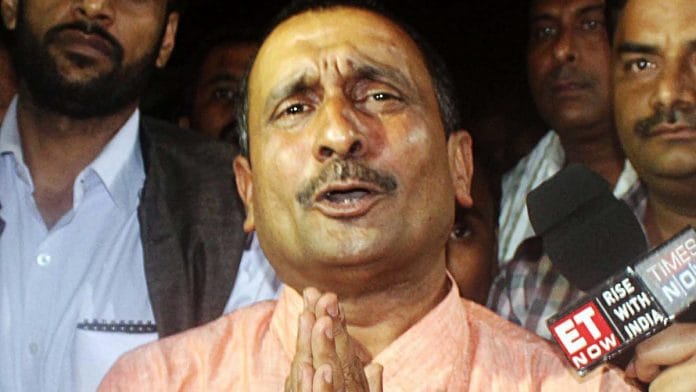



New Delhi: The Delhi High Court Monday dismissed expelled BJP leader Kuldeep Singh Senger’s appeal for the suspension of his 10-year sentence in the custodial death case of the Unnao rape victim’s father, rejecting his argument that his criminal appeal had not been heard for years. The delay was “partly because of him”, the court said.
The court was referring to Senger’s repeated interim applications, including multiple pleas seeking suspension of sentence, which, it noted, contributed to delays in the hearing of his main criminal appeal—the challenge to his 13 March 2020 conviction and sentence in the custodial death case.
While delivering its verdict, the high court also held that the gravity of the offence and its deep societal impact outweighed the arguments advanced for bail.
This marks Senger’s second failed attempt to seek suspension of sentence in the case. A similar plea was dismissed by the Delhi High Court earlier on 7 June 2024.
In the Unnao rape case, a division bench of the High Court granted Senger temporary suspension of sentence and bail in December 2025, but the Supreme Court stayed the order days later.
The case currently before the court arises from events in April 2018, following the rape of the minor. The family of the survivor had travelled to Unnao for a court hearing when her father was assaulted in broad daylight by those with the accused. The next day, police arrested the father on allegations of illegal possession of arms.
The father later died in police custody due to the injuries sustained. A postmortem revealed 14 external injuries, and concluded that he died of septicemia caused by a perforated intestine.
In August 2019, the Supreme Court transferred the trial of five cases linked to the Unnao rape, including the custodial death case, from Uttar Pradesh to Delhi to ensure a fair trial.
Senger was convicted in the rape case in December 2019 and sentenced to life imprisonment. Three months later, on 13 March 2020, he was convicted of conspiring in the custodial death of the survivor’s father.
Before the Delhi High Court, the defence argued that Senger had already undergone seven and a half years of incarceration, more than half of the 10-year sentence. It also submitted that he had been granted interim bail on four occasions and that he complied with all conditions and did not misuse the liberty granted to him.
The defence further said that Senger had been in custody since 13 April 2018 and that no adverse conduct reports had been received from jail authorities. It also argued that no court had found Senger guilty of threatening the survivor or her family.
Despite these submissions, the Delhi High Court denied relief in the custodial death case.
Opposing the plea, the CBI argued that Senger’s earlier application had been dismissed after a detailed appreciation of evidence, and that no fresh circumstance had emerged to justify reconsideration.
The agency further contended that Senger’s political influence created a real apprehension of interference with witnesses and the administration of justice if released.
The prosecution also pointed out that applications seeking removal of CRPF security provided to the survivor, her family and her lawyer were pending before the Supreme Court, underscoring continued concerns for their safety.
It urged the court to rely on the findings of the coordinate bench on the gravity of the offence, the nature of the crime, and its societal impact, arguing that these could not be lightly disregarded.
In its 12-page order, the High Court reiterated that “suspension of sentence under Section 389 of the CrPC is not a matter of right”, and that such power is discretionary and must be exercised after careful judicial consideration.
“The offence committed is of grave magnitude and has a deep societal impact,” the court observed, rejecting Senger’s plea.
The court has listed Senger’s main criminal appeal for expeditious final hearing on 3 February.
(Edited by Madhurita Goswami)