





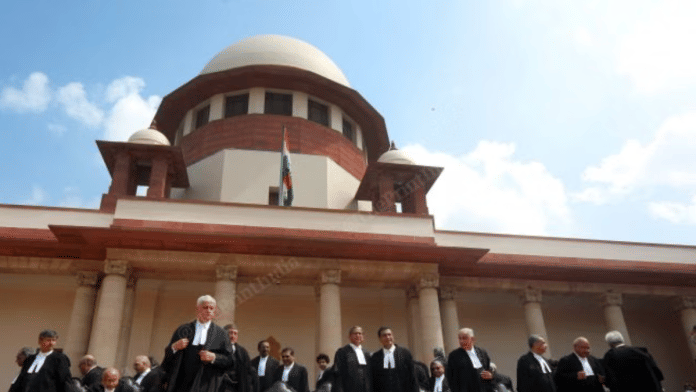



New Delhi: The ‘Think India’ forum, comprising students of law universities and other national institutes, hosted the 9th National Symposium on Landmark Judgments of 2025 Sunday at the PM’s Museum and Library in Delhi.
A panel of 15 legal experts, including the attorney general of India, discussed key legal cases from last year at the event attended by at least 300 students and advocates.
The discussions centred on questions of re-summoning advocates who give legal opinions to clients, the Pragya Singh Thakur case, the All India Judges Association case mandating a three-year legal practice for judicial service examinees, and a constitutional matter involving a presidential reference to the top court on the powers of Governors.
The panel included Attorney General of India R. Venkataramani, Delhi High Court Judge Justice Saurabh Banerjee, Additional Solicitor General of India and senior advocate Archana Pathak Dave, and ABVP National Organising Secretary Ashish Singh Chauhan.
The symposium began with senior advocates Vijay Hansaria, A.S. Nadkarni, and Siddharth Dave speaking on a landmark Supreme Court order regarding lawyer-client privilege and its scope.
Lawyer-client privilege
In their addresses, Hansaria and Nadkarni emphasised the importance of protecting the privilege for both the lawyer and the client.
Dave added another perspective, discussing legal advice in complex economic transactions. “A lawyer can, according to me, be prosecuted for giving advice knowing it to be wrong; privilege does not absolve him, it does not protect him,” she remarked.
The petition arose from a summons issued by a police assistant commissioner in Ahmedabad to an advocate in an investigation involving his client.
A three-judge bench of the Supreme Court, then led by then-Chief Justice B.R. Gavai, passed the landmark order while hearing a Special Leave Petition filed by advocates. The SLP was filed after the high court rejected the advocate’s application against the police summons.
The top court interpreted the existing laws and issued clarifying directions. It, however, refused to issue specific guidelines on the matter.
Lawyer-client privilege would apply to litigation, pre-litigation, and non-litigious matters, it held, ruling that investigating officers cannot summon advocates representing an accused for any case details. This holds unless certain exceptions are met, such as the client’s consent or continuing crime, the SC said.
Any such summons, it held, would be subject to judicial review and require specific facts, along with written approval from the police superintendent.
Pragya Thakur case
Advocate on Record Ayush Anand and Special Prosecutor for the National Investigation Agency (NIA) Rahul Tyagi discussed the Pragya Singh Thakur case.
In July 2025, a special court in Mumbai cleared seven accused, including former BJP MP Pragya Singh Thakur, in the 2008 Malegaon blasts, which killed six people and injured several others.
The court acquitted them of all charges, including those under the Unlawful Activities (Prevention) Act, observing, “Upon comprehensive evaluation of the entire evidence available on record, I am of the considered view that the prosecution has failed to adduce cogent, reliable, and legally acceptable evidence. The testimony of prosecution witnesses is riddled with material inconsistencies and contradictions.”
The court noted there was no substantial proof linking Sadhvi Pragya to the motorcycle found at the blast site.
Rahul Tyagi, in his address, pointed out the public perception in the case, stating, “The victims think these people did this and have been let off, but what they don’t realise is that the real culprits, in this narrative of politics and media coverage, were never found or investigated.”
He, however, admitted the irony of being the NIA special prosecutor in a case prosecuted by the central agency where all the accused were acquitted.
Also Read: Teacher, lawyer, minister—legal fraternity remembers the many hats AK Sen wore successfully
3-year practice requirement
Another of 2015’s landmark judgments was discussed by former Judge and Member of Parliament Mahendra Singh Solanki. In the All India Judges Association case, the Supreme Court upheld a mandatory three-year practice requirement for civil judge (junior division) recruitments, balancing merit with practical experience.
MP Solanki, at the symposium, highlighted the advantages of practical experience as a lawyer for those transitioning to the bench.
Standing Counsel for the state of Gujarat and Advocate on Record Swati Ghildiyal spoke about the significance of this judgment while speaking to ThePrint. “It’s a wonderful initiative, and the participation of so many practising lawyers in this event shows their commitment to Think India’s cause.”
The court, at the time of the verdict, sought affidavits from all high courts and state governments regarding the practice requirements, and a majority of the judicial and government bodies supported the requirement.
Pronouncing its judgment, the court clarified and resolved several questions related to judicial services and promotion schemes. It resolved seven other issues during the hearing, restoring the limited departmental competitive examination (LDCE) quota for district judge promotions from 10 per cent to 25 percent and issuing guidelines for nationwide amendments to service rules. These included a dedicated quota for promoting meritorious junior division civil judges, tests for stability in merit-cum-seniority promotion quotas, and standardisation of rules for reservations based on cadre strength rather than annual vacancies.
Powers of Governors
The final session of the symposium addressed the Presidential reference on the powers of Governors. It was led by senior advocates Sanjay Ghose and Shravan Yammanur, partner at a Delhi law firm.
Shravan Yammanur discussed the “amphibious structure” of India’s federalism, emphasising the unique balance of power between the Centre and states. He explained that the Presidential reference case aimed to clarify this balance.
Senior advocate Sanjay Ghose stressed the importance of understanding verdicts in their context and advised students to study the history and chronology of the cases in which they are decided. He noted that the context of the state of Tamil Nadu vs the Governor of Tamil Nadu was shaped by prior Supreme Court decisions in cases from Punjab and Kerala.
Following a 2025 Supreme Court judgment in the matter where the court set a three-month outer limit for any Governor’s actions, the President referred 14 questions to the Supreme Court on the constitutional position of presidential and gubernatorial powers.
The questions included clarifications on the review of bills, the timeline for executive action on bills cleared by the legislature, and the scope of Article 200 (Governor’s assent to bills) and Article 201 (bills reserved for the President’s consideration).
In its response, the five-judge Constitution Bench unanimously rejected the concept of “deemed assent” or automatic assent due to delay. The court ruled that Governors exercise independent discretion when deciding on bills and are not bound by the aid and advice of the council of ministers. It also held that neither the President nor the Governor can be bound by court-mandated deadlines for action on bills, as Articles 200 and 201 do not prescribe such limits.
The court emphasised, “It is impermissible for the courts to undertake judicial adjudication over the contents of a bill before it becomes law.”
It further stated, “In the absence of constitutionally prescribed time limits for the exercise of power by the Governor, it would not be appropriate for this Court to judicially prescribe timelines for the exercise of powers under Article 200.”
ThePrint was a media partner for the event.
(Edited by Madhurita Goswami)
Also Read: The humble lawyer’s toolkit is going designer. It’s the age of courtroom chic