





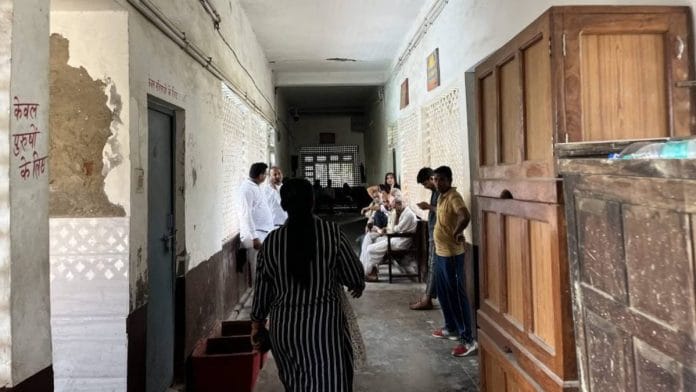



New Delhi: Decades after they were established, 10 districts in Uttar Pradesh will finally get a permanent integrated court complex each that will house all subordinate courts under one roof.
At present, these courts are operating from temporary structures, with some even functioning out of rented premises with no basic infrastructure such as advocates’ bar room or litigant waiting halls.
The two-phase project aims to develop state-of-the-art judicial facilities in 10 districts.
The first phase will be inaugurated Saturday in Chandauli where Chief Justice of India Surya Kant and Supreme Court judge Vikram Nath will lay a common foundation stone for six districts: Chandauli, Hathras, Mahoba, Auraiya, Shamli and Amethi.
The proposed integrated court building will facilitate a convenient and user-friendly work environment for lawyers, court staff as well as litigants, sources in the know told ThePrint.
“These complexes have been planned in such a way that they will accommodate all types of courts such as criminal, civil, motor-accident, special courts, in a single building, offering all facilities and conveniences as a holistic solution in a green, sustainable and futuristic integrated court complex,” one of the sources said.
The project is a collaborative exercise between the state’s Yogi Adityanath-led government and the Allahabad High Court. The estimated cost of the first phase, covering six districts, is over Rs 1,630 crore.
Sources in the UP government told ThePrint that several of the districts were formulated by the Mayawati government and the one prior to hers. Despite having been in existence for over 25 years, none of the districts had any court complex. Courts were scattered all over, with one operating in one corner and the other somewhere else.
Before the government took up the task of providing proper judicial infrastructure in these districts, it initiated the process of developing them first. For this, the state established police lines and then undertook construction of district jails.
Given that judicial infrastructure is critical to a district, the state then planned creation of an integrated court complex at the instance of the HC.
The court buildings have been designed to include a 250-seating capacity conference hall, a residential complex for judicial officers, recreation centre such as meeting room, mediation room, yoga room, gymnasium, dining with kitchen and suites.
Advocate chambers, waiting rooms for litigants and parking area will be the other facilities at these new complexes that will be equipped with the latest technology to facilitate online hearings and use of Artificial Intelligence tools.
To be built at the cost of Rs 286.39 crore, the Chandauli district court will have 37 courtrooms, while Hathras will have 44 that would entail an expenditure of about Rs 322.31 crore. In Mahoba, 37 courtrooms will be built at Rs 287.42 crore and in Shamli 23 that would cost Rs 240.22 crore. Auraiya will have 37 courtrooms at the cost of Rs 278.66 crore and Amethi will see a spending of around Rs 220.03 crore on 17 rooms.
The sources said that the design of these complexes is such that they would be in a position to accommodate more judges and court staff in case the strength increases in future.
“Considering that more citizens are resorting to litigation, it is possible that more judicial officers get appointed to these courts in future. The proposed plan has kept this possibility in mind and allows for space to adjust in case of new appointments,” the source mentioned earlier said.
(Edited by Nida Fatima Siddiqui)
Also Read: ‘Courts not seen as workplace’ — In Hapur, 13 women judges, 200 lawyers have 1 working toilet