





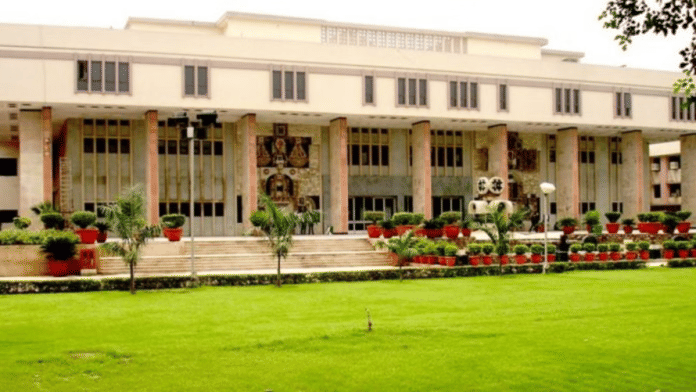



New Delhi: Arbitrary, unconstitutional and violative of the right to equality and non-discrimination—these are the grounds on which the Delhi High Court this week quashed the recruitment process undertaken by the National Institute of Educational Planning and Administration (NIEPA) for a PwBD-reserved post of assistant professor.
The court held that the declaration of the post as “none found suitable” reflected a failure of the process rather than any shortcoming on the part of the candidates.
“The 100 percent interview-based selection process, as actually applied by the respondents without structured criteria, objective benchmarks, internal distribution of marks or recorded reasons is arbitrary, unreasonable and violative of Articles 14 and 16 (Equality Before Law and Equality of Opportunity in Public Employment respectively) of the Constitution of India,” the court said.
It also ruled that that the selection process violated Section 34 of the Rights of Persons with Disabilities Act, which mandates 4 percent reservation in government jobs for persons with benchmark disabilities.
In its 22 December ruling, a bench of Justices C. Hari Shankar and Om Prakash Shukla set aside the advertisement for recruitment to the post “to the extent it prescribes a 100 percent interview-based selection for a PwBD-reserved post without laying down a structured and objective evaluation framework, and the declaration of the PwBD post as none found suitable”.
“Such an outcome, viewed through the prism of constitutional morality, suggests not
the failure of the candidates, but the failure of the process itself,” the court said while directing a re-advertisement of the post of assistant professor reserved for PwBD candidates within eight weeks, retaining the PwBD character of the vacancy.
The court was acting on a plea by Dr Sachin Kumar, challenging a 2023 advertisement by the NIEPA inviting online applications for recruitment to various faculty positions, including four posts of assistant professor. Of these four posts, one post was notified as reserved for PwD candidates. The 2023 advertisement also stated that concession would be provided to PwD candidates with over 40 percent disability, while adding that the selection for the said post was based entirely on performance in the interview.
Also Read: For son who can’t walk, Delhi HC brings BSF ASI home—PWDs’ caregivers entitled to transfer exemption
What the court ruled
The institution argued that “none of the candidates interviewed by the selection committee was found suitable” for the PwBD-reserved post.
The two-judge bench noted that this conclusion was arrived at without disclosure of any objective evaluation criteria, cut-off marks, internal distribution of interview marks, or recorded reasons explaining why none of the PwBD candidates met the suitability threshold.
The court found that the recruitment advertisement was vague and opaque, as it failed to
specify the subject-wise requirements, evaluation parameters, or the manner in which reasonable accommodation for PwBD candidates would be operationalised.
This led the court to remark that the declaration of “none found suitable” could not be treated as a genuine or reasoned assessment of merit.
Relying on Vikash Kumar v. UPSC (where court ruled that denial of reasonable accommodation would amount to discrimination), the court reiterated that reasonable accommodation is not a matter of discretion or charity, but a positive obligation flowing from Articles 14 and 16 of the Constitution, and requires substantive modifications to neutralise structural disadvantage faced by persons with disabilities.
The court also raised an alarm that if such hollow compliance was to be accepted, it would enable institutions to routinely declare PwBD candidates “not suitable” and thereby render disability reservation illusory. “Approving such an approach would defeat the very object of the RPwD Act and reduce statutory reservations to a mere formality,” the court added.
The court also noted that the government body had violated the right to equality and non-discrimination of the petitioners. Although the body had relied on UGC regulation to say that an interview-based selection is permissible, the court pointed out that this did not authorise the abandonment of fairness and transparency in the selection process. It cannot be interpreted to legitimise a “wholly subjective, unstructured and exclusively interview-based selection mechanism,” the court said.
“A purely interview-based selection process, devoid of objective scaffolding, creates an opaque zone of discretion inconsistent with constitutional governance,” the court also said, rejecting the process undertaken for recruitment.
The two-judge bench also held that the conversion of the unfilled PwBD vacancy into an EWS–PwBD vacancy was illegal and contrary to the horizontal nature of disability reservation under Section 34 of the RPwD Act, which mandates every appropriate government to appoint in every government establishment at least 4 percent of the total vacancies with PwDs.
Why Kumar challenged the selection process
Dr Sachin Kumar, who was admittedly a person with a 75 percent locomotor disability, applied for the post of assistant professor under the PwD category in January 2024.
Once his application was scrutinised by the screening committee, he was awarded 73 out of 100 marks and found eligible for the subsequent interview. He was then directed to appear before the selection committee in February 2025.
However, in February, when the results were declared, Kumar was shocked to find that although candidates were selected under the categories of Unreserved, Other Backward Classes and Scheduled Caste, in the category of persons with disabilities, the results said “none of the candidates interviewed by the committee was found suitable for the post”.
This led Kumar to file RTIs seeking information about the reasons for non-selection, subject-wise distribution of vacancies, marks obtained, constitution of the selection committee, and how the internal distribution of marks took place.
Even after this, the NIEPA, which deals with management of education, refused to furnish several material details, while stating that no reasons were recorded by the selection committee for declaring “none found suitable” for the concerned PwD post. The response also said that 13 PwD candidates were interviewed and the unfilled PwD posts would be treated as backlog vacancies and carried forward as EWS-PwD posts, meaning a seat for PwDs only from the economically-weaker sections. In June, the NIEPA issued another advertisement which confirmed that these seats were unfilled.
This prompted Kumar to challenge the selection process on grounds like an interview-only selection process, absence of structured evaluation criteria, and failure to apply relaxed standards or reasonable accommodation in this case, which led to the systematic exclusion of PwBD candidates, in violation of the Rights of Persons with Disabilities Act, and settled principles governing public employment.
What was argued in court
Kumar’s lawyers argued that as he had nearly 16 years of teaching experience in the field of education and social sciences and suffered from benchmark disability with 75 percent locomotor impairment of both lower limbs, he was squarely covered under the Rights of Persons with Disabilities Act, 2016. Mainly, he challenged the 2023 and 2025 advertisement for recruitment to the post, and the results, saying that they provided for selection to the post of assistant professor, although only on the basis of interview performance.
Despite securing 73 out of 100 marks and being called for an interview, Dr Kumar found it strange that no PwD candidate was selected, even though 13 PwD candidates, including him, were shortlisted and interviewed.
The actual results were completely silent on a separate cut-off for PwD candidates, nor were reasons given for no one being found suitable.
(Edited by Viny Mishra)
Also read: UPSC to ensure no PwBD candidate denied centre of choice for examination