








New Delhi: The Calcutta High Court has a new address with a connection to Japan. In a notification issued Thursday, the court announced that after the renaming of the ‘Esplanade Row (West)’ as ‘Justice Radhabinod Pal Sarani’ by the Kolkata Municipal Corporation, its address is now ‘High Court at Calcutta, 3, Justice Radhabinod Pal Sarani, Kolkata, West Bengal, PIN – 700001’.
But this street isn’t the only memorial dedicated to the judge.
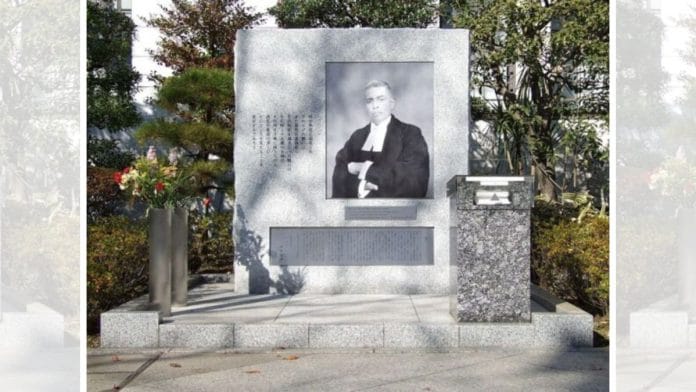
Japan has monuments dedicated to Indian jurist Radhabinod Pal at both the Yasukuni Shrine in Tokyo and the Kyoto Ryozen Gokoku Shrine.
The events leading to this connection go back to November 1948. That year, Justice Pal, serving as a judge at the 1946-established International Military Tribunal for the Far East (IMTFE)—commonly referred to as the ‘Tokyo Trial’—wrote a powerful dissent.
The IMTFE was convened by the Allies after World War II to prosecute senior Japanese political and military leaders.
Among the tribunal’s 11 judges, Justice Pal was the only one who concluded that all Japanese defendants should be acquitted. Others filed separate dissenting and concurring opinions.
His dissent cemented Japan’s affection, and it has been acknowledged several times since.
In April 2005, Manmohan Singh mentioned Justice Pal during his banquet speech in honour of Japanese Prime Minister Junichiro Koizumi, highlighting the judge’s influence.
“The dissenting judgment of Justice Radhabinod Pal is well-known to the Japanese people and will always symbolise the affection and regard our people have for your country,” Manmohan Singh said in that speech.
When Japanese Prime Minister Shinzo Abe visited India in 2007, he made a special pitstop to meet Justice Pal’s son, Prasanta Pal, then 81.
“Your father is still respected by many in Japan,” Abe was quoted as saying.
Also Read: India, Japan wrap up 18th Strategic Dialogue. Talks focus on critical minerals, UNICORN radar
The trial
The ‘Tokyo War Crimes Trial’ sentenced seven convicts to death, sixteen to life imprisonment, and two to fixed prison terms of 20 years and seven years.
The seven executed—including former Prime Minister Hideki Tojo—were found guilty of inciting, authorising, or failing to prevent mass atrocities against civilians and prisoners of war, including the Rape of Nanking and the Bataan Death March.
Justice Pal, who commentators have noted, in his dissent, “advanced a historical perspective that integrated Japanese actions in Asia and the Pacific within the broader story of British, French, and Dutch colonialism”, rejected the jurisdiction of the Tribunal itself. “A victor’s power under international law does not entitle him to sit on trial over the vanquished for all his life’s doings,” he observed.
Investigating the Rape of Nanking in China and the Bataan Death March in the Philippines, Justice Pal argued that there was not enough “factual nexus (direct connection)” to prove that the high-ranking leaders on trial were criminally responsible, questioning whether the Japanese leadership could be implicated through doctrines of command responsibility.
Mentioning the Hiroshima and Nagasaki bombings by the United States, Justice Pal also said that any claims that breaches of shared humanity should be criminally punished “were non-existent” when another State deployed atomic weaponry.
In his dissent, Justice Pal also rejected allegations against the Japanese officials of a conspiracy against the Soviet Union, one of the Allied powers in World War II that defeated the Axis of Germany, Japan, and Italy.
Against the backdrop of the Cold War between the Soviet Union and the US, the WWII victors, immediately after, and the returning ‘Red Scare’, Justice Pal observed, “…the whole world suffered from the terror of Communism and Communist developments, and Japan only shared this feeling. Even today, the world has not been able to free its mind of this terror, real or fancied. The whole world was preparing, and is, even now, preparing against the apprehended aggression of communism and of the communist state. I do not see why we should single out Japan’s preparation alone as an aggressive one.”
Justice Pal felt that the proposed extension of the law of conspiracy to international law “may only give a dangerous weapon in the hands of an unscrupulous victor”. He concluded that “conspiracy” by itself was not yet a crime in international law.
On Japan’s Pearl Harbour attack, Justice Pal argued that the US had already been acting as a co-belligerent alongside China during the Second Sino-Japanese War—just not with direct military personnel.
“Long before that attack, America, by her action, became, in that case, a belligerent country, and whatever might have been the nature of the war which Japan was carrying on against China, as soon as America chose to take part in it on the side of China, Japan became entitled to take any belligerent steps at any time against America,” he said.
Also Read: Indo-Pacific security demands a strong India-Japan relationship
‘We do not agree’
Following his dissent, Justice Pal was appointed to the United Nations International Law Commission (ILC) as a member—a position he held from 1952 to 1966. He was elected as the Chair of the Tenth Session of the ILC in 1958.
On the other hand, Prime Minister Jawaharlal Nehru distanced himself from Pal’s opinion.
A cable sent by him in November 1948 to the Governor of West Bengal, Kailash Nath Katju, read: “Apart from this, any such move on our part would associate us with Justice Pal’s dissenting judgment in Tokyo trials. In this judgment, the wild and sweeping statements have been made, many of which we do not agree with at all. In view of suspicion that the Government of India had inspired Pal’s judgment, we have had to inform governments concerned informally that we are in no way responsible for it.”
In another letter to the premiers (chief ministers) of the provincial governments of India on 6 December 1948, Nehru further wrote, “The Indian judge on that Commission, Justice Pal, wrote a strong dissenting judgment. That judgment gave expression to many opinions and theories with which the Government of India could not associate itself. Justice Pal, of course, is not functioning in the commission as a representative of the Government of India but as an eminent judge in his individual capacity.”
The judgment is revered in Japan but draws mixed reactions across the board.
For instance, jurist AG Noorani wrote in 2007 that Justice Pal “defended Japan’s expansionism [in China and Korea] and even its recourse to brutal war” and that Nehru’s “strong censure of Pal was perfectly justified”.
The Bose connection
Justice Pal was born in the Kushtia district of Bengal Presidency, an area in present-day Bangladesh.
Born into a family of potters, Justice Pal endured hardships throughout his childhood, as documented by scholars.
Researchers write that “Pal’s support of armed struggle and resistance against imperialism, his admiration of (Netaji Subhas Chandra) Bose and Japan’s historical ties with Bengal are keys to decoding both his personality, and the response to his judgment”.
Justice Pal’s connection with Netaji continued after the latter’s death, too.
Professor Samar Guha, in his book Netaji-Dead or Alive, claimed that Pal had, on several occasions, told him that Justice Pal had “many reasons to disbelieve the story of the plane crash [which is believed to have killed Netaji]”.
Guha writes about a letter that Justice Pal had written to freedom fighter A.M. Nair, saying, “I could not accept as true the story of Netaji’s death in Formosa. In any case, I feel that the whole thing demands a thorough investigation.”
Justice Pal’s name had come up in the years that saw an inquiry into Netaji’s death, as well.
In a letter written to Nehru on 2 April 1956, Bose’s brother, Suresh Bose, said the position of Shah Nawaz Khan as the chairman of the Netaji Enquiry Committee was not appropriate, suggesting Pal’s name instead to head the committee.
However, Nehru had opined that Pal’s appointment to this committee “was not suitable because of the part he played in the war criminals’ trial”.
“He is, of course, a very eminent criminal jurist and is well known in Japan and elsewhere. But, in the circumstances, his functioning in this committee might raise difficult problems and might not be liked by some foreign countries, like the USA, which has considerable influence in Japan…” a note written by Nehru said.
In its report submitted in 1956, the committee declared that Netaji met his death in an air crash, and that the ashes kept at Renkoji Temple, Tokyo, were his.
(Edited by Madhurita Goswami)
Also Read: Japan’s snap election and what it means for India