





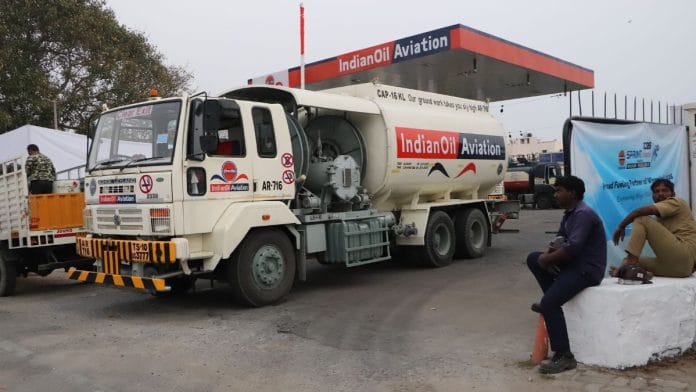



Hyderabad: India’s push to build a domestic sustainable aviation fuel ecosystem received a fresh signal at Wings India 2026, where state-owned Indian Oil Corporation Ltd signed a letter of intent with Akasa Air to explore future SAF supplies for the airline.
The announcement at Asia’s largest civil aviation event in Hyderabad brings together a major fuel producer and one of India’s youngest carriers at a time when the aviation sector is under mounting technological pressures to cut emissions.
As per the agreement, the IOCL and Akasa Air will establish a framework to support the airline’s sustainability goals with a supply of SAF. After the LOI, the parties intend to evaluate possible supply volumes, delivery locations, timelines, and approve sustainable feedstocks and certified production pathways.
IOCL is looking at producing up to 30,000 metric tonnes per year of low-carbon jet fuel that meets international sustainability standards. The fuel would be made from feedstocks such as used cooking oil (UCO) and agricultural waste. Materials considered “waste-based” have lower lifecycle emissions compared to fossil jet fuel.
“This LOI reflects our commitment to scaling low-carbon fuels and supporting our customers in their energy transition,” said Shailesh Dhar, Country Head (Aviation Business) at IOCL.
“By leveraging our expertise across fuel production, supply and logistics, we aim to play a meaningful role in enabling an early transition to the usage of SAF,” Dhar added.
SAF is seen globally as one of the most practical tools to reduce aviation’s carbon footprint. Unlike hydrogen or electric aircraft, which require entirely new aircraft designs and infrastructure, SAF can be blended with conventional jet fuel and used in existing aircraft and engines.
Depending on the feedstock and conversion technology, SAF can cut lifecycle greenhouse gas emissions by 60 to 80 per cent or more.
Also Read: Mongolian carrier to custom-built Dreamliner—what Wings India 2026 showcases
Production remains the biggest bottleneck
The SAF market is still relatively small, with a limited pool of global suppliers, which often leads to price volatility.
SAF prices are significantly higher than conventional jet fuel, airlines remain keen, but with supply security and price volatility concerns continue to mount.
There are also technological and logistical challenges, depending on whether the SAF is derived from ethanol or UCO. SAF pathways require different certification systems and refining processes. Production must meet strict sustainability criteria under international frameworks such as the Carbon Offsetting and Reduction Scheme for International Aviation (CORSIA) developed by the International Civil Aviation Organisation (ICAO). An ISCC CORSIA certification is a key prerequisite for commercial SAF production.
IOCL has already positioned itself early and became the first Indian company to receive an ISCC CORSIA certification at its Panipat refinery and signed an MoU with Air India in 2025 for UCO-based SAF supply.
Also Read: HAL is back to civilian aircraft manufacturing—SJ-100 in the spotlight at Wings India
India’s blending roadmap
India has set phased targets in Aviation Turbine Fuel, blending SAF with conventional jet fuel. The government has set indicative blending levels of 1 per cent in 2027, 2 per cent in 2028 and 5 per cent by 2030.
Industry optimism partly stems from ICAO’s recent SAF report, developed in collaboration with the Ministry of Civil Aviation, which sees alcohol-to-jet (ATJ) pathways as a major opportunity for India. ATJ converts alcohols such as ethanol into jet fuel and could leverage the country’s existing ethanol ecosystem.
“India has over 750 million metric tonnes of available biomass and nearly 230 million metric tonnes of surplus agricultural residue. The country has the capacity not only to meet its own SAF demand but also to emerge as a global leader and exporter,” said Union Civil Aviation Minister Shri Ram Mohan Naidu during the unveiling of the SAF feasibility report on 3 September 2025.
However, timelines are tight. Experts say it takes at least three-and-a-half years to set up a greenfield SAF facility. Even if investments are made today, large volumes may only come online closer to the time when blending mandates approach 5 per cent, when demand becomes commercially meaningful.
(Edited by Insha Jalil Waziri)