





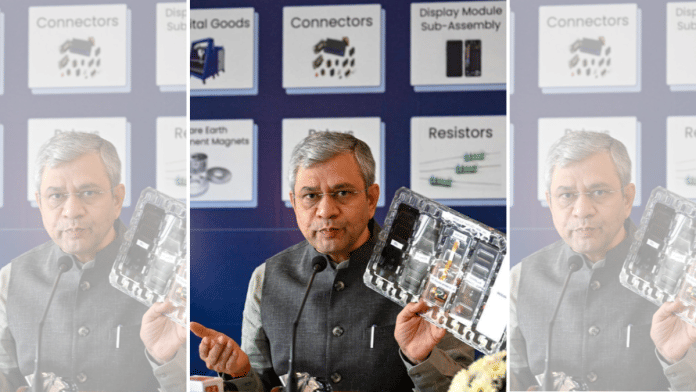



New Delhi: Union Minister Ashwini Vaishnaw on Monday approved 29 new applications under the fourth tranche of the Electronics Component Manufacturing Scheme (ECMS), taking the total number of approved projects to 75, with cumulative investments of Rs 7,104 crore and projected employment of 14,246 new jobs.
But, the approvals came with a warning. “Not getting support from industry… Not very happy with the progress,” the Electronics and Information Technology Minister said at a press conference on Cabinet decisions, adding that “industry needs to do more”.
He warned ECMS firms of halting both fresh approvals and fund disbursements for already cleared projects if companies fail to accelerate execution. “The government is willing to take harsh measures, including stopping approvals and funding.”
Across all four tranches, the ECMS programme has approved 75 projects worth Rs 61,000 crore, expected to generate approximately 65,000 direct jobs. Around 28 projects have already begun manufacturing on the ground.
The scheme targets components that India currently imports in large volumes. Under the fresh approvals, capacitors will meet around 16 percent of domestic demand, connectors about 33 percent, and laminates nearly 100 percent.
Lithium-ion cells for the electronics segment will meet around 61 percent of domestic demand, rare earth magnets for electronics around 45 percent, and relays will meet 100 percent of domestic demand—with India positioned to become a global exporter of relay components. Metallised films will meet about 44 percent of demand.
Printed circuit boards represent one of the scheme’s largest opportunities. India currently imports around Rs 40,000 crore worth of PCBs (Printed Circuit Boards) annually. “With the new capacities, we will be able to meet about 50 percent of our domestic demand, leading to a substantial reduction in imports.”
Warning on design
The sharpest part of Vaishnaw’s address was directed at companies treating the scheme as a manufacturing subsidy without building design capabilities. “If anyone wants to proceed without design, they can leave the programme.” Companies that do not invest in research and development and in-house design “will be weeded out,” he added.
The minister called on firms to collaborate with universities and build core technical capabilities. “For us, nation comes first… design capabilities are very important.”.
He specifically pulled up industry body India Cellular and Electronics Association (ICEA) and its member companies for not following the integrated approach set by the Ministry of Electronics and Information Technology (MeitY) to develop self-reliant electronics manufacturing. He asked the association to submit a structured plan within 15 days.
The scheme, ICEA chairperson Pankaj Mohindroo said, had generated industry confidence. “The fourth tranche of approvals under the ECMS is a welcome step towards strengthening India’s electronics manufacturing ecosystem. Continued policy support, ease of doing business, and a stable, long-term framework will further enable the industry to scale and integrate with global value chains.”
West Asia conundrum
On the ongoing conflict in West Asia, Vaishnaw said the electronics sector has not been affected yet. “We have consulted almost every industry association in the electronics sector. All of them—whether in mobile manufacturing, IT hardware, or passive components—have said that so far there is no impact. However, this is an evolving situation, and we will continue to monitor it closely,” he added.
The industry, according to Vaishnaw, views the conflict as short-term and sees no need for special policy intervention at this stage. The government will continue to watch the situation, he said.
On the current surge in memory chip demand, Vaishnaw clarified the cause. The demand spike is not linked to the West Asia conflict but is primarily driven by the rapid expansion of AI data centres globally, he said.
Separately, Vaishnaw addressed the rise of AI-generated deepfakes, calling it a “new menace” and a threat to individuals, institutions, and society.
Social media platforms have almost doubled or tripled their takedowns of deepfake content, he said. “Countering it effectively is very important for society, for every individual, and institution.”
(Edited by Tony Rai)
Also Read: ‘India to attract investments worth $200 billion in data centres’ — Vaishnaw at AI Summit