





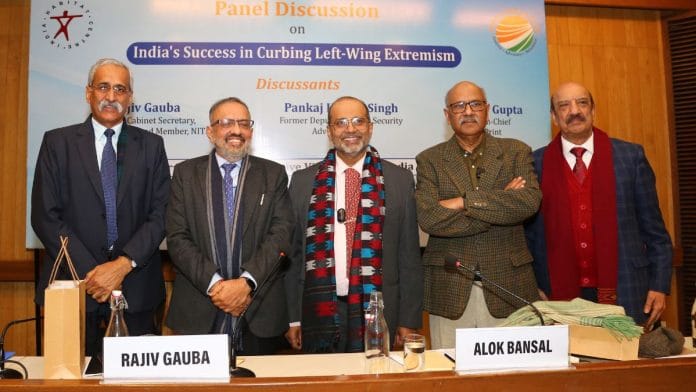



New Delhi: A “lack of clarity” in the approach to dealing with “Left-wing extremism”, and symptoms of a “soft-State syndrome” in not acting against “frontal organisations and urban sympathisers” enabled the growth of Maoist violence in the country for decades, said India’s longest-serving cabinet secretary and retired IAS officer Rajiv Gauba.
Gauba was addressing a gathering of journalists and policy analysts in Delhi Tuesday, prior to a panel discussion on ‘India’s Success in Curbing Left-Wing Extremism’. Retired IPS officer Pankaj Singh, former deputy national security adviser and Border Security Force chief, and Shekhar Gupta, Editor-in-Chief of ThePrint, were also present.
Maoist violence continued to intensify for decades, Gauba said, until the central government brought in a comprehensive policy to deal with Left-wing extremism.
Under this “whole-of-government approach”, all arms of the State—from investigative agencies, to welfare programs and administrative planning—reached areas previously controlled by Maoists, while agencies curtailed the financing and urban support base for them.
Gauba served as India’s cabinet secretary August 2019 to August 2024. For the two preceding years, he served as Union home secretary.
“A lack of clarity of approach and a certain ambivalence of the political and administrative leadership… Some elements within certain political parties in the field were even aligned with the Maoists, and provided them with covert support and shelter in exchange for assistance during elections,” Gauba said Tuesday. “Consequently, the Maoist violence kept rising, and over a period of nearly five decades, they have killed nearly 7,000 civilians, including a large number of women and children.”
He added, “The turning point, so to speak, came in 2015, when the Ministry of Foreign Affairs formulated the National Policy and Action Plan, a whole-of-government, all-of-government approach devoid of self-doubt or ambiguity. Security interventions were significantly intensified, and a saturation approach to development and welfare was implemented, ensuring that rights and entitlements were upheld in the Mission mode. And it is this resolute implementation of the action plan, using the combined might of the state, that has brought about the sea change in the scenario we are witnessing today.”
Gauba further said that while Maoists “indulge with impunity in brutal killings of civilians and security forces”, they get “ideological support” from intellectuals and academicians, who “often also give them shelter and logistical support”.
“And let’s face it. Suffering from a soft-state syndrome, the government never touched for a long, long time,” he remarked. “And this deep-rooted ecosystem in different institutions in urban areas, which often had linkages to some international organisations needed to be systematically dismantled.”
Former IPS officer Singh credited the success of the security forces in operations over the last couple of years to “phenomenal synergy” between the Centre and state governments, which trickled down to the forces and officials in key aspects, such as intelligence gathering and sharing for operational planning.
“They [Maoists] are hiding…they do not have a specific security apparatus around them, and they are on the run within an area of almost over 100 square kilometres spread across two states, Chhattisgarh and maybe Odisha,” he said.
Also Read: RSS didn’t always honour the Constitution. It’s a new phenomenon: Shashi Tharoor
‘Confusion among policymakers in the past’
Shekhar Gupta concurred with Gauba’s view that policymakers were “confused” in 2010, when the then prime minister, the late Manmohan Singh, had described Naxalism as the biggest threat to India’s internal security.
The ex-PM’s remarks had come a month after as many as 76 troops of the Central Reserve Police Force had been massacred by Maoists in Dantewada in April 2010.
However, Gupta said, while Manmohan Singh had been emboldened by the Congress’s improved tally after five years of rule at the centre in 2009, the fight against Maoists had been “sabotaged” from within the government itself.
“P. Chidambaram had become home minister after 26/11, and he had decided to launch a more steadfast, more organised assault on Naxal activity. Within three weeks, the same month in April, Vijay Singh wrote an article in The Economic Times, saying you can do all this, but all of this will not resolve the Naxal issue,” Gupta added.
He further said that Maoist movement in the country flourished and prospered due to “confusion” among policymakers, and support and sympathy from urban quarters, following Kondapalli Seetharamaiah’s work on this aspect of the movement.
Seetharamaiah had founded the People’s War Group in April 1980 in Andhra Pradesh, which merged with the Maoist Communist Centre of India in October 2004 to form the Communist Party of India (Maoist).
Gupta said that Seetharamaiah had studied extensively the factors behind the failure of the Naxalbari movement led by Charu Mazumdar, namely the absence of a rear base and an urban support system.
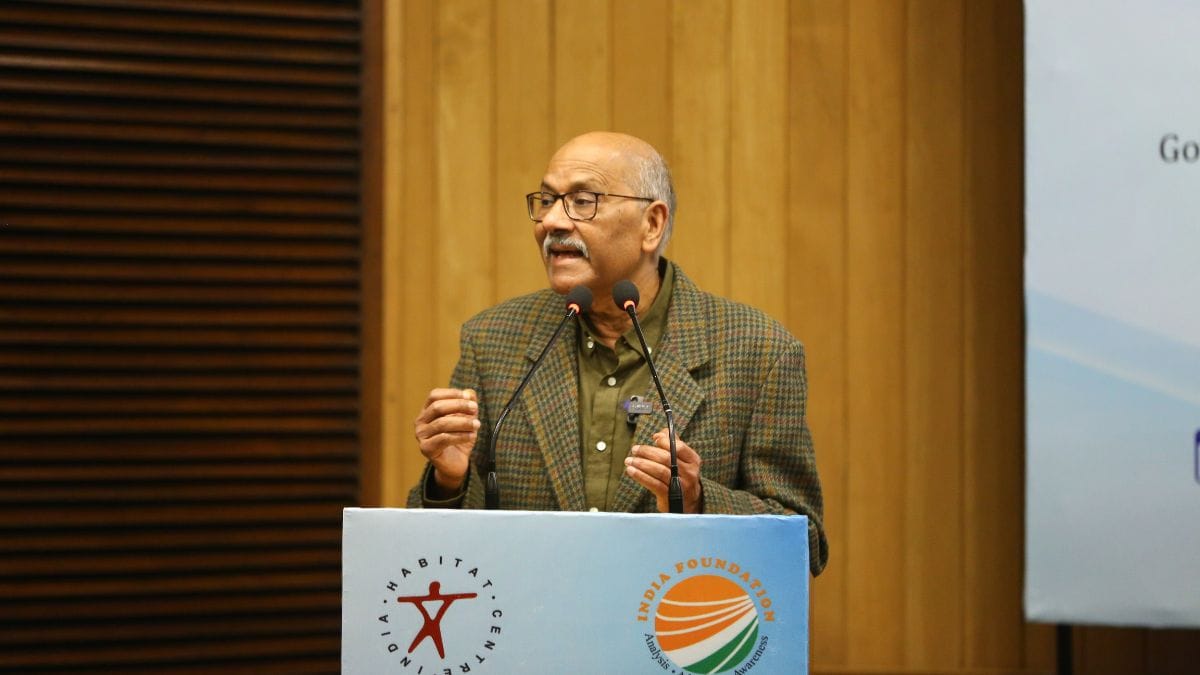
“And that’s how, when he started rebuilding this, he started by building urban support structures, and he founded the Radical Students’ Union. That was very overground, very urban, very young, and then it expanded from there. So that is how he built up an urban structure, and then because he had to secure a rear base, a secure rear base,” Gupta added.
Seetharamaiah chose India’s “most inaccessible regions”—in Chhattisgarh, Jharkhand, Bihar, Madhya Pradesh, Jharkhand, Odisha, Maharashtra, and parts of West Bengal—he further said.
“These regions were largely stateless at that time, and a governance vacuum existed. So what did the Maoists do? As they reached there, they filled that vacuum by also providing governance. If there were disputes between two landowners, to whom would they go? Going to a government court was very problematic. It would take forever, you just went to the Maoist court, and they settled it for you, so they replaced the government in these areas.”
(Edited by Mannat Chugh)
Also Read: Kapil Mishra calls Delhi Shabdotsav a ‘surgical strike against ideological terrorism’