





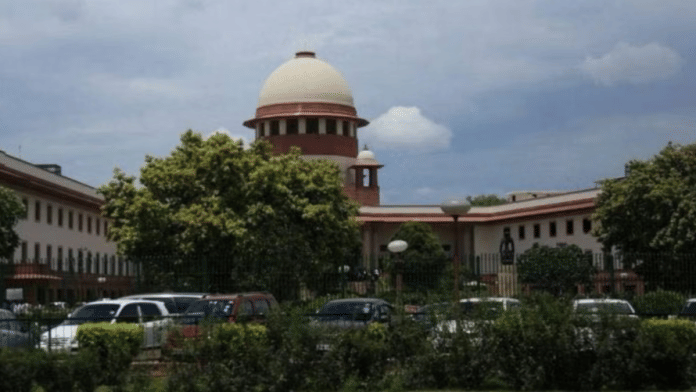



New Delhi: The Supreme Court on Thursday refused to entertain a PIL seeking a comprehensive legal framework and enforcement of minimum wages for domestic workers, saying it cannot issue a writ asking the Centre and states to consider amending existing laws.
The top court also observed that trade unionism has been largely responsible for stopping the industrial growth in the country.
“How many industrial units in the country have been closed thanks to trade unions? Let us know the realities. All traditional industries in the country, all because of these ‘jhanda’ unions have been closed, all throughout the country. They don’t want to work. These trade union leaders are largely responsible for stopping industrial growth in the country,” Chief Justice Surya Kant said.
“Of course exploitation is there, but there are means to address exploitation. People should have been made more aware of their individual rights, people should have been made more skilled, there were several other reforms which should have been done” the CJI said.
While acknowledging the “plight” of millions of domestic helps across the country, a bench comprising CJI Kant and Justice Joymalya Bagchi maintained that the judiciary cannot encroach upon the legislative domain to mandate the enactment of laws.
The bench, in its order, said, “No enforceable decree or order can be passed unless the legislature is asked to enact a suitable law. Such a direction we are afraid ought not to be issued by this court.” It, however, asked petitioners, including Penn Thozhilalargal Sangam, a domestic workers’ union, to highlight the plight of domestic helps to states and the Union to take a suitable decision in the matter.
“We observe that petitioners may continue to highlight the plight of domestic helps and impress upon the stakeholders to take a final call in relation thereto.. and the correspondence shows it is under active consideration by states and we are hopeful that a suitable mechanism shall be deployed for their help and to prevent exploitation,” the bench said while disposing of the PIL.
The petition sought, among other reliefs, recognition of non-payment of minimum wages to domestic workers as a violation of fundamental rights and enforcement of minimum wage regimes across States.
Senior advocate Raju Ramachandran appeared for the petitioner organisation and submitted that domestic workers, predominantly women, remain among the most vulnerable sections of the unorganised workforce, lacking effective legal protection.
Drawing comparisons with international standards, he pointed out that in several Asian jurisdictions such as Singapore, domestic workers cannot be employed without statutory safeguards, including mandatory leave and minimum service conditions.
However, the CJI expressed reservations about judicial intervention in matters involving economic and labour policy.
The CJI cautioned against unintended consequences of well-meaning legal measures, remarking that “in our anxiety to bring something non-discriminatory on the legislative front, something undesirable is sometimes brought about which is then exploited.” “Once minimum wages are fixed, people may refuse to hire. Every household will be dragged into litigation,” he said, adding trade union models have not always succeeded across sectors.
Notwithstanding the exploitation of workers, the CJI said these workers’ unions have created roadblocks in the country’s industrialisation and growth.
“Tell me how many industries have been able to hire successfully using trade unions? See, all sugarcane unions closed,” the CJI said.
The CJI also said such a move could turn every Indian home into a legal battlefield.
“When a minimum wage is enforced, these unions will ensure that every household is dragged into litigation,” he said.
Responding to the submission that collective bargaining could address these concerns, Justice Bagchi noted that domestic workers are already covered under existing welfare frameworks.
“It is not as if there is no safety net. The Unorganised Workers’ Social Security Act does take care of several aspects,” he said, while acknowledging that the petitioner’s concerns were “well taken.” The bench also red-flagged the role of employment agencies in exploitation of workers.
When the petitioner sought a declaration that non-payment of minimum wages violates Articles 14, 15 and 16 of the Constitution, the CJI said such declarations would amount to “lip service” unless backed by enforceable mechanisms.
“All your prayers are legislative in nature. No effective decree can be passed unless the legislature is asked to enact a suitable law, which we are afraid this court cannot do,” the bench said.
Ramachandran said while some states had notified minimum wages for domestic workers, others had failed to do so, despite the nature of domestic employment remaining uniform across the country.
He also relied on a Supreme Court judgment dated January 29, 2025, where the court had highlighted the plight of domestic workers and noted repeated but unsuccessful legislative attempts to enact a comprehensive law. PTI SJK SJK DV DV
This report is auto-generated from PTI news service. ThePrint holds no responsibility for its content.
Also read: SC stays 2026 UGC rules on caste-based discrimination in higher education institutions