





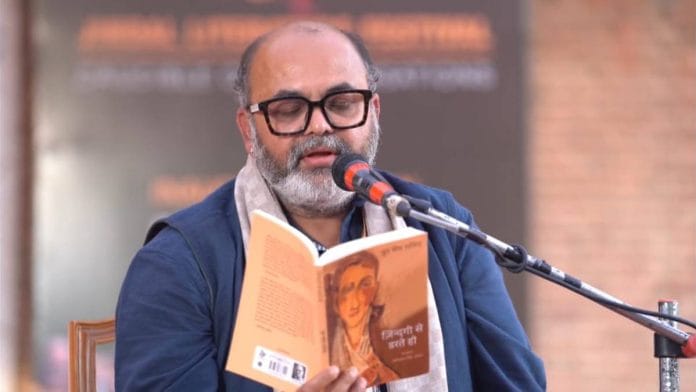



Hisar: Urdu poet Noon Meem Rashid’s complex individualist verses have often been overshadowed by the revolutionary fame of Faiz Ahmad Faiz. But Rashid has found a new voice through Zindagi Se Darte Ho, a collection of his nazms (poems) in Devanagari, compiled and edited by Amitabh Singh Baghel.
On the inaugural day of the Jindal Literature Festival last month, Baghel, literary curator and director of the event, was in conversation with Tarana Husain Khan, author and food historian, on the relevance of Rashid’s thought and imagination, where he shed light on some of his favourite nazms.
Expanding upon the efforts to carry on the legacy of Urdu poetry and make it accessible to the public, he said: “Though the script is different, the language remains the same. The challenge was not translation but interpretation and explaining the words that have lost their meaning for the ordinary reader.”
Baghel said his discovery of Rashid was serendipitous. “When you start reading him, he draws you in completely. Yet, his work remains invisible in the public domain. Faiz’s verses are everywhere, but Rashid speaks to the human conscience and not just politics,” he said.
On the difference between Faiz’s poetry as leaning towards revolution and Rashid’s profoundly individualistic approach to exploring the local and psychological condition of mankind, Baghel contrasted the two poets by saying: “Faiz’s idea was aesthetic. It pleased the shayari tradition. Rashid, in contrast, wrestled with global questions of conscience and identity.”
Reading from his favourite nazm, Andha Kabhadi or “the blind scrap dealer”, Baghel illustrated Rashid’s vision of modern decay. The poem imagines a ragpicker who roams the city at night, collecting broken dreams, some without limbs, some decaying, attempting to cleanse and rebuild them.
“It’s about our lost ability to imagine,” he said, adding that Rashid’s allegory exposes how the need to conform dulls our creative instincts.
When asked why Rashid’s words still matter today, Baghel invoked sociologist Erving Goffman’s theory of “total institutions”, stating that the people have become so tuned to systems of control that they can no longer dream freely.
Rashid lived through the military regimes of Pakistan, where the power of expression was continuously suppressed. His poetry discreetly comments on that suffocation, Baghel said.
One of the moderator’s most pointed questions was whether Rashid’s poetry reflects a defeatist mindset, given that it seems to constrain any sense of hope.
Baghel responded with a firm no, stating: “His poetry asks us to rediscover ourselves. He inspires people to dream and to resist shrinking into the margins. Humanity was the central thread in Rashid’s writings. Every poem is a mirror of an individual’s struggle against systems that deny imagination.”
At the end, he wished that his translation of Rashid’s nazms in Zindagi Se Darte Ho would make the poet more visible among the Hindi-reading Indian audience.
ThePrint is the official media partner for the Jindal Literature Festival.
Also Read: Perfect reels, real problems: Teens, online mirage & ‘learning to play the game’ at Jindal Lit Fest