





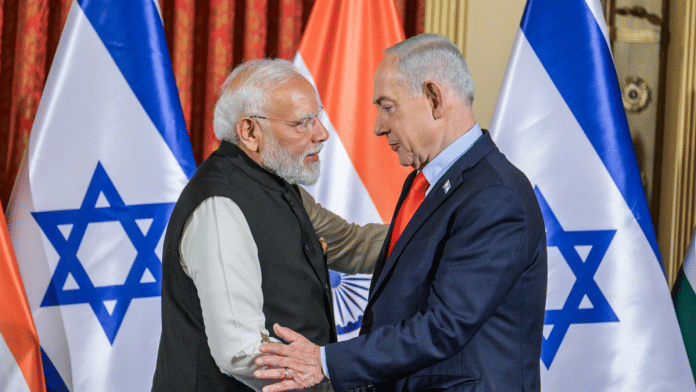



New Delhi: India’s opposition groups criticized Prime Minister Narendra Modi for his Israel trip last week, saying it gave tacit approval for subsequent airstrikes in Iran that have sparked a crisis in the region.
The main Indian National Congress said on Saturday that Modi’s two-day visit to Israel was ill-timed and gave the perception of “partisan alignment and tacit endorsement” of Israel’s coordinated strikes with the US on Iran. Congress party spokesman Jairam Ramesh said Sunday that the Modi government’s response has been a “betrayal of India’s values, principles, concerns, and interests,” while another Congress leader, Priyanka Gandhi, called the assassination of Iran’s leader Ayatollah Ali Khamenei “despicable.”
The attacks on Iran also drew heavy criticism from the Communist Party of India on Sunday.
Modi’s visit to Israel “was wrongly timed and has completely ripped India off its neutrality on the subject,” former Indian ambassador K. C. Singh said in an interview on IndiaToday. “There’s nothing we can do about it now. We are seen in the Israeli corner.”
With about 9 million Indians working in the Gulf region and India heavily reliant on oil imports, the widening Iran crisis creates fresh uncertainty for the economy. India imports nearly 5 million barrels a day, making it the world’s third-largest oil consumer.
“The immediate impact for India is in terms of its population that’s working in West Asia or tourists transiting. That’s a massive number,” said Ashok Malik, partner at the Asia Group. “Further, energy prices are sure to go up.”
India’s government hasn’t officially responded to Khamenei’s killing. In two separate social media posts on Sunday night, Modi said he spoke with the leaders of Israel and the United Arab Emirates. He condemned the attacks in the UAE, without naming Iran, and called for a halt in hostilities in his conversation with Israeli Prime Minister Benjamin Netanyahu.
The Ministry of External Affairs and prime minister’s office didn’t respond to a request for comment on Sunday.
The media could not be loaded, either because the server or network failed or because the format is not supported.
Meanwhile, protests erupted Sunday in parts of Jammu and Kashmir, India’s only Muslim-majority region which has been plagued by militant violence. Omar Abdullah, chief minister of the region, called for calm and said police should refrain from using force or restrictive measures.
The immediate worry for the economy would be the impact of higher oil prices, which could widen India’s trade deficit and put pressure on the currency. Oil surged by the most in four years, with the conflict effectively closing the Strait of Hormuz and plunging the global crude market into turmoil. Brent rallied as much as 13% to above $82 a barrel — the highest level since January 2025.
“If oil prices climb and stay over $80 a barrel, current account deficit can widen by about $10 billion, exert pressure on the rupee and push fuel inflation up,” said Gaurav Kapur, an economist at IndusInd Bank.
Oil Imports
Based on available data for April to November, India sourced about 32% of oil imports from Russia, followed by 18% from Iraq, and the remainder from other Gulf countries and the US. India’s purchases from Russia, however, have fallen sharply in recent months after US President Donald Trump slapped punitive tariffs on Indian goods to push the country to halt imports from Russia.
A senior official in New Delhi said oil trade has been disrupted, while cargo shipments to the Middle East are now halted. The situation is highly volatile and it’s difficult to estimate the impact on exports, the official said, asking not to be identified because the discussions are private.
If shipping lines through the Red Sea and key Gulf straits are disrupted, then carriers would have to be rerouted around the Cape of Good Hope, which would add 15-20 days extra to the transit, according to Ajay Sahai, director general of the Federation of Indian Export Organisations.
The attacks in Iran also put India’s investment in the Chabahar port in Iran at risk. India signed a long-term agreement in 2024 to operate the strategic port and expand its regional footprint. The port allows India to ship goods to Afghanistan and Central Asia, bypassing Pakistan. However, India has scaled back its operations there after the US imposed sanctions on Iran.
Iran is critical partner for India and the crisis there creates more uncertainty, said Asia Group’s Malik.
“Iran is an important factor in Indian regional and security policy,” he said. “We have coordinated with Iran on various issues, including Afghanistan, for decades. We have a working relationship with Iran — we coordinate on security and intelligence. So that relationship isn’t going away.”
Disclaimer: This report is auto generated from the Bloomberg news service. ThePrint holds no responsibility for its content.
Who cares for the opposition. Let them cry.
Did ex PM Manmohan Singhs meeting in Pakistan barely a few months after 26/11 give tacit support to cross border terrorism by Pakistan ? Congress spokesperson is not aware that this trip was announced long back ?