





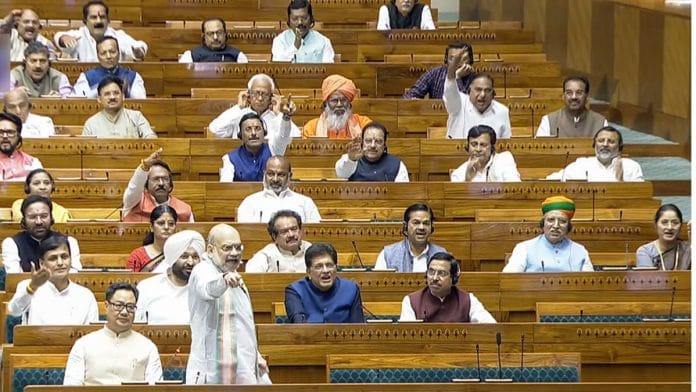



New Delhi: Responding to the debate on the steps taken for the eradication of Left wing extremism in the country, Union Home Minister Amit Shah rejected all observations by the Opposition that the insurgency was born of injustice and poverty. Instead, he said, Maoism has its roots in ideology and is the reason regions like Bastar have been left underdeveloped.
He launched a staunch critique of opposition members who had raised doubts about the Narendra Modi-led government’s initiative and strategy to contain Maoists. He also criticised some members of civil society and activists, describing their calls for a ceasefire and dialogue as “dual standards”.
“Not an article written by intellectuals, popularly called as urban Nnaxals, has been written for the mothers whose children were taken away from them by Maoists. Not one article has been written condemning the blowing up of innocent farmers’ legs by IEDs. Are all of their moralities limited to those who take up arms and challenge the democratic form of government? I reject this dual standard in the name of humanity,” Shah said.
Shah’s response to the debate came a day before his publicly-declared deadline to eradicate Left wing extremism expires.
Shah also spoke about the Supreme Court judgment of 2011 that banned the Salwa Judum movement. He said the Maoists did not lay down their weapons, and SPOs and other members of the Salwa Judum had to give up on the orders of the apex court. “People part of the Salwa Judum were picked and shot to death selectively,” Shah said.
“Whoever believes in the law and order of the country will never support Sudarshan Reddy, their candidate. I severely condemn the judgment,” he further said.
The Salwa Judum was a state-sponsored militia in Chhattisgarh, formed in 2005 to combat Maoists, but was struck down as unconstitutional by a Supreme Court bench comprising B. Sudershan Reddy and Surinder Singh Nijjar in 2011. Put up as a candidate in last year’s vice-president’s election, Reddy was defeated by the National Democratic Alliance’s (NDA) nominee C. P. Radhakrishnan.
Giving an update on the state of the Communist Party of India (Maoist), Shah said that the outfit had 21 members in its top decision-making bodies—the Central Committee and the Politburo. Out of the 21, Shah said, one has been arrested, seven have surrendered, and 112 have been killed. “One is absconding. The talks are going on with the absconding one, and I believe he too will surrender very soon,” Shah said.
“All main armed Maoist cadres have been finished,” Shah asserted.
Also read: Odisha’s top Maoist Sukru surrenders weeks after hacking deputy to death over laying down arms
Poverty due to Maoism, not other way round
Responding to questions on representation of tribals at the ground level and the state of on-ground developmen by opposition members such as Asaduddin Owaisi and Mahua Moitra, Shah said: “Maoism did not spread because of poverty, but Maoism led to poverty in regions such as Bastar.”
“The literacy in four regions and districts, such as Naxalbari, Bastar, Bihar’s Saharsa and Uttar Pradesh’s Balia, were comparable, but the Left wing extremism flourished only in Bastar after its origin in Naxalbari,” Shah said.
This, he said, was because the Maoists chose Bastar as a region to dominate due to the vacuum there and not because Bastar was poorer on the human resources index.
Attacking the opposition, Shah said serious questions should be asked of the people advocating for Maoists in the name of tribal rights. How did China’s Mao Zedong replace their own inspirational figures, he asked.
“There has to be introspection on how great personalities such as Tilak Manjh and Birsa Munda fell from the imagination of the tribal youth between 1947 and 1968. How did they stop eulogising them and instead adopt the teachings and methods of Zedong,” Shah further said.
Shah also accused Leader of Opposition Rahul Gandhi and the opposition Congress party of being soft and influenced by the Maoist ideology.
“After Hidma was killed in an encounter, there was a protest… and Rahul Gandhi tweeted the video (of the protest) from his account. If there is one person to be blamed for the continuous spread of the Maoist movement in the country since the 1970s, it is the Congress party,” Shah concluded.
Changes after 2014
Shah said that there have been a number of discussions around what has changed since 2014, when Narendra Modi came to power. He said the Congress party also made efforts to bring development to Bastar, but these were undermined by the strong Maoist presence.
“We have taken action and removed those who used to carry out the blasts and other activities, which used to stop development work,” Shah said, adding that a clear policy and political will made the difference since 2014.
Shah referred to three landmark dates in the fight against Left wing extremism: 20 August 2019, 24 August 2024, and 31 March 2026. He said that several key calls—such as a unified approach between state police forces and central forces and the induction of surrendered Maoist cadres into the system for intelligence gathering—were made at the 20 August 2019 meeting at the Ministry of Home Affairs. After the Left wing extremism review meeting in August 2024, Shah had declared 31 March 2026 as the deadline.
However, he blamed the Congress party, which came to power in 2018, as the stumbling block in the fight. “All states, except Chhattisgarh, had become Naxal-free to a great extent by 2023, but Chhattisgarh became a laggard because the Bhupesh Baghel government shielded Maoists,” Shah launched an attack against Congress, protested by a handful of MPs from the party.
The Union Home Minister also heaped praise on the Central Armed Police Force (CAPFs) for braving the summer season and hilly heights of the Korregattalu hills where they carried out Operation Black Forest lasting 21 days.
(Edited by Viny Mishra)
Also read: Maoists had plans to expand beyond Abujmarh. MP’s Hawk Force stood in their way