





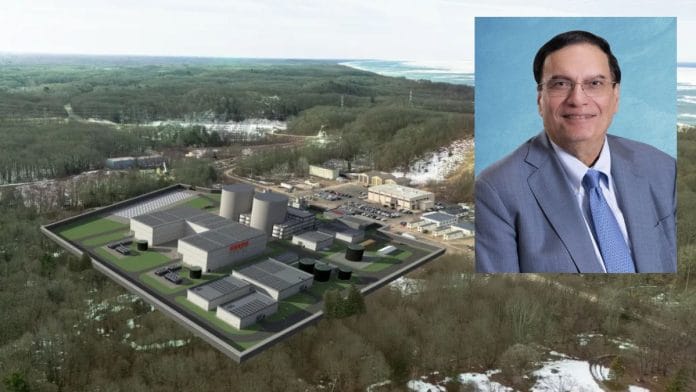



New Delhi: As the Narendra Modi government frames rules to operationalise the SHANTI Act, one of America’s leading nuclear equipment suppliers Holtec International is eyeing an entry in India’s nuclear power sector with ambitious plans of manufacturing small modular reactors (SMRs) at scale here, firm’s chairman and CEO Kris Singh told ThePrint.
In an exclusive interview, Singh said that Holtec has set a goal of manufacturing 200 SMRs in India. “I think 200 is a good goal, if you consider India has 600 districts. If you put up 200 SMRs, you will cover only one-third of it, but the important thing is to understand the challenge that lies ahead… All this is not going to happen by waving a magic wand,” he added.
SMRs are advanced nuclear reactors, with power generation capacity ranging from less than 30 MWe (Megawatts electric) to over 300 MWe, that provide a flexible, scalable and cost-effective alternative to conventional large nuclear reactors.
Holtec, Singh said, will begin discussions with the Atomic Energy Regulatory Board (AERB)—India’s nuclear regulator—very soon for the approval of the design of their 300 MWe SMRs. Holtec is already developing a dual unit SMR-300 plant at the Palisades Energy Centre in Covert, Michigan in the US.
“In anticipation of that proceeding, we are about to buy land to build a new factory in Gujarat to manufacture capital equipment for nuclear power plants,” he said. “We probably will have the land by next month.”
The equipment manufactured at the Gujarat plant, he further explained, would be dual purpose—capable of being used in nuclear as well as commercial power plants.
This will be Holtec’s second manufacturing unit in India. The company already has a condenser unit in Dahej.
The CEO hopes that the AERB approval will come in six months. “How fast they will be able to approve depends on how well they are resourced. AERB has great leadership. They just have to ensure that they get the necessary resources from the government to be able to do it.”
Singh stressed that he would be the first one to request that the regulator not be shortchanged: “Make sure that they are fully resourced because if the regulator is weak, the public will lose confidence and that would be the end of India’s nuclear programme.”
Holtec already has partnerships with international companies for sourcing fuel, which will not be an issue, he said. “There are multiple sources of fuel… We have a strong partnership with French nuclear company EDF, and we also buy fuel from Framatome, another French company that works with EDF.”
Singh added that after Holtec gets its reactors going in India, it also plans to build a fabrication plant here in collaboration with a suitable partner, like EDF or Framatome. “There are others, too, who are interested.”
Also Read: Budget gives nuclear energy sector another fillip soon after SHANTI paved way for private players
Eye on partnership with more Indian firms
In March 2025, the US Department of Energy had granted specific authorisation under 10CFR810.9 to Holtec International to sell its flagship small modular reactor SMR-300 in India.
The authorisation allowed Holtec to tie up with three Indian companies—Tata Consulting Engineers, L&T, and its own Indian subsidiary Holtec Asia—with whom it can share the required technical information to execute its SMR-300 programme. Singh told ThePrint that partnering with more Indian companies to execute the SMR-300 programme will require an amendment to the original authorisation.
The US authorisation, he explained, has been too restrictive. “It is difficult to do business under the current one, so we are filing for an amendment that will allow us to do things we can’t do at scale at present.” The amended authorisation will allow them to partner with Indian companies to “Indianise” the SMR-300 reactors. “We are going to take our US reactors and Indianise the design, so that it will be built locally, except for those parts that can be supplied from the US,” he said.
Doing so, Singh added, while preserving all the safety features will bring down the cost. “It is possible, and will make the reactor more affordable. We have to keep in mind the energy cost, which is a critical element, and we have to be cost competitive,” he said, adding that where they will manufacture domestically, or get the parts from the US, depending on wherever it makes more sense. “I am looking to India and the US collaborating in a way that is a win-win for both countries.”
Holtec also plans to have hundreds of more engineers in India to work in the nuclear energy sector. “India does not have an adequate number of nuclear engineers, currently as the nuclear economy is limited. It needs to build up. We are proposing to the government through partners in India that we develop academic institutions, different nuclear programmes in IITs and general institutions that focus on nuclear SMRs, run some training schools that teach nuclear manufacturing, to develop manpower and infrastructure so that we can build at scale,” the Holtec CEO said. There is also a need to have a nuclear quality assurance programme, which is very different from a commercial programme, he went on.
Big push for SMRs
Singh said that in a large country like India, where getting land is a challenge, SMRs can be one of the key options to ensure energy security. “Our SMRs are designed in a way that the land requirement is small, and you don’t need a large exclusion zone outside the reactor premises. Land is an issue in India. Our two reactors—we build in pairs—have 600 MWe output and require 30 acres. Outside of the 30 acre perimeter, you can build apartment buildings because in case of an accident, radioactivity will not affect the people living outside.”
He asserted that the level of safety is paramount, saying that building SMRs at scale does not mean that the risk factor would also go up. “Look at all the accidents in the past, in the history of nuclear power plants. Every single time, it is a pump, a motor, a man-made equipment that has failed. What we have done in our reactors is if there is any accident, the safety recovery system does not need any pump or motor system. It runs on gravity.”
In India also, there is a big push for SMR technology as the government is looking at accelerating its nuclear power generation capacity from the current 8 GW to 100 GW by 2047.
The challenges in India
However, Singh foresees technical challenges in India, mainly shortage of water and risk of earthquakes. “We have designed our reactors so that you can put it in any place in the country, in places which are more seismically active and it will be qualified for earthquakes.”
Singh added that his recommendation to AERB is to only approve reactors that will qualify to 0.5 times the acceleration due to gravity as the earthquake requirement. “That will cover the whole country, and there should be one design for the entire country.”
(Edited by Mannat Chugh)
Also Read: The enhanced powers of govt under SHANTI Bill & what’s changed when it comes to nuclear liability