





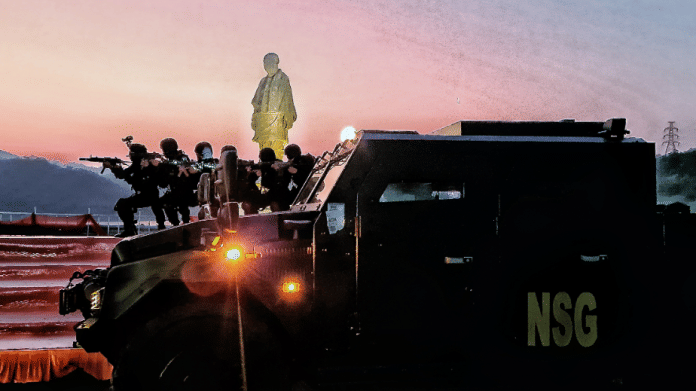



New Delhi: India’s elite anti-terror urban warfare force, the National Security Guard (NSG), ranked a dismal 62nd in the SWAT challenge held this week in Dubai. There were 109 teams from 48 countries participating.
The competition was swept by the two units from Kazakhstan, which had three teams in the top 10, followed by a team from the Chinese Police, a team from Thailand, and a SWAT team from the Rwanda National Police. The teams from Pakistan stood 68th and 90th on the points tally.
Sources in the force said that the NSG came third in the fifth and final stage of the competition involving crossing obstacles.
The NSG was the sole unit representing India at a four-day event organised by the Dubai Police, during which the force and its counterparts from several other countries participated in exercises simulating real-world scenarios and their respective areas of operations.
During this event, the forces participated in five challenges: assault, hostage rescue, officer rescue, tower assault, and obstacle course.
The NSG scored 236 points, compared to 536 and 515 points secured by the toppers from Kazakhstan.
Sources in the force, however, said that the competition was not directly comparable to their real-world operations and that the objective of participating was exposure.
“We participated in the competition for the first time, and it was just for familiarisation and exposure for our troops. Scores in the competition do not necessarily reflect the operational readiness and strength of any force,” an NSG official told ThePrint, requesting anonymity.
“Based on these rankings and scores, one can assume Kazakhstan’s units are superior to Russians…is that even possible…?” the official further asked.
The United States sent four units to the competition, while China and Russia sent six units each, including a team of the Moscow Police. Pakistan sent two units—the Elite Punjab Police and the Special Security Unit of the Sindh Police.
According to details made public by the event organiser, the competition begins with the first stage, called ‘Assault Challenge’, in which teams compete in a shooting competition.
Each team comprises five members, including snipers in four of the five stages of the competition.
The next stage of the competition is ‘Hostage Rescue’, in which a six-member team participates in an exercise to breach the structure, neutralise the designated dummy targets, and rescue the dummy hostage.
The team comprises five assault members, who carry out the work of removing the obstacles to reach the dummy hostage to be rescued, while the lone sniper in the team engages a target from long-range before returning to the finish line.
In the third stage, the team has a similar composition: four assault members and one sniper, who rescues a teammate acting as a casualty during the operation. At this stage, the troops also have to move a large tyre and return to the finish line within a stipulated time period.
The next stage is called ‘Tower Assault Challenge’, in which two snipers on a five-member team climb the tower, rappel down from the top, and clear the close-range targets. One additional sniper joins the team for the stage to demonstrate engaging two long-distance targets from two different firing positions with precision rifles.
In the fifth and final stage of ‘Obstacle Course Challenge’, the troops are in combat uniform and gear, and each member must complete 21 obstacles, including climbing walls and a low-crawl obstacle.
(Edited by Varnika Dhawan)
Also Read: India made Sniper rifle trumps American in police commando competition