





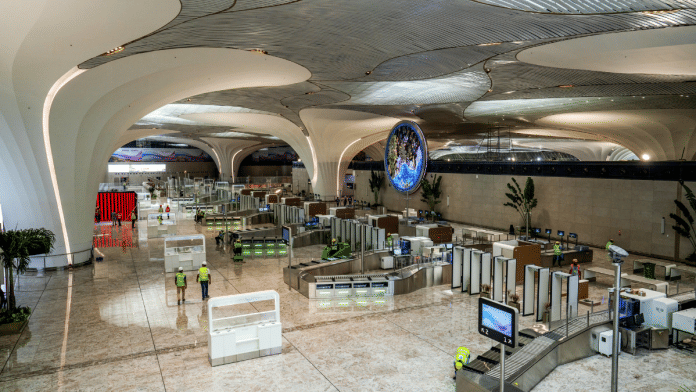



Mumbai: The Navi Mumbai International Airport will launch commercial operations on Thursday, with 30 flights scheduled for the opening day, making the Mumbai Metropolitan Region the first in India to have two functional airports.
According to a press release, the first flight to land at the airport will be IndiGo’s 6E 460 from Bengaluru at 8 am. It will be followed by the first departure—IndiGo flight 6E 882 to Hyderabad at 8.40 am. Three other airlines will operate services on the opening day—Akasa Air, Air India Express and Star Air.
Inaugurated by Prime Minister Narendra Modi on 8 November, the airport is expected to serve passengers from Navi Mumbai along with neighbouring areas Thane, Raigad, Pune, and parts of the Konkan region.
For decades, Chhatrapati Shivaji Maharaj International Airport (CSMIA) at Vile Parle has served as Mumbai’s sole international gateway, handling over 50 million passengers annually under significant capacity constraints. The addition of NMIA is expected to ease pressure on the facility.
Also Read: Mumbai gets new airport & critical 33-km metro: A look at infra revolution in Mumbai & Maharashtra
The airport was developed as a public-private partnership between Mumbai International Airport Limited (MIAL), a subsidiary of Adani Airport Holdings Limited, and the City and Industrial Development Corporation of Maharashtra (CIDCO). It will be operated by Navi Mumbai International Airport Ltd (NMIAL), an Adani Group subsidiary.
CIDCO Vice-Chairman and Managing Director Vijay Singhal said Wednesday that the launch of NMIA reflects the Maharashtra government’s efforts to expand aviation infrastructure and reduce passenger burden on the Chhatrapati Shivaji airport.
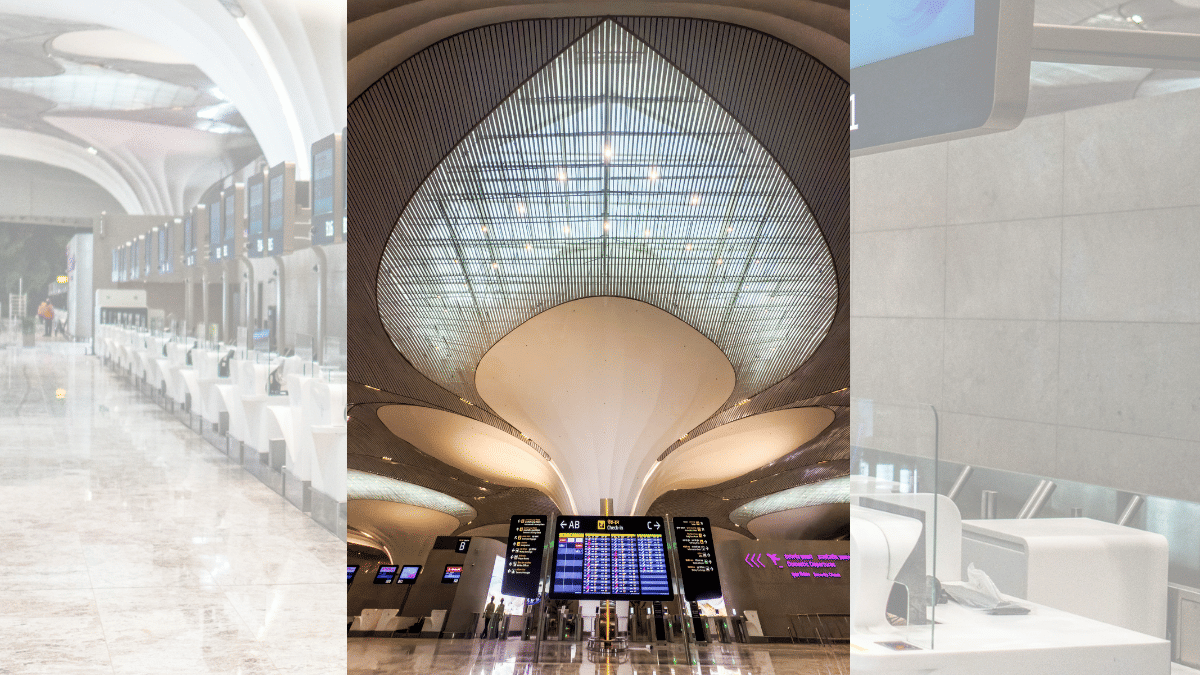
The greenfield airport at Navi Mumbai, designed by British firm Zaha Hadid Architects, will initially handle limited flights, both domestic and international. Flight numbers will go up as regulatory approvals are received and infrastructure readiness is established.
On 11 October 2024, an Indian Air Force (IAF) aircraft successfully touched down on NMIA’s south runway, marking its first test-landing.
The idea of a second airport for Mumbai and surrounding areas was conceived as far back as 1997, but it took another ten years for the project to get the Civil Aviation Ministry’s formal approval. Construction began only after another decade.
In July earlier this year, Maharashtra Chief Minister Devendra Fadnavis said the first commercial flight will take off from the airport in September. When that didn’t happen, authorities said the facility was waiting for an approval by the Central Industrial Security Force (CISF).
So far, one terminal of the airport has been built, at a cost of Rs 19,647 crore, as part of phase-1 of the project. Under this phase, maximum annual passenger capacity is expected to touch 20 million. Three more terminals will be constructed in the next three phases. Together, the airport—once completed—is expected to handle 90 million passengers in a year.
After Navi Mumbai airport, the Noida International Airport—also in final stages of phase-1 completion—will be the second such facility for passengers in Delhi-NCR and surrounding areas.
Connectivity plans & access
The airport will be connected to South Mumbai via Atal Setu, also known as the Mumbai Trans Harbour Link, and the upcoming Ulwe Coastal Road.
CIDCO aims to complete the full 5.8km Ulwe Coastal Road with an additional 0.9km airport link, though it is likely to be ready only by 2026-end. Until then, travellers will have to take the Uran-Panvel Road and the Ulwe-NMIA-Belapur Road after exiting Atal Setu to reach the airport.
CIDCO also plans to develop a Navi Mumbai Airport Express Metro to link the two airports at Navi Mumbai and Vile Parle. The 34km route, spanning 25.8km of elevated tracks and 8.2km of underground sections, is expected to feature 20 stations–14 elevated and six underground.
The route will have multiple interchanges with the under-construction Metro 2B from D.N. Nagar to Mandale-Mankhurd; the operational Metro 3 from Aarey-JVLR to Cuffe Parade, and Metro 6 from Swami Samarth Nagar in Andheri Lokhandwala to Vikhroli.
The Navi Mumbai Municipal Transport (NMMT) also plans to operate bus services between Targhar and NMIA terminal 1, while NMIAL plans to run shuttle services in due course.
Maharashtra Governor Acharya Devvrat, CM Fadnavis, Deputy Chief Ministers Ajit Pawar and Eknath Shinde, Union Civil Aviation Minister Ram Mohan Naidu Kinjarapu, Union Minister of state for Civil Aviation Murlidhar Mohol and Adani Airports director Jeet Adani were among those who attended the NMIA inauguration last month.
(Edited by Prerna Madan)
Also Read: Engineering wonder built over 60-storey drop in the Sahyadris. Making of Mumbai-Pune ‘missing link’