





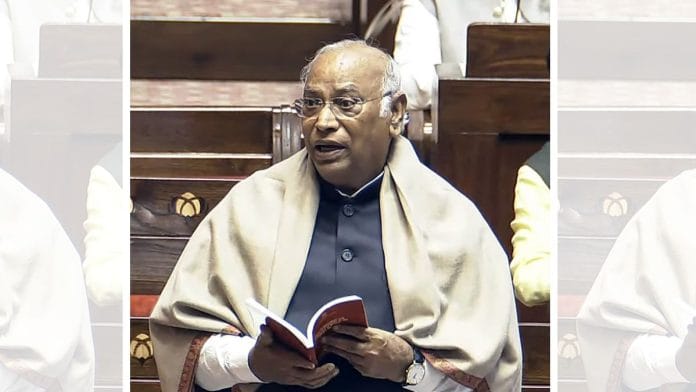



New Delhi: Congress President Mallikarjun Kharge has criticised Prime Minister Narendra Modi’s statement on the war in West Asia in Rajya Sabha, calling it “an exercise in obfuscation”.
Following the PM’s speech Tuesday, Kharge raised questions on India’s energy security amid rising shortages, its failure to secure safe passage for its vessels, and an “inconsistent and swinging diplomatic posture”.
Taking to X, Kharge questioned Modi’s visit to Israel before the US-Israel strikes on Iran, saying, “…the Prime Minister appears to have altered the balance of India’s strategic autonomy…Why did the Prime Minister fail to take Parliament and the nation into confidence about this apparent shift, and what concrete steps have been taken to restore India’s strategic autonomy?”
Earlier in the day, the PM said in his statement, “More than three weeks have passed since this war began in West Asia; this war has created a serious energy crisis across the entire world…India has condemned attacks on civilians, on civil infrastructure, and on energy and transport-related infrastructure.”
On the energy crisis, Congress President Kharge said, “The Prime Minister has claimed in Parliament that India has diversified its energy imports from 27 to 41 countries. If so, which countries are currently supplying LNG, LPG, and crude oil to India, and in what quantities? More importantly, if diversification has been achieved, why are citizens still facing shortages, long queues, black marketing, and sharp price rises across the country?”
“Is the Prime Minister now suggesting that 140 crore Indians must once again fend for themselves as the country stares at an escalating energy crisis, along with looming food, fertiliser, MSME, and inflationary pressures?” he asked.
Citing “nearly 37–40 Indian-flagged ships carrying around 1,100 sailors” stranded in the Strait of Hormuz, he asked, “Why are countries like China, Russia, Japan, along with other ‘friendly nations’, being granted safe transit, while Indian ships remain stuck?”
The central government has maintained that it is managing the situation through continued diplomatic engagement with all sides, while ensuring the safety of Indian citizens.
CPI(M) Rajya Sabha MP John Brittas, speaking to ThePrint, said, “India’s muted response does not suit its stature, history or civilisational trajectory, especially in the face of an illegal and immoral war against a sovereign nation, especially when even its allies are not completely backing the US and Israel.”
The PM’s speech
On Tuesday, Prime Minister Narendra Modi, in his address to the Upper House, reiterated the government’s commitment to ensuring the safety of millions of Indians living in the Gulf and promoting peace and dialogue worldwide. He also announced a Rs 70,000-crore initiative to build ships.
He reassured farmers that the government was taking all necessary steps to ensure a sufficient supply for the upcoming sowing season and stressed that necessary steps were being taken to ensure sufficient fertiliser suppliers for the upcoming sowing season.
Leader of Opposition and Congress MP Rahul Gandhi, however, criticised the government, calling its foreign policy and the PM “compromised”. He said, “Modi only does what the United States and Israel want him to do. He can never make decisions in India’s interest, and that is clearly visible.”
John Brittas also criticised the Centre’s approach to the war, urging it to take cues from Congress president Mallikarjun Kharge, rather than Congress MP Shashi Tharoor, who referred to the government’s position on the US-Israel’s war with Iran as “responsible statecraft”, “not a moral surrender”.
Tharoor, in a recent The Indian Express column, said he would not “condemn the government for choosing silence over confrontation”, even while acknowledging that the war “cannot be justified under international law” and violates principles India has historically upheld.
The Indian government, however, stated that it was engaged in meaningful dialogue with Gulf Nations, reaffirming India’s diplomatic engagement. Prime Minister Narendra Modi reiterated the need for India to be “self-reliant”—a remark that Congress president Mallikarjun Kharge later countered on social media.
Kharge flagged that the Prime Minister’s remarks suggested a push towards complete self-reliance without government support.
“It has now been 25 days since the conflict began, and India is facing a deepening energy crisis, one for which the government should have been far better prepared. The Prime Minister has now likened the situation to being ‘Covid-like’. The nation cannot forget the tragic suffering during the pandemic, when over 40 lakh lives were lost, and countless citizens were left struggling for basic necessities like oxygen,” he said, questioning whether Indians must once again fend for themselves.
(Edited by Madhurita Goswami)
Also Read: ‘Pre-committed purchase pact & 2-minister ping-pong’: Tharoor’s scathing jibe at India-US trade deal