





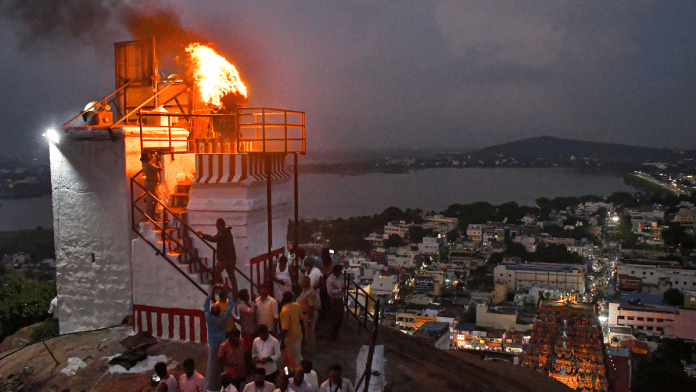



Chennai: The Madras High Court late on Thursday quashed prohibitory orders imposed and directed police to provide full protection to Hindu devotees for a ritual at a spot considered sacred by them on a hill-top in Madurai.
Justice G.R. Swaminathan of the Madurai bench of the high court passed the order while hearing a contempt petition filed by devotees against the district administration’s move to block them from reaching Deepathoon – a sacred stone pillar linked to the Subramaniya Swamy temple on Thiruparankundram hill.
The High Court order set the stage for a fresh confrontation as hundreds of Hindu Munnani functionaries and BJP leaders, including the party’s state president Nainar Nagendran, thronged to the foothills after the ruling.
They were again blocked by police, who told the gathering they would not allow anyone to climb the hill.
Police detained over a 100 people, including Nagendran, and told the gathering they would not allow anyone to climb the hill. Separately, they said that they will appeal the High Court’s decision to quash the prohibitory order and permission to light the ‘Deepam’ at Deepathoon.
The dispute over the hill has been simmering for months, as the Thiruparankundram hill is the site where both Subramaniya Swamy temple and a dargah have coexisted for decades. Earlier this year, some Hindu outfits and BJP functionaries started protesting and demanding that Muslims be stopped from carrying out animal sacrifices on the hill. They said the hill belonged only to the Hindus.
Also Read: The Thevar factor in southern Tamil Nadu & how DMK, AIADMK have harnessed it for electoral gains
In the court
The latest controversy erupted after devotees approached the high court, seeking direction to light the Deepam at Deepathoon, which is closer to the dargah on the hill, rather than at the traditional spot at the temple.
On 1 December, the court allowed this plea to allow devotees to carry out the ceremony at Deepathoon.
But on the evening of 3 December, moments before the ritual, devotees approached the court and said Madurai officials had made no arrangements and were ignoring the court’s order.
Justice G.R. Swaminathan subsequently authorised petitioner Ravi Ramakumar and ten others to climb the hill and light the ‘Deepam’ themselves. The judge also ordered CISF protection for the group of devotees.
However, on Wednesday, when the CISF team and devotees reached the foothills, Madurai Police Commissioner J Loganathan allegedly blocked them and cited a prohibitory order issued by the district collector under Section 163 of the Bharatiya Nagarik Suraksha Sanhita (BNSS).
CISF personnel withdrew, and the devotees were stopped from proceeding.
The district administration then filed an appeal petition against contempt proceedings.
A two-member bench of justices G. Jayachandran and K.K. Ramakrishnan, hearing the appeal on Thursday afternoon, said there “was no illegality in giving CISF protection” since police failed to provide protection. The bench pointed out there was no change in the original order and said the single judge would continue to hear the case.
The state government, which did not allow the devotees even after the evening order, filed an appeal petition before the Supreme Court against quashing of the prohibitory orders as well as lighting of the lamp at Deepathoon, rather than the traditional spot.
Court tears into administration
When the contempt petition came up for hearing on Thursday evening, Justice Swaminathan came down heavily on the Madurai district administration for what he described was “deliberate and calculated” defiance of his direction to permit the ceremony at Deepathoon.
Justice Swaminathan remarked that once a court issues a direction, “it has to be complied with in letter and spirit” and the executive “cannot remain in hibernation”.
Quoting a May 2025 Supreme Court judgement, he added that nobody, “howsoever high they may be”, can consider themselves above the law, and that disobedience “attacks the very foundation of democracy”.
The judge noted this was a clear attempt to “nullify the directions” of the court and to give police a “convenient reason to defy the order”.
Striking down the prohibitory order, Justice Swaminathan declared that a district magistrate cannot override a judicial order, and that even Parliament cannot nullify a court judgement except through constitutionally permissible means.
Citing multiple Supreme Court precedents on separation of powers, the judge observed, “If officers are allowed to defy courts’ orders in this fashion, it will lead to anarchy. Such a situation must be nipped in the bud.”
Directing police to fully assist devotees in lighting the Deepam on Thursday, the judge dictated the order in the presence of the police commissioner via video conferencing, stating that non-compliance would attract “harsh consequences”.
The court also emphasised that Article 261 of the Constitution obligates authorities to fully enforce judicial orders. The judge asked to enforce the orders before 7pm and posted the case for compliance reporting at 10 am Friday.
Political battle lines harden
AIADMK General Secretary Edappadi K. Palaniswami condemned the DMK government for failing to implement the single judge’s order.
“By not implementing the order, the DMK government has created an unnecessary tension for the past two days,” he said in a statement, adding that the people of the state will soon teach a befitting lesson to Chief Minister MK Stalin’s model of government.
BJP State President Nagendran welcomed the high court judgement and said Tamil Nadu people will give a decisive mandate for change.
“People will always stand by those who stand by them. In 2026, Tamil Nadu will give a decisive mandate for change, and we will build a government that protects women, children and families,” he had said before his detention.
He also said BJP will not allow any government to disrupt Tamil culture. “For 100 years, our temples have safeguarded tradition. We will not allow any government to disrupt Tamil culture, Tamil faith or the rights of Tamil people,” he said, alleging that the DMK government had failed to protect Hindus.
Chief spokesperson of the Tamil Nadu BJP, Narayanan Thirupathy, called on the DMK government to release all those detained, news agency PTI reported.
Reacting to the criticism, state Minister Regupathy told journalists the government has been following the Madras High Court’s 2014 order, which says the Deepam has to be lit only at the traditional spot, and not at a new location.
“We respect law and we respect the courts. The petitioners have approached the court without the knowledge of the settled matter and we will appeal against the new order,” he said, adding that the “Hindutva group has been trying to make inroads into the state using Karthigai Deepam as a weapon”.
(Edited by Prerna Madan)
Also Read: Why DMK-led Tamil Nadu govt is at war with the Centre over NEP
The so-called ‘deepathoon’ of Tiruparamkundram looks like a landmark used by the Geological Survey of India which mapped the entire India during the British times. Similar landmarks can be seen in Britain on raised parts of that country used for geological surveys. Nobody wants to tell the people about the actual dimensions of this stone pillar.
If it was indeed used for lighting a lamp, the lamp could not have been very big and it could not be seen from the bottom of the hillock. Hence a large flare has been lit in the nearby temple like in the photo all these times.