





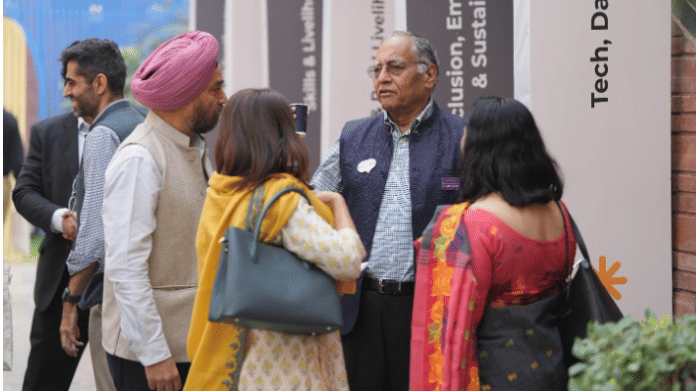



I’ve often found myself in and around conversations where people from government, markets and civil society are speaking about the same issue – but from different starting points. Each brings clarity from their own vantage point. What becomes visible, though, is how quickly challenges spill across boundaries once you look closely.
India has built scale well. Roads, digital public infrastructure, financial inclusion systems and welfare delivery have expanded reach across the country. That achievement matters. But as the economy grows more complex and uneven, a different question is coming into view. Not whether India can grow – but whether its institutions can keep pace with the way challenges now overlap. That question surfaced repeatedly at charcha 2025. Not as a single takeaway or a grand declaration, but through the quiet consistency of what people were grappling with across rooms.
Conversations ranged widely – from AI and employment to rural livelihoods, from capital and philanthropy to inclusion and skills. Yet the underlying tension was familiar. Solutions exist. Capability exists. What often lags is the ability to connect efforts across institutions so that they reinforce rather than outpace one another.
This is where the samaaj–sarkaar–bazaar frame becomes practical rather than philosophical.
Markets bring speed and efficiency. The state brings scale and legitimacy. Communities bring context and trust. None of these can substitute for the others. And yet, we continue to ask them to operate largely in parallel, each doing its part, but not always in step.
The result is not failure, but friction. We become very good at strengthening parts of the system, while outcomes that depend on coordination remain harder to move. Across sessions on technology and data, livelihoods and rural enterprise, AI-enabled work, inclusion and skills, one pattern kept repeating. The challenge isn’t the absence of ideas or effort. It is the absence of shared capacity to coordinate across institutions and sustain solutions over time.
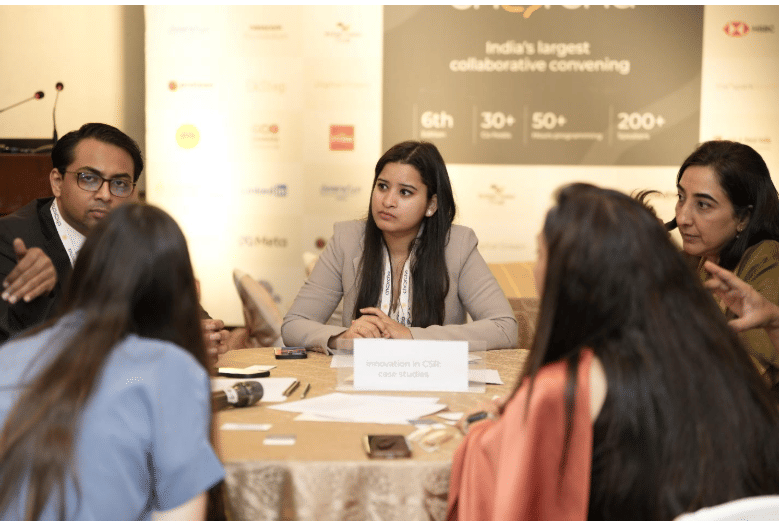
Jerold Pereira articulated this in his opinion piece as alignment infrastructure – the ability of sarkaar, samaaj and bazaar to listen to one another, understand constraints and design together, rather than pass problems downstream. This matters because the changes India is already living through do not sit neatly within sectors.
The move from rural markets to digital platforms. The shift from informal labour to platform and AI-enabled work. The journey from aspiration to opportunity for young people outside large cities. None of these can be addressed through a single policy lever or market intervention. They demand the ability to navigate incentives, social realities and public systems at the same time.
That complexity showed up most clearly in conversations about work and livelihoods. Speakers returned repeatedly to the idea that jobs cannot be understood only through training or placement numbers. Work is shaped by place, mobility, care responsibilities and local economies. For an informal worker, extreme heat is not an environmental abstraction – it is income loss. For a woman micro-entrepreneur, access to credit works only when mobility, safety and community support move alongside it.
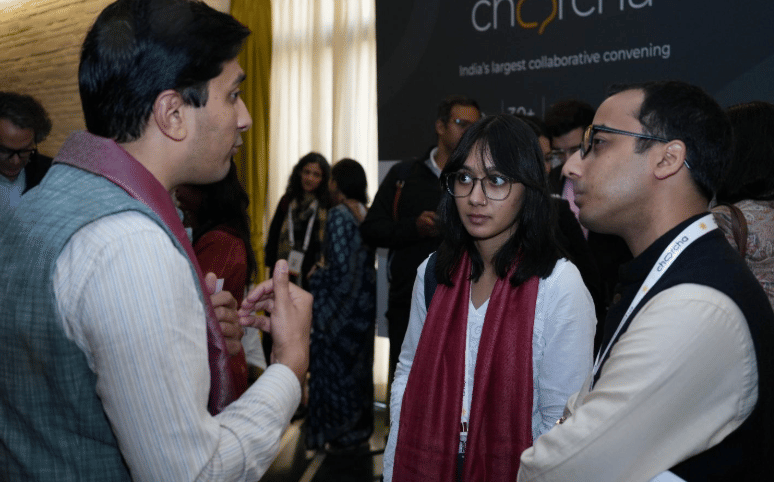
Technology discussions echoed this logic. AI was rarely framed as a standalone sector. It was described as an environment – one that now touches agriculture, services, governance and care work. Several speakers spoke about the growing importance of “human-in-the-loop” roles, where judgment, language and context remain central. Unlocking this opportunity, especially beyond metros, depends on skilling providers, platforms, employers, credentialing systems and public infrastructure moving together.
Capital conversations pointed in the same direction. Whether the discussion was on CSR, patient philanthropy or blended finance, the emphasis was less on volume and more on fit. Short-horizon instruments struggle to support institutional journeys that unfold over years. Flexible, long-term capital works best when it complements government systems and market pathways, rather than sitting beside them.
Even sessions on inclusion and social protection reinforced this systems view. For gig workers, migrant families, persons with disabilities or informal urban communities, vulnerability is not occasional. It is a steady condition shaped by how systems intersect – documentation, discovery of entitlements, grievance redressal, market access and local governance.
What stood out was not disagreement, but convergence. People working in very different roles were often describing the same underlying reality, using different language. The challenge, then, is not intent or conviction. It is coherence.
This is where convenings like charcha play a particular role.
They do not solve India’s challenges. But they do something essential. They create deliberate space for overlap – for shared language, for listening across roles, for reasoning together without performance. In a country of India’s size and diversity, that connective tissue is not a soft outcome. It is strategic.
As I walked out of charcha, I wasn’t thinking about new programmes or platforms. I was thinking about how rare it still is for institutions to think together, calmly and consistently, once problems cross lanes – and how much depends on building that habit.
Scale has taken India far. Coherence will decide how far it can go next.
By Vaibhav Budhraja, Senior Director, Marketing, The/Nudge Institute
At charcha 2025, India’s largest collaborative convening, a multitude of industry experts and partners converged to explore various topics. With 40+ sessions spanning across 6 immersive, livelihood-intersecting themes, supported by 30+ sector-leading co-hosts, charcha convened to collaborate towards the shared goal of Viksit and Inclusive Bharat by 2047.
charcha 2025, an initiative by the*spark forum, was held at India Habitat Centre, New Delhi, from November 12–14, 2025. To know more, visit: charcha25.thespark.org.in
ThePrint was an official media partner for charcha 2025.