








New Delhi: Indian refiners are seeking guidance from New Delhi on the future of Russian purchases after President Donald Trump announced the world’s third-largest oil importer would stop taking Moscow’s crude in exchange for lower trade tariffs.
Trump, whose administration has pressed India for months to cut back its trade with Russia, made the announcement in a social media post after a call with Prime Minister Narendra Modi, providing few details. In his own response confirming an agreement, the Indian leader didn’t mention oil at all.
India has cut back its buying over recent months, particularly after sanctions on Moscow’s leading producers, but has not halted flows as discounts remain attractive.
At least three refiners are seeking clarification from the government, with two of the processors temporarily halting purchases, according to people familiar with the situation, asking not to be named because of the sensitivity of the matter.
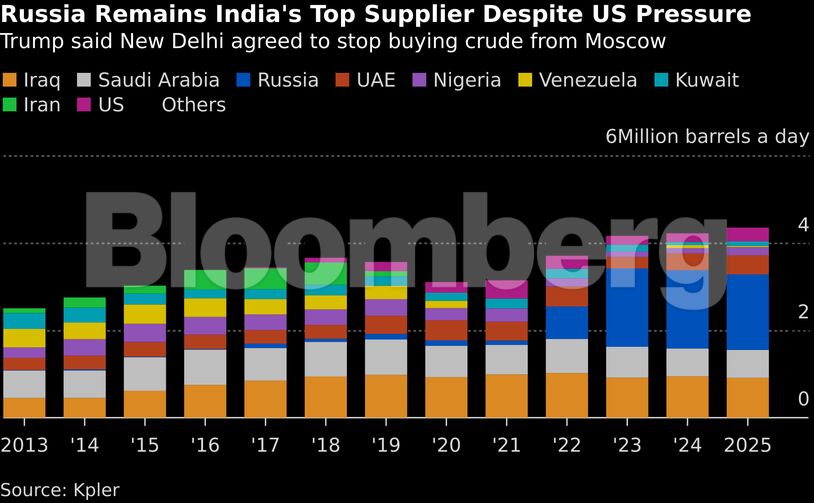
India became a key buyer of Russian crude after the invasion of Ukraine in 2022. At its peak, the Asian nation was taking more than 2 million barrels a day. Daily flows fell to around 1.2 million barrels in January, according to data from Kpler.
Officials at a major industry event last week estimated imports could drop further to 800,000 barrels to 1 million barrels per day in the coming months, a level seen to be both achievable for India and acceptable for the US. About half of that total would go to Nayara Energy, a plant part-owned by sanctioned Russian producer Rosneft PJSC, with the balance split among others.
At the peak of US pressure last year, some refiners had forecast imports would go to virtually zero.
Trump also mentioned Modi agreed to potentially buy more from Venezuela. The US has tapped global trading giants Vitol Group and Trafigura Group to market barrels from the country after Washington’s intervention earlier this year.
Reliance Industries Ltd., Indian Oil Corp., Bharat Petroleum Corp., and Hindustan Petroleum Corp. didn’t immediately respond to requests seeking comment.
This report is auto-generated from Bloomberg news service. ThePrint holds no responsibility for its content.