





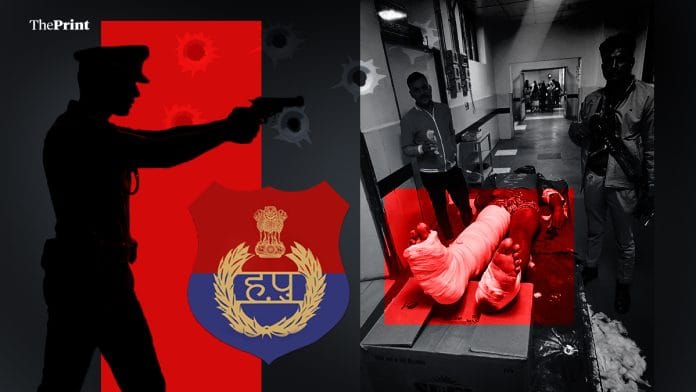



Gurugram: Around 3.30 am Thursday, a suspect was shot on both legs. Police said they retaliated after he opened fire on a Crime Investigation Agency (CIA) team that had cornered him on Beri Road in Rohtak.
A bullet, CIA-1 in-charge Kuldip said, hit the chest of an assistant sub-inspector, who was luckily wearing a bullet-proof jacket. The accused, wanted in connection with firing at a liquor vend, was rushed to Community Health Centre (CHC), Sampla, for treatment.
The Rohtak firing may seem like run-of-the-mill police action. But there have been several such instances, allegedly involving gangsters and extortionists, many of whom have been arrested with gunshot injuries on their lower limbs.
On late Tuesday, a Rajasthan man allegedly snatched a pistol from a police officer and fired during an arms recovery exercise in Faridabad’s Pali. He is currently being treated at a hospital.
Last week, two alleged extortionists and their accomplices were taken into custody in Yamunanagar. The two key suspects were injured too.
Similar operations were reported in Fatehabad’s Tohana, where two suspected members of the ‘Boxer gang’ were cornered, and in Gurugram’s Sohna on 4 February.
Then, on 31 January, an accused was shot in the leg and another suffered a fracture while allegedly trying to escape from police custody in Gurugram.
State sanctioned?
Haryana Police, especially in Gurugram and Fatehabad, has been regularly posting photographs of these injured accused on social media—men lying on hospital beds with bandaged legs.
The images are accompanied by details of arms recovery and criminal histories of the suspects–apparently intended to send a message that the force is striking hard against suspects. The captions underline “decisive action” of the police.
In a social media post on 9 February, Haryana Minister Krishan Bedi spoke of this practice openly.
The Facebook post featured a news clipping with the text, “Koi gunda meri behan, beti, mere vyapari bhai, mere mazdoor va kamzoor varg ki taraf aankh utha ke dekhega, toh uski pindi mein aar paar suraakh hoga (roughly translated to–any criminal who dares to disturb my sisters, daughters, traders, workers or the disadvantaged will have a bullet mark on their calves),” the minister, who is the MLA from Jind district, said.
On Republic Day, Deepak Gulia of Haryana Police’s CIA, who is often called “encounter specialist” by his colleagues, was feted with a bravery award by the state government. The award’s citation said that he spearheaded 14 encounters.
A Haryana Police spokesperson told ThePrint that since January 2025, 18 criminals were killed and 221 injured in 162 encounters. Haryana Police, as a rule, retaliates only in self-defence, the spokesperson asserted.
The trend doesn’t appear to be new.
On 1 September last year, then Director General of Police Shatrujeet Singh Kapur said at a law and order review meeting that Haryana Police had carried out 110 encounters since 1 January 2024.
This police action resulted in the deaths of 13 suspects and injured 156 others. Kapur praised the police’s courage and urged the force to keep up the momentum.
A few days before that, Chief Minister Nayab Singh Saini had presented the same set of data before the state Assembly, highlighting that it was part of the drive against gangsters who had fled abroad.
Action is ‘language that criminals understand’
Police encounters have drawn praise from some unlikely groups.
Bajrang Dass Garg, president of the Haryana Pradesh Beopar Mandal, said: “Hardly a day passes when someone or the other doesn’t receive a ransom call in Haryana. Even today, Meham’s former MLA Balraj Kundu has lodged a police complaint regarding a ransom call,” Garg, who is also the Congress Hisar President, told ThePrint.
“I would simply put it this way—police must speak to the criminals in the language they understand, so that peace-loving people can live without fear and the traders can do business without fear of extortion,” he added.
But there have been obstacles too.
In mid-January, a police team claimed to have exchanged gunfire with four miscreants, one of whom was shot in the leg, in Jhajjar. The injured man later turned out to be the son of a BJP functionary from Dighal village.
Calling the encounter “fake”, the BJP functionary alleged that his son had an altercation with policemen at a hotel, after which he was picked up and shot in the leg while police pinned him down.
A Special Investigation Team (SIT), subsequently formed to look into the allegations, concluded that the incident was a “mistake of fact”. The two men, including the injured, detained in the case were released on court orders after the police filed an application admitting its error.
Voices critical of such action have suggested that “half-encounters”—as they are known in police and criminal circles—are inspired from Uttar Pradesh.
Last month, the issue of encounters in UP reached the Allahabad High Court, which expressed strong displeasure over similar practices and observed that UP police officers appeared to be firing bullets below the knee for “appreciation, premature promotions and social media applause”.
The court warned the force that SP, SSP and police commissioners would be held personally liable for contempt if Supreme Court guidelines on encounters were violated, and reiterated that punishment is the job of the judiciary, not the police.
What SC guidelines & experts say
The Supreme Court’s 2014 judgment in People’s Union for Civil Liberties (PUCL) v. State of Maharashtra laid down 16 binding guidelines to stop ‘fake’ encounters and ensure that every police firing that causes death or serious injury is probed transparently and independently.
That includes handing the probe to an independent team, mandatory magisterial inquiry, prompt report to the State or the National Human Rights Commission, surrender of weapons for ballistic and forensic tests, provision of immediate medical aid with magisterial recording of statements if the injured can speak, and a strict bar on instant gallantry awards or promotions until an inquiry clears the officers.
Even in cases of non-fatalities, the top court has repeatedly said that the safeguards apply “as far as possible” to those grievously hurt.
Retired IPS Prakash Singh, who headed the Border Security Force, Uttar Pradesh and the Assam Police, told The Print that it is not about the number of incidents where the criminals have sustained gunshot wounds in the legs, but it is about whether the police are following the guidelines or not.
“The Supreme Court guidelines are very clear and elaborate. The question is whether the Haryana Police has been following them or not. So far as the UP Police is concerned, it has always maintained that it has been following the guidelines and holding the mandatory magisterial inquiry in all such cases,” Singh said.
Former Haryana Police chief K.P.Singh said the law empowers police to use force in their pursuit to arrest criminals. The prerogative, he stressed, was the use of minimum force to carry out arrests.
“When police shoot a criminal in the legs, the purpose is to incapacitate so that he can’t retaliate or escape. This has been happening in the past, too, and there is nothing new in this,” Singh said.
He, however, added that in case the trend has increased, it was a matter of investigation.
(Edited by Tony Rai)
Also Read: Hillock butchered, HC tears into Haryana govt for ‘environmental plunder’ at Charkhi Dadri mine
There is a grammatical error in the headline. ‘Haryana police uses’ is incorrect. It should be ‘Haryana police use’.
Honestly I am okay with it. Mumbai saw this when gang violence was so rampant that it became normalized. To curb this, we have “special” powers to police to basically kill anyone who is associated with gangs.
Now did some innocents get caught in this mess ? Yes. But did Mumbai became safe after this whole war? Absolutely. Probably one of the safest big cities right now.
Let this continue until you see a complete reversal in trends. Safety and security is important for a growing economy otherwise it spooks the businesses. Which is why Bihar couldn’t get started with industrial development.