





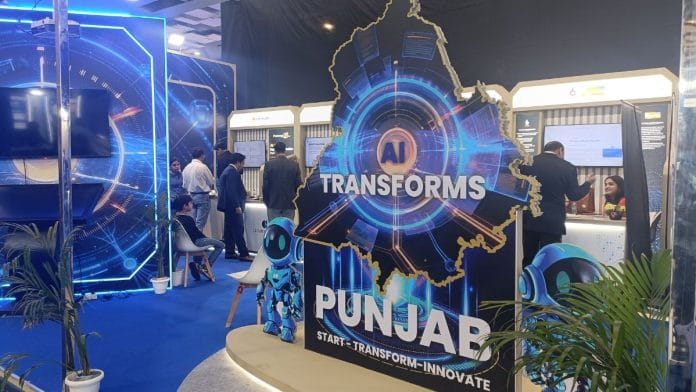



New Delhi: The AI Impact Expo 2026 at Bharat Mandapam in New Delhi featured stalls and pavilions from more than 15 Indian states, showcasing their innovation and development of artificial intelligence applications. The exhibition is part of the AI Impact Summit 2026.
As Indian states move ahead with developing AI policies, establishing data centres and AI cities, ThePrint visited some of the state pavilions to understand their innovation.
Karnataka
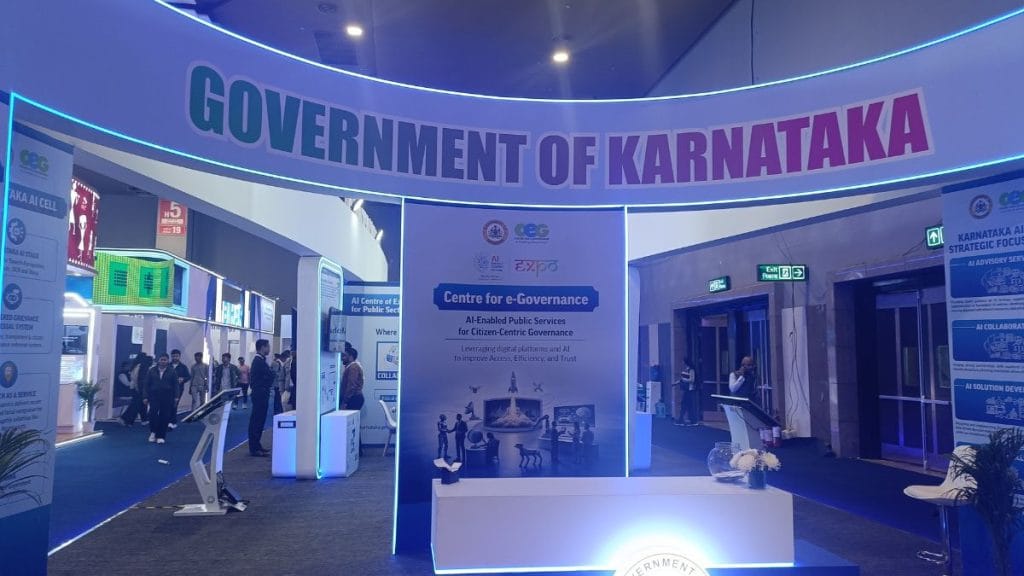
The Karnataka government’s pavilion greeted visitors at the entrance of the expo area, where the state’s Centre for E-Governance and Karnataka AI cell had set up their stalls. The Centre for E-Governance (CEG), a decade-old body, is an organisation under the Karnataka state government’s Department of Personnel and Administrative Reforms.
The Karnataka AI cell, one of the first such initiatives in the country, was formed in 2025 in CEG. While the state does not have a dedicated AI policy yet, the government is making strides in integrating AI into its functioning.
“The AI cell started with one question—how can we use AI to improve public service delivery, across all government departments?” explained T Bhoobalan, CEO of CEG. “It is meant for AI advisory, capacity building, collaborations, and even building in-house AI solutions.”
Kartavya, a facial recognition system, was developed by the AI cell and is used by the state government offices for marking attendance—a step ahead of simple biometrics. Another similar system, called Nirantara, was developed for schools and colleges to register attendance easily. The software works using group photographs of the class, so that teachers only need to click one photo and mark attendance for the day.
Other systems include Saaramsha, which is an AI-based summarisation tool for government orders and documents, helpful for both citizens and the public. A grievance redressal chatbot has also been developed to connect citizens to government platforms. It can collect and file a complaint with the right department. All citizens have to do is click a photo, type or send a voice note describing their grievance.
Bihar
Displaying the first-ever AI-integrated, e-voting initiative in the country, Bihar’s pavilion drew huge crowds. The State Election Commission of Bihar had a small booth where the team explained how they tested the system in the Nagar Palika (municipal) elections in 2025.
With AI-based face recognition models and OCR counting systems, they developed an app through which elderly, pregnant, disabled and migrant voters could register and vote in municipality elections without going to their respective polling booths.
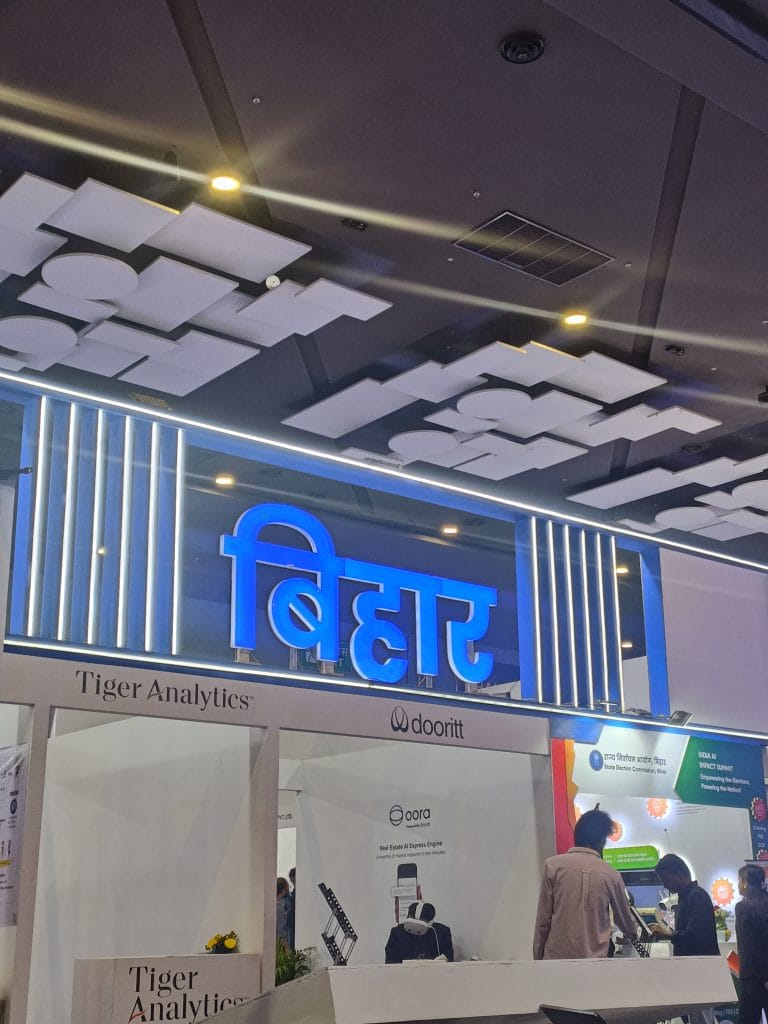
Along with this electoral initiative, the stall also featured start-ups like OORA.ai, a real-estate search engine powered by AI. It was marketed as the “world’s first real estate AI companion” to help people sort through properties and prices using an AI model.
Gujarat
Gujarat’s pavilion featured unique AI systems developed to tackle typical Indian problems, such as stray cattle on roads. In collaboration with private company DSW, the state government is working on an ‘AI-powered stray cattle intelligence’ platform that would help track, identify and remove stray cattle from roads.
According to a prototype of the model displayed at the state’s booth, the platform would allow people to ‘register’ new cattle that they see on the roads onto an integrated platform, which would then alert city authorities. Right now, as part of the ‘Smart Cities’ endeavour, the Ahmedabad Municipal Corporation identifies stray cattle through unique RFID tags, but has to manually click pictures of them on roads and then identify them.
The new AI-powered system would make this process more efficient.
Odisha
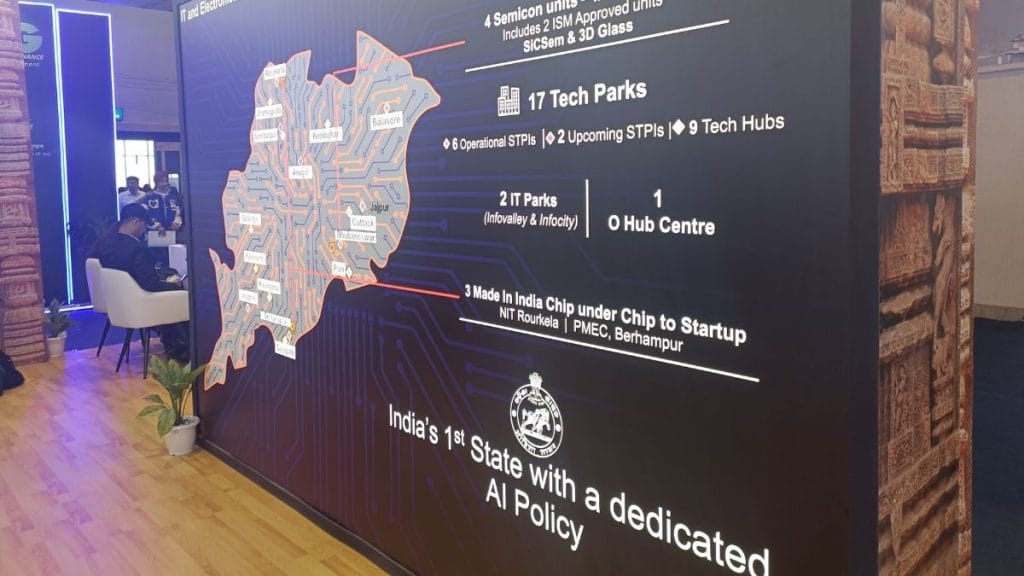
As the first state to have a dedicated AI policy, Odisha’s pavilion focused on its initiatives and tie-ups with private AI start-ups in fields such as forest management, agriculture, health, education and governance.
The pavilion was peppered with small booths from leading AI start-ups like Sarvam.ai, Wadhwani.ai, and Kudrat.ai, which have all either signed MoUs with the state or have embarked on projects with Odisha’s government departments.
Kudrat.ai, for example, has developed an AI-focused, sensor-based camera which can detect and identify movements by animals and humans in forested areas. As a pilot project, their cameras were deployed in the Simlipal Tiger Reserve in Odisha. According to their representatives at the booth, these cameras have busted more than 150 poachers and reduced poaching incidents by 80 per cent in the reserve.
Meanwhile, Sarvam.ai and the state government—which signed an MoU on 6 February—are working to develop a sovereign ‘AI Park’ in the state. The AI park, which will be a 50MW facility, is supposed to focus on integrating AI into Odisha’s main sectors—mining, heavy industries, and skilling. Sarvam will facilitate this hub by developing an entirely sovereign AI model for the state, trained on Indian data, with Odia-to-English facilities.
Uttar Pradesh
One of the biggest pavilions at the exhibition was showcased by Uttar Pradesh. It featured various governance and other AI-based startups as well as its plans for Lucknow as an ‘AI City.’
The Puch AI startup featured prominently in their booth, and it was designed as a ChatGPT-like large language model, but meant ‘for Indians’. As a voice-first LLM which supports both Indian languages and accents, the Puch AI product was marketed as ‘AI for Billions’.
Meanwhile, Noida-based EkVayu Tech demonstrated its anti-phishing technology called PhishAegis to protect against email attacks. The technology uses AI and machine learning to directly block phishing emails in real-time.
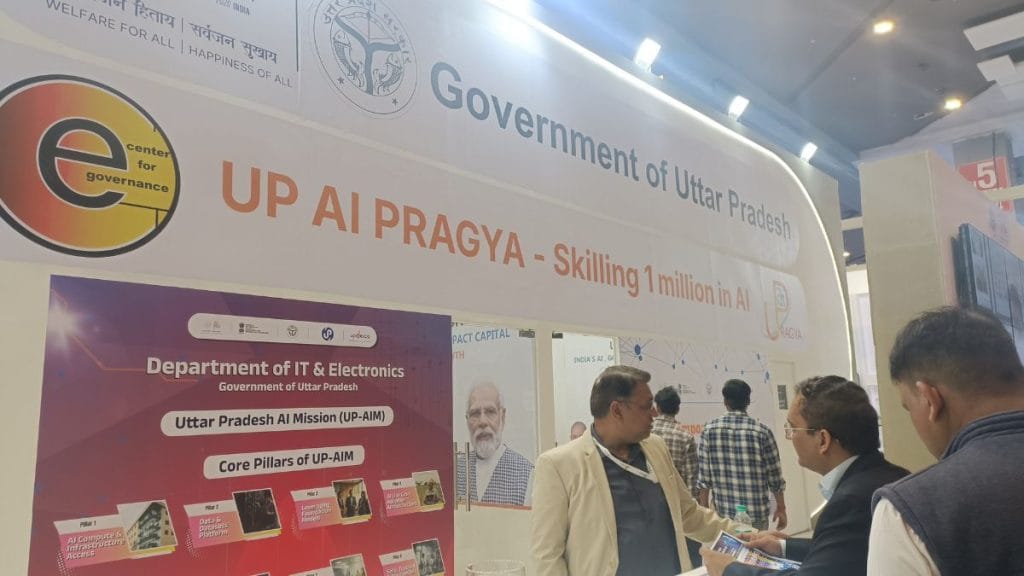
Apart from these, governance and police-focused AI startups also displayed their products. For instance, Staqu, founded 10 years ago, provides AI-based image and video analysis, speaker identification and speech recognition, making it useful for governance and policing.
Staqu showcased how their technologies are used by the UP Police to identify ‘persons of interest’ through voice recognition, and it is also used for data collection and analysis.
Their AV software JARVIS, which is enabled in CCTV cameras, was also used during the Ram Mandir inauguration ceremony by the Ayodhya Police to conduct facial recognition of suspicious visitors and miscreants, as well as suspicious vehicle identification, by integrating with the police’s criminal database.
(Edited by Saptak Datta)