





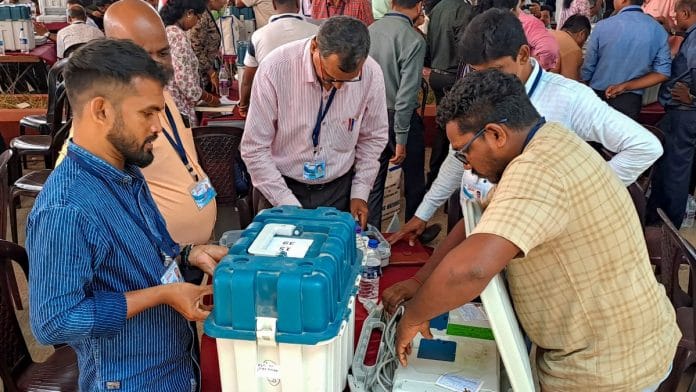



New Delhi: A working paper from the Economic Advisory Council to the Prime Minister (EAC-PM) estimates that holding Lok Sabha and state assembly elections simultaneously would reduce polling personnel deployment by 28 per cent—or 26 lakh people—over a five-year election cycle. Translated into days, accounting for two training sessions and two days of deployment per person, that is 1.04 crore polling personnel-days saved over five years.
The paper, authored by EAC-PM member Sanjeev Sanyal and Joint Director Satvik Dev, arrives on the same day—Wednesday—that the Lok Sabha extended the tenure of the Joint Parliamentary Committee examining the One Nation, One Election bill, giving it time till the first day of the last week of the Monsoon Session of 2026 to submit its report.
India’s election machinery draws polling officers primarily from state government employees, the largest pool being schoolteachers. Most polling stations are set up inside school buildings. Each election requires teachers to attend two training sessions and be deployed for at least a day before polling and on polling day itself.
As per Election Commission of India (ECI) data, approximately 70 lakh polling personnel and election staff were deployed for the 2019 Lok Sabha elections alone—and that was just one election in one cycle that also saw multiple state elections across the country.
The ECI sets staffing norms by election type. A state assembly polling station requires one presiding officer and three polling officers. A Lok Sabha polling station requires one presiding officer and four polling officers. Hold both separately and each polling station consumes nine people across the two events. Hold them together—one presiding officer and five polling officers managing two EVMs at the same station—and six suffice. That is a 33 per cent reduction on paper.
The paper tests these benchmarks against actual deployment data from West Bengal’s 2016 assembly election, Tamil Nadu’s 2019 Lok Sabha election, and Odisha’s 2019 simultaneous election. The actual numbers match ECI benchmarks to within half a percentage point in each case, validating the model. As the paper puts it, “actual deployment of polling personnel does indeed follow the benchmarks prescribed by the ECI”.
Why 28%, not 33%
Three factors reduce the gross estimate.
The first is premature dissolutions. Between 1999 and 2024, covering five complete Lok Sabha cycles, state assemblies were dissolved early for political reasons 10 times—in Haryana, Goa, Gujarat, Manipur, Bihar, Karnataka, Jharkhand, Delhi, and Telangana. That averages two per five-year cycle.
Under simultaneous elections, the paper notes, “the dissolved assembly will have to be re-elected to serve a truncated ‘unexpired’ term till the next synchronised cycle, when it will be elected again simultaneously with the Lok Sabha”—meaning two elections instead of one, increasing rather than reducing personnel deployment for those states.
The second factor is, some states are already synchronised with the Lok Sabha. Andhra Pradesh, Odisha, and Sikkim have historically held assembly elections alongside the Lok Sabha. No savings accrue for these states.
The third is union territories without legislatures—Ladakh, Lakshadweep, Dadra & Nagar Haveli and Daman & Diu, Chandigarh, and Andaman & Nicobar Islands. These hold only Lok Sabha elections and have no assembly elections to consolidate.
To account for the variation in polling station numbers across states, the paper constructs a notional average state with 33,904 polling stations—derived by dividing the 10.51 lakh stations used in 2024 across 31 states and UTs with legislatures—and runs the adjustments through that baseline.
The net result: A reduction of 28 per cent, or “26 lakh polling personnel approximately for a 5-year election cycle”. Taking four days of obligation per person—two for training and two deployment days—”the net estimated reduction in personnel-days of polling officers under simultaneous elections is 1.04 crore for a 5-year election cycle”.
Security, EVMs, counting
The paper does not extend its estimate to security personnel. The ECI told the Ministry of Law and Justice in 2023 that simultaneous elections would require 50 per cent more Central Armed Police Forces (CAPF) companies compared to a standalone Lok Sabha election, because duties beyond polling station security—law and order, VVIP cover, EVM strongroom protection—scale up when two elections run together. Against that, separate state assembly security deployments would fall. The paper does not net these out, saying it is “difficult to come up with a single point estimate of the impact of simultaneous elections on deployment of security personnel”.
With regard to EVMs, simultaneous elections would reduce the number of first level check and commissioning rounds over five years but double the machines involved in each round. The net change in personnel-days is left unquantified.
There would be no reduction in counting personnel. ECI rules require, even under simultaneous elections, “separate counting tables and separate staff” for state and Lok Sabha votes.
The paper also specifies that the 28 per cent estimate applies only to the STEADY?? state—after the transition is complete. During the transition, states mid-term would hold elections twice: Once to finish their current term, and again at the synchronised cycle. That temporary increase in deployment, the authors note, involves “too many assumptions about how the transition is phased in”.
Status of One Nation, One Election
The idea of simultaneous elections is not new. India held its first four general elections—in 1951-52, 1957, 1962, and 1967—simultaneously with state assemblies. The cycle broke in 1968-69 when premature dissolutions of some state assemblies disrupted the synchronisation.
The proposal was revived in recent years, first through a Law Commission draft report in 2018, and then through a high level committee headed by former President Ram Nath Kovind, which submitted an 18,000-page report to President Draupadi Murmu in March 2024. In December 2024, Law Minister Arjun Ram Meghwal introduced the Constitution (129th Amendment) Bill, 2024 in the Lok Sabha, which passed it 269 to 198 before referring it to a 39-member JPC for wider consultation.
The Opposition INDIA bloc has objected to the One Nation, One Election Bill, arguing the government did not secure the required two-thirds majority for such a measure. The JPC, chaired by P. P. Chaudhary, has been consulting legal experts, former election commission members, and other stakeholders. Its deadline has now been extended to the Monsoon Session of 2026. Implementation, if it happens, is expected no earlier than 2034.
(Edited by Viny Mishra)
Also read: ONOE—Ex-CJIs say bill ‘may not’ violate basic structure of Constitution, but question powers to EC
We should have 1 nation – 3 elections.
2 sets of state elections during 5 year period between general elections.
Half the states together, 1.5 years after general election, and other half at 1.5 years before the next general election.
There should be a way to gauge the mood of the nation, during the 5 year period, while having fewer elections.