





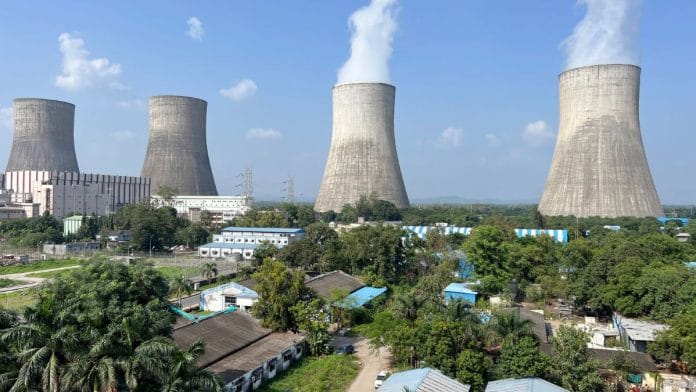



New Delhi: In what is expected to give a big fillip to India’s civil nuclear capacity and help meet its target of producing 100 GW energy by 2047, the Modi government has introduced an overarching law in Parliament today that proposes to open up the entire range of nuclear business to the private sector for the first time.
The umbrella bill will repeal the Atomic Energy Act 1962, which prohibited participation of private players in the nuclear sector, and the Civil Liability for Nuclear Damage Act, 2010 (CLND), where provisions including the nuclear operators’ right to recourse had become a big stumbling block for private companies to take up projects in India.
The Sustainable Harnessing and Advancement of Nuclear Energy for Transforming India (SHANTI) Bill 2025 has also removed the supplier’s liability clause from the provision on the operator’s right to recourse and proposes a “pragmatic” civil liability regime for nuclear damage.
The 2010 CLND Act provided the right to recourse to operators in three scenarios—where it is expressly provided for in a contract in writing; where the nuclear incident has resulted as a consequence of an act of the supplier or his employee, which includes supply of equipment or material with patent or latent defects or sub-standard services; and where the nuclear incident has resulted from the act of commission or omission of an individual done with the intent to cause nuclear damage.
The SHANTI Bill has removed the supplier’s liability and states that the operator’s right to recourse against the supplier will now be based on what is specified in the contract signed between the two parties. The earlier provision had created apprehension among suppliers and was seen as one of the main reasons that private players stayed away from investing in the nuclear energy sector in India.
Once it is enacted, the SHANTI legislation is expected to pave the way for India to meet its clean energy goal. India currently generates 8 GW nuclear power, which is just 1.6 percent of the total energy mix.
The Bill proposes to strengthen the implementation of security safeguards, clearly specifies the conditions where a nuclear operator is liable for damages in case of an accident, and provides for establishing the Atomic Energy Redressal Advisory Council to facilitate settlement of disputes.
It spells out the limits of liability of the operators for different categories of nuclear installation and proposes that the maximum amount of liability of a nuclear operator in case of a nuclear incident shall be the rupee equivalent of 300 million “Special Drawing Rights” (about Rs 3,000 crore).
Special Drawing Rights are an international reserve asset created by the International Monetary Fund, the value of which is determined and allocated by it to the member countries.
Stringent penalties have been proposed for any person involved in breach or violation of the law. The penalty varies from Rs 5 lakh for minor breaches and up to a maximum of Rs 1 crore for severe violations. ThePrint has reviewed the bill that was circulated to Members of Parliament post midnight Sunday.
“The new legislation is aligned to achieve the objectives of increasing the share of nuclear energy in the total energy mix of India, facilitate innovation in nuclear science and technology, expand its applications to non-power applications and continue to honour India’s obligations towards safety, security, safeguards and towards nuclear liability,” states the text of the bill.
Only for pvt firms established or registered in India
The bill proposes that besides government-owned or government-controlled department/institution/corporations, any company under Section 2(20) of the 2013 Companies Act shall be eligible to apply to the central government for a licence to build, own, operate or decommission a nuclear power plant or reactor. However, private companies incorporated outside India will not be allowed.
Private companies can also apply for a licence for fabrication of nuclear fuel including conversion, refining and enrichment of uranium-235 up to such threshold value, or production, use, processing or disposal of other prescribed substances, as may be notified by the Centre.
They will also be allowed transportation or storage of nuclear fuel or spent fuel, import or export, acquisition or possession of nuclear fuel or prescribed equipment, any technology or software, that may be used for the development, production or use of nuclear energy.
Research, development and innovation activities will, however, be exempted from licence. The bill states that source material and fissile material in any form, produced within India or imported, will remain under the surveillance and control of the Centre for the purposes of accounting; and shall be subject to such safeguards as may be specified by the government.
Besides applying for licence, any person who seeks to manufacture, possess, use, export, import, transport, dispose or transfer by sale or otherwise, any radioactive substance and radiation generating equipment establish, operate or decommission a radiation facility or undertake associated activities, will need to obtain a safety authorisation from the Atomic Energy Regulatory Board.
The Centre will have the power to suspend or cancel the licence and authorisation over violation of prescribed conditions.
The Centre will also be solely involved in mining and processing of certain source material in onshore or offshore areas containing uranium and thorium. The decommissioning of such mines shall also be carried out only by the government.
Liability of the operator
The bill mandates that the operator of the nuclear installation shall be liable for nuclear damage if a nuclear incident has occurred in that nuclear installation, or during the transportation of the nuclear material from that installation.
An operator, however, will not be liable if a nuclear incident leading to damage to the installation has been caused due to a “grave natural disaster of an exceptional character” or an act of armed conflict, hostility, civil war, insurrection or terrorism.
In case more than one operator is liable for nuclear damage, the liability of the operators involved will not exceed the extent of liability specified in the Second Schedule.
The central government will be liable for nuclear damage in respect of a nuclear incident where the liability exceeds the amount of liability of an operator specified in the Second Schedule.
The Centre can also assume full liability for a nuclear installation not operated by it if it is of the opinion that it is necessary in the public interest to do so. A Nuclear Liability Fund will be established.
The Bill mandates that before operation of nuclear installation, an operator will have to obtain an insurance policy or other such financial security or a combination of both, covering the liability specified in the Second Schedule that spells out the limits of liability of the operators for different categories of nuclear installation.
For instance, in nuclear installation with reactors having thermal power up to 150 MW, the limit of operator liability has been fixed at Rs 100 crore. The liability goes up to a maximum of Rs 3,000 crore for reactors of thermal power over 3,600 MW.
The Bill also lays the onus on the operator to renew the insurance policy or other financial security when required.
Right of recourse & Nuclear Damage Claim Commission
An operator of the nuclear installation, after paying the compensation for nuclear damage, will have a right to recourse where such right is expressly provided for in a contract by an individual with the intention to cause nuclear damage.
An individual can claim compensation for damage in a host of cases including if the nuclear damage has occurred within the territory of India, in or over the maritime areas beyond the territorial waters of India, on a ship registered in India under the Merchant Shipping Act 1958 or under any other law in force at the time.
“Whoever suffers nuclear damage shall be entitled to claim compensation in accordance with the provisions of this Act,” the Bill states.
For adjudicating claims for compensation in respect of nuclear damage, the central government has been empowered to designate one or more officers not below the rank of Joint Secretary to the Government of India, as Claims Commissioner, within thirty days of the date of notification of the incident.
This is an updated version of the report.
(Edited by Viny Mishra)