








New Delhi: A Parliamentary Standing Committee has recommended that the Unique Identification Authority of India (UIDAI) conduct efficiency audits, explore public-private partnerships for technology upgrades, and publish transparent reports on fund utilisation. This comes after the panel found that the authority was allocated Rs 572.41 crore for 2026-27 against its stated requirement of Rs 2,272.10 crore.
The Twenty-Fourth Report of the Standing Committee on Communications and Information Technology on Demand for Grants, tabled in Parliament Monday, notes that the Ministry of Electronics and Information Technology (MeitY) told the committee that UIDAI “will meet the excess expenditure from its internal resources”—a formulation the committee examined at length before issuing its recommendations.
The committee, headed by BJP MP Nishikant Dubey, called on UIDAI to use “performance-based funding requests” to make the case to MeitY for higher allocations, recommended that Direct Benefit Transfer expansion be “aligned with authentication reliability”, and said that “cost-benefit analysis must guide every new initiative”. It also recommended that UIDAI “collaborate with state governments for shared infrastructure”.
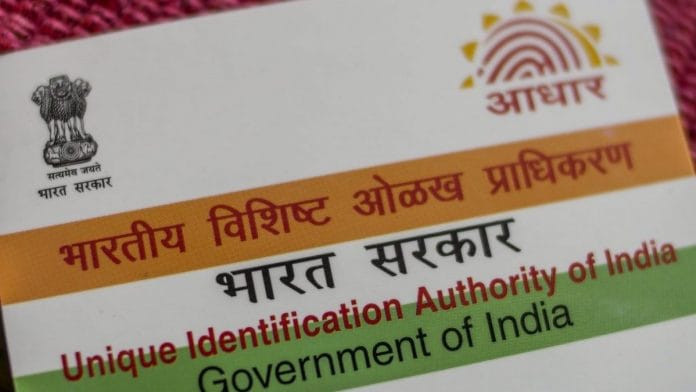
UIDAI is a statutory authority established by Government of India under MeitY. It is responsible for issuing a unique identification number called Aadhaar to all residents of India. The Aadhaar card is a 12-digit unique identity number linked to an individual’s biometric and demographic data, which is stored in a centralised database.
The funding allocated to UIDAI at the Budget Estimates stage has declined over successive years—from Rs 1,110 crore in FY 2022-23 to Rs 940 crore in FY 2023-24, Rs 600 crore in each of FY 2024-25 and FY 2025-26, and Rs 572.41 crore for FY 2026-27. UIDAI’s stated requirement, meanwhile, has moved in the opposite direction. The authority projected a need of Rs 2,272.10 crore for the upcoming financial year, against Rs 700 crore projected in 2025-26.
UIDAI generates revenue through authentication charges levied on entities—banks, telecom companies and government departments—that use Aadhaar-based verification services. As of November 2025, the system had processed 16,570.25 crore cumulative authentication transactions and 2,681.91 crore e-KYC transactions. A portion of fees from these transactions constitutes UIDAI’s internal revenue. The ministry has not specified publicly what share of UIDAI’s total expenditure is met through this route as against government grants.
The committee’s call for transparent fund utilisation reports would, if acted upon, make that breakdown publicly available.
Also Read: UIDAI covers mandatory biometric update for students in over 1 lakh schools
Extensive agenda
UIDAI’s agenda for 2026-27, as submitted to the committee, is extensive. The authority has set a target of achieving 70 percent e-KYC biometric authentication across transactions, enabling State Cooperative Banks and District Cooperative Banks to leverage Aadhaar-based payment services, and completing the migration from L0 to L1 iris-registered devices, which use Trusted Execution Environment technology for hardware-based protection against spoofing.
The API integration with the Registrar General of India for deactivation of Aadhaar numbers of deceased persons, the ministry told the committee, remains “under progress”.
Among the targets listed in the report for the next five years is the clearance of a pending biometric update backlog of approximately 17 crore cases. Under UIDAI rules, children enrolled in Aadhaar as infants are required to update their biometrics at ages five and fifteen, when fingerprints and iris patterns have stabilised.
The authority told the committee it plans to address this pendency “in a phased manner over a period of next five years”. To bring down the numbers, UIDAI has been conducting targeted camps and has waived mandatory biometric update charges for the 7-15 age group for one year from October 2025.
Online verification of documents remains a challenge. The ministry told the committee that legacy documents issued by several states and Union Territories are still not digitised, do not carry QR codes, or are not available on API Setu—the government’s API integration platform. The UIDAI CEO has written to chief secretaries of all states and UTs directing them to issue documents in digitised, QR-coded format and make them available on API Setu.
As of December 2025, UIDAI had generated 143.50 crore Aadhaar numbers against a projected population of 143.50 crore, with the number of estimated live Aadhaar holders standing at 134.45 crore. Enrolment, the Ministry noted, is an ongoing activity, with the difference between total generated and live Aadhaar accounted for by deaths.
The committee has asked to be kept informed of progress on all counts.
(Edited by Nardeep Singh Dahiya)
Also Read: EC’s proposed consultations with UIDAI to ‘clean up’ voter lists acceptance of our charge: Congress