





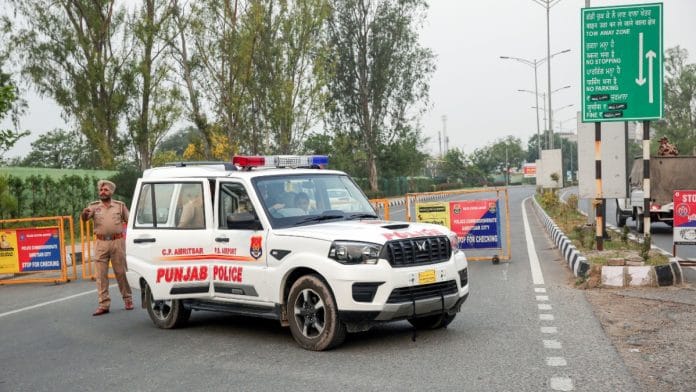



Chandigarh: A series of cold-blooded killings in Punjab over the past few months has put the spotlight on a striking paradox—a state that boasts the highest number of director general of police (DGP)-rank officers in the country, still facing a major law-and-order crisis.
Opposition parties and former police officers attribute the crisis to a combination of factors—a top-heavy police structure, a throwback to the militancy era; a shortage of officers at the field level; and the absence of a regular DGP appointed through the Union Public Service Commission (UPSC) process.
Facing increasing flak from the Opposition, Chief Minister Bhagwant Mann called a special meeting of the police top brass Saturday to discuss the law-and-order situation.
Punjab has 17 DGP-rank officers—from the 1989 batch to the 1994 batch—the highest for any state. Apart from this, one DGP-rank officer from the Punjab cadre, Parag Jain, is heading the Research and Analysis Wing (R&AW).
Six of the 17 DGP-rank officers are slated to retire next year, but that will not bring the numbers down, as five of the seven 1995 batch officers will be eligible to be promoted to the rank of DGP by the end of this year.
Punjab BJP chief Sunil Jakhar told a press conference earlier this month that police have lost control, despite the force being served by 17 DGPs. He said that some in the police were actually “gangsters in uniform”.
Leader of Opposition and Congress MLA Partap Singh Bajwa also took on the Aam Aadmi Party (AAP) government over the recent spate of killings. “Extortion calls in Punjab are the new normal,” he told ThePrint last month.
Also Read: From militancy victim to a life of crime — who was Sukhdool Singh, gangster slain in Canada
Unabated killings
Punjab has witnessed a series of high-profile killings over the past two months.
On 15 December, 30-year-old kabbadi player Kanwar Digvijay Singh, also known as Rana Balachauria, was shot dead during a tournament in Mohali. Two days later, main suspect Harpinder, also known as Middu, was killed in an exchange of fire with the Punjab Police in Mohali.
Two weeks before that, gang members led by Shubham Mota and his rival, Ankur, exchanged fire during a wedding at Ludhiana’s Bath Castle Resort on 1 December. Two guests were killed in the incident.
November too saw several killings. On 27 November, unidentified bike-borne shooters fired multiple rounds at the house of AAP leader Daljit Raju Darvesh in Phagwara. Later, a note demanding Rs 5 crore was found.
In Amritsar district, 65-year-old shopkeeper Manjit Singh was shot dead in the Dhulka village on 16 November, allegedly after he refused to pay Rs 50 lakh in response to an extortion demand.
On 15 November, RSS leader Baldev Raj Arora’s 32-year-old-son Naveen Arora was shot dead in Ferozepur by motorcycle-borne assailants. The alleged main shooter, Badal, was later killed in an encounter.
Despite this increase in incidents of violence, Punjab DGP Gaurav Yadav said in a video message last week that the police force had maintained peace and harmony, resolving all reported terror incidents.
While providing a 2025 police report card, he added that as many as 416 criminal modules had been busted and 992 gangsters arrested.
He said there has been “a significant reduction” in incidents of “major crimes”. Murder cases were down 8.7 per cent, while kidnapping and abduction cases have fallen by 10.6 per cent, he added.
As for CM Mann, when he was asked about the law-and-order situation at a press conference on 16 December, he blamed the previous government for “allowing” criminal networks to take root.
He also issued a strong warning to criminals and gangsters, saying, “No gangster or criminal who is indulging in gun violence will be allowed to go scot-free. They will face serious consequences.”
DGPs galore, but no regular police chief
Though Punjab has only two sanctioned DGP cadre posts, it has the highest number of DGP-rank officers in the country because the government chooses to promote them against non-cadre posts.
Under India Police Service (IPS) cadre rules, officers become eligible for promotion on completing a certain number of years of service—30 for DGPs, 25 for additional director general of police (ADGPs) and 18 for inspector generals (IGs)—as part of a vertical tenure-based promotion system.
Most states follow stricter cadre management traditions and promote officers only when a vacancy arises in the cadre posts.
But in Punjab, officers are promoted almost immediately when a batch becomes eligible, regardless of whether there’s a vacancy. These offices are adjusted in non-cadre posts.
Cadre posts for IPS officers are sanctioned by the Central government in consultation with the state government, with a fixed number for each state. Non-cadre, or ex-cadre posts, are created by state governments, ideally on a temporary basis. These may or may not be occupied by IPS officers.
Despite having the highest number of DGPs in the country, Punjab does not have a regular DGP.
Incumbent Gaurav Yadav, of the 1992 batch, has been an officiating DGP since 2023 because the Punjab Police is yet to send a panel of candidates to the UPSC for the selection of a regular DGP. Yadav was chosen as the state DGP, superseding his several seniors.
1989-batch officer Sanjiv Kalra, the seniormost police officer in the state, is posted as the Commandant General of the Punjab Home Guards and Director of Civil Defence. He will be retiring in February.
Among the DGP-rank officers from 1992 and 1993 batches, only one is in charge of law and order. Others are heading different wings such as the Punjab Police Housing Corporation, the anti-narcotics task force, the community affairs division and women’s affairs, human resources and welfare division and railways police.
The officers from the 1994 batch who were promoted as DGPs in July this year are heading human rights, technical support services, security, the Vigilance Bureau and the intelligence wing, traffic and road safety, cyber crime, as well as the Punjab Police Academy.
ThePrint called Yadav for comment, but there was no response. This report will be updated if and when he responds.
Legacy of militancy
Senior officers say the Punjab Police remains top-heavy because of its legacy of decades of militancy.
“In the 1980s and 1990s, there was an acute shortage of senior officers as the number of those allotted to the Punjab cadre in the 1960s and 1970s was few. There were some years during those decades when not a single IPS officer was allotted to Punjab,” one of the DGPs told ThePrint on condition of anonymity.
“In 1980s and 1990s, a lot of officers were assigned to Punjab who are now at the top. As a result, Punjab has been a top-heavy police force for the past few years,” the officer added.
Gurinder Dhillon, a retired ADGP of Punjab, told ThePrint that promoting an entire batch when it is eligible is common in Punjab, leading to increased politicisation of the police force.
“In Punjab, it is common to have multiple officers promoted to non-cadre posts. IPS officers get upset when Punjab Police Service (PPS) officers occupy cadre posts meant for them at junior levels. For instance, there was a lot of hue and cry when PPS officers occupied cadre posts of SSPs meant for IPS officers. Many such officers occupying these positions have no work at all because these posts have been created for them,” said Dhillon.
“In the past 30 years, there has been a complete politicisation of the Punjab Police. Whether it is a throwback to the days of militancy or for any other reason, professional, scientific and practical policing has been replaced by political agendas,” said Dhillon.
Another officer told ThePrint on the condition of anonymity that the reason every officer eligible to be in the DGP-rank is promoted almost immediately in Punjab is that only a person holding the rank can be considered for the position of head of the police force.
“Despite the fact that ideally a DGP of a state is chosen from among the officers listed, by the UPSC, it is a practice not followed all the time. And it suits the politicians in power to have a larger list to choose from and play around with when a choice has to be made for the DGP. Officers, on the other hand, are happy that they have reached the pinnacle of their service,” he said.
ADGPs too abound
Apart from the 17 DGPs, Punjab also has 17 ADGP-rank officers, from the 1995 to 2000 batches. Of these, five are posted in the Centre, leaving a dozen ADGPs in the state. The sanctioned cadre strength for ADGPs in Punjab is only seven.
But, the state faces a shortage of Inspector Generals. Between the 2001 and 2006 batches, Punjab has nine IGs, of whom one was serving at the Centre. The sanctioned cadre strength at this level is 19.
Neighbouring Haryana, on the other hand, presents a picture which is in stark contrast to Punjab.
Though its size and population are comparable to Punjab, Haryana only has seven DGP-rank officers, ranging from the 1989 to 1993 batches. Two of these DGPs are set to retire by the end of this month, including the head of the police force, O.P. Singh. Another two DGPs will retire next year.
Haryana has 16 ADGPs from the 1994 to 1998 batches. Two of these from the 1994 batch are eligible to become DGPs but are yet to be promoted, while counterparts in Punjab have been promoted.
Haryana has 11 IGs from the 1999 to 2006 batches. Two officers of the 1999 batch and one officer of the 2000 batch are still serving as IGs in Haryana, while their counterparts in Punjab have become ADGPs.
(Edited by Sugita Katyal)
Also Read: Extortion calls a new normal in Punjab. Cops point fingers at Canada-based gangsters