





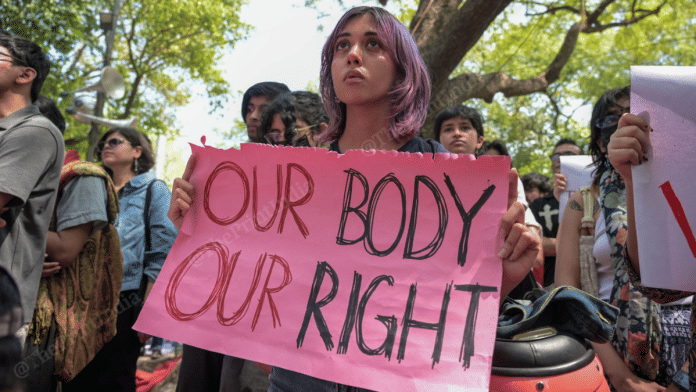



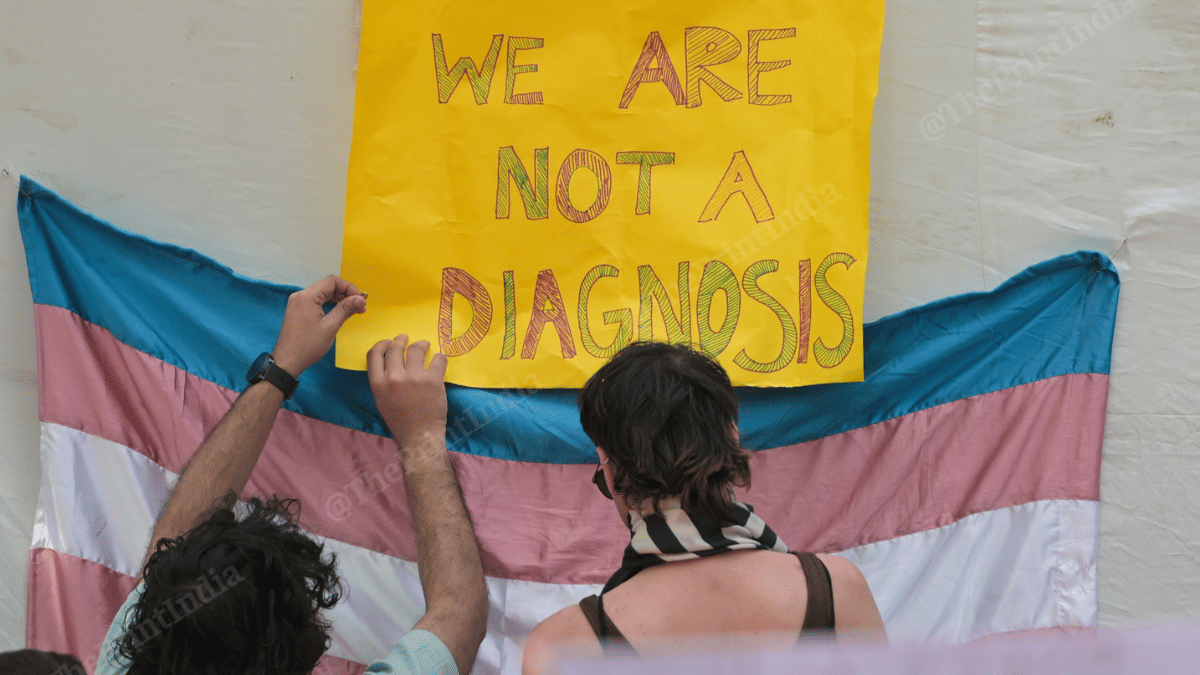
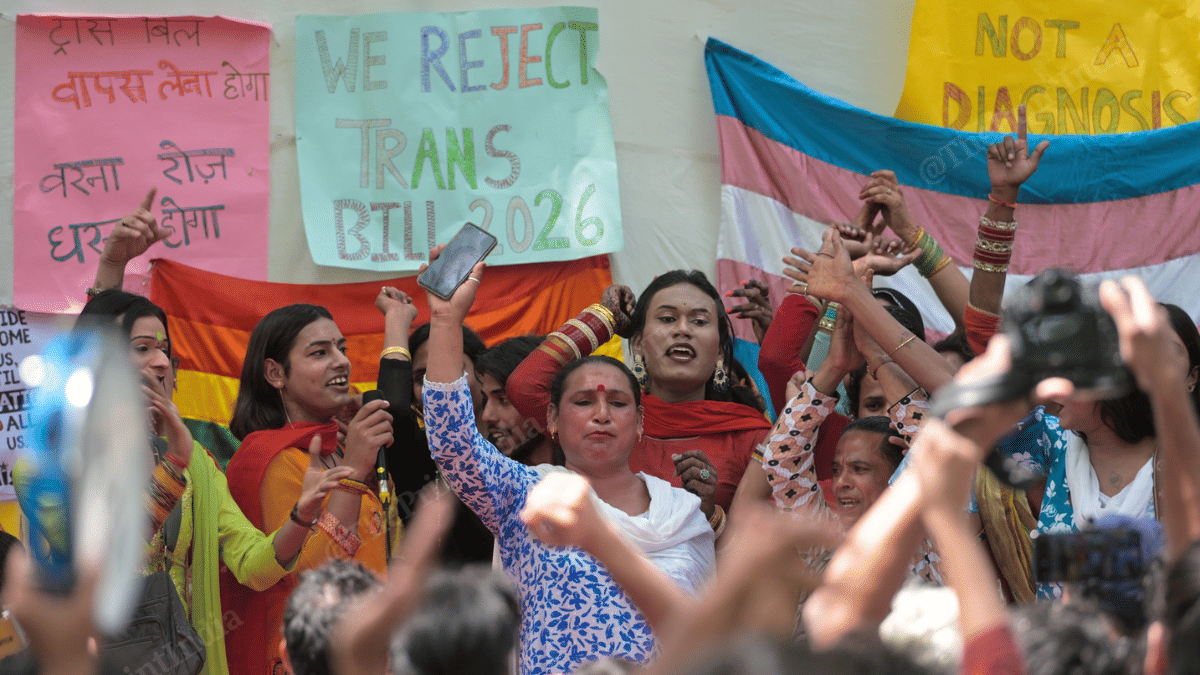
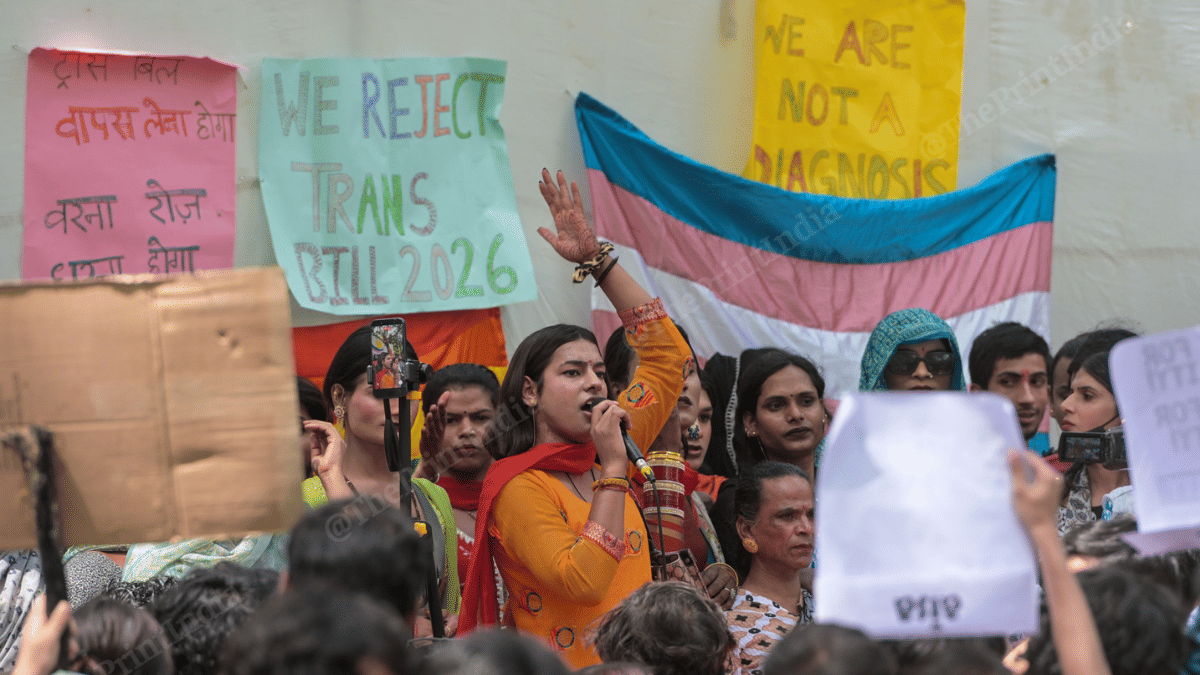
New Delhi: The atmosphere at Jantar Mantar in New Delhi on Thursday was one of grief and fury in equal measure. Hundreds of members of the transgender community—kinnars, hijras, as well as rights activists—had gathered to protest the Transgender Persons (Protection of Rights) Amendment Bill, 2026, which was passed by both Houses of Parliament allegedly without a single formal consultation with the people it claims to protect.
The protesters held placards, raised slogans, and spoke in voices that cracked with exhaustion and fear. Several people ThePrint spoke to described the proposed law not as protection, but an extinction notice.
The bill’s most consequential proposed change removes the right to self-perceived gender identity that the 2019 Act had guaranteed, replacing it with a certification process requiring recommendation from a medical board headed by a Chief Medical Officer, before a District Magistrate issues an identity certificate.
Kumkum, 60, a kinnar who has spent decades living and working on Delhi’s streets, had a simple demand. “We were living how we were before. Let us continue to live that way.”
She described a community that already feels consigned to the margins of survival, and fears the new law would embolden those who wish to push them them further. “If this passes, the police, who at least hesitate to touch us now—nobody will stop the goons who approach us. Society will not let us live. Where will we go?”
Mona said she was forced to leave her home at 15. She spoke with quiet devastation. “My parents threw me out. Society did not accept me. I stood on my own feet, lived as trans, earned my own living.”
Like many kinnars at the protest, Mona survives through sex work and begging— not by choice, she said, but because those are the few avenues a community abandoned by family and State is left with. “I do sex work, I beg, I fill my stomach. I don’t bother anyone, I don’t snatch from anyone. Our community has values. We know we have to live in this society.”
Fiza, 49, also a kinnar and a beggar, was incandescent on the medical board provision — one of the most contested elements of the new amendment. “The biggest problem is the medical board. Our ecosystem is not sensitive enough. These people will look at us naked and decide what we are? That is the greatest sin. You call yourself intelligent while committing this stupidity.”
“The government might as well give us poison to drink. This is not our fault — God made us this way. You did not make us. So what right do you have to strip us and examine our bodies to decide who we are?” she said.
Also Read: Transgender amendment bill drops self-perceived identity, adds penalties for coerced identity change
‘A bill passed in haste’
The Transgender Persons (Protection of Rights) Amendment Bill, 2026 was added to Parliament’s agenda through a supplementary business list, and it was introduced in Lok Sabha on 13 March.
The Bill also restricts recognition to individuals with specific biological or physiological characteristics, intersex variations, or socio-cultural identities such as kinner, hijra, aravani and jogta —effectively writing trans men, non-binary persons, and genderqueer individuals out of the law entirely.
The Lok Sabha passed the Bill on Tuesday by a voice vote amid a walkout by the Opposition. The Rajya Sabha followed on Wednesday, also by a voice vote, rejecting a DMK motion to refer the Bill to a Select Committee.
In both Houses, the government’s refusal to allow any committee scrutiny drew sharp criticism. Opposition MPs across parties—Congress, CPI(M), TMC, and others — argued the Bill dismantled self-identification rights protected by the Supreme Court’s 2014 NALSA judgment, violated the right to privacy upheld in the Puttaswamy ruling, and would deepen the marginalisation it claimed to address.
The government, for its part, leaned heavily on cultural references in the Ramayana and the Mahabharata in its defence of the Bill.
Institutional opposition
Parliament cleared the Bill even as institutional resistance was mounting.
Justice (Retd.) Asha Menon, Chairperson of the Advisory Committee appointed by the Supreme Court in the Jane Kaushik v. Union of India case, wrote an urgent letter to the Ministry of Social Justice on Wednesday— the day the Rajya Sabha took up the Bill—urging the government to withdraw it.
Multiple members of the National Council for Transgender Persons (NCTP), the statutory advisory body constituted under the 2019 Act, have now resigned. NCTP members had been invited to Delhi at the last minute on March 22, but the Minister for Social Justice did not meet them. The resignations, activists say, reflect the total democratic deficit in the process.
Lawyers, feminists, and civil society organisations have now written to President Droupadi Murmu urging her to invoke Article 111 of the Constitution and return the Bill to Parliament for reconsideration.
The letter, signed by members of the All-India Feminist Alliance (ALIFA) and the National Alliance for Justice, Accountability and Rights (NAJAR) — platforms associated with the National Alliance of People’s Movements — lists both procedural and constitutional “violations”.
It claims the government violated the Pre-Legislative Consultation Policy of 2014 by not undertaking any prior public or stakeholder consultation. It alleged Minister of Parliamentary Affairs Kiren Rijiju misled Lok Sabha in claiming extensive debate had occurred when none had.
It also highlights that the Bill’s omission of Section 4(2) of the 2019 Act — which guaranteed every person the right to self-perceived gender identity — directly violates the NALSA judgment’s holding that self-determination of gender is a fundamental right under Articles 14, 19, and 21.
The letter also flags a more “insidious” provision: the substituted Section 18, which criminalises compelling any person to “outwardly present a transgender identity.”
Read alongside the narrowed definition of “transgender person”, the signatories warn, this effectively treats self-determined transgender identity as the product of coercion or deception — and could be weaponised against the very community support networks that have served as informal safety nets in the absence of State protection.
The signatories — among them senior advocates from Bombay, Madras, Calcutta and Karnataka high courts, feminist historians, public health activists, researchers, and trans rights activists from across the country — urge the President, as “guardian of the fundamental rights of citizens,” to withhold assent.
The demanded the bill be referred to a Standing or Joint Parliamentary Committee for thorough consultation with transgender, intersex, non-binary, and genderqueer communities.
‘We have been legally erased’
On Thursday afternoon, a group of “trans men” held a press conference at the Constitution Club of India foregrounding their specific invisibility under the new law. The conference, titled Loss of Autonomy, Identity and Legal Erasure of Trans Men, brought together activists and researchers to highlight how the amendment’s redefined categories render trans masculine persons legally non-existent.
Transgender rights activist Dr. Laxmi Narayan Tripathi, who joined the conference, drew on one of the most resonant images of violated womanhood in Indian tradition to describe what the community is living through.
She said the community feels like the government has performed what she called a “vastraharan“, a public stripping of dignity, on them.
She claimed the proposed medical board would work as an instrument of state surveillance with no accountability, noting that district magistrates have no expertise or rightful authority over a person’s gender identity.
She raised the treatment of intersex children—abandoned on the road, she said, by families and by the State— as evidence of how little infrastructure exists for the medical board to function with any sensitivity. “If the President signs this and it becomes an Act,” she warned, “thousands of us will go to court”.
‘A very curated kind of citizenship’
Krishanu, a trans activist and researcher, told ThePrint the night the Bill passed the mood across the country was one of collective heartbreak.
“Last night, everybody was feeling very dejected and heartbroken in different ways,” Krishanu said. “It’s an entire environment of panic and chaos, especially for trans men who don’t see themselves as a part of this bill. What that does is erase your identity from being a citizen. It’s a very curated kind of citizenship.”
Krishanu was scathing about the ruling party’s parliamentary defence. “The BJP and their ally parties are talking only about two talking points — Ramayana and Mahabharata. We are not ready to be deified. You talk about the power of our blessings. How about our rights?”
Quoting Grace Banu, the trans rights activist and signatory to the President’s letter, Krishanu said. “You want our blessings but you don’t want to give us rights.”
Krishanu also drew attention to the caste dimensions of the issue, particularly for traditional kinnar and hijra communities. “These are also caste-coded communities. Their bodies are put in a certain place in the larger society — where can you go, where can you not go, what is your occupation. And this is exactly what this Act is doing. It is telling certain bodies where they can and cannot be.”
Protests, Krishanu added, have broken out in Kolkata, Kerala, Kozhikode, Tamil Nadu, Indore, and elsewhere. More than 88 statements have come in from queer and trans groups, feminist organisations, Dalit Bahujan groups, Adivasi organisations, and farmers’ movements.
“Across the board, people are saying how draconian and unconstitutional this Bill is.”
What comes next
The community is now mapping its legal strategy. Krishanu said consultations are underway across regions, identities, and socioeconomic backgrounds before a coordinated approach is finalised.
“Trans is a larger identity. Within that, people in this country come from various backgrounds — trans men, non-binary persons, people with disabilities, people from different regions. We have to take everyone into consideration,” Krishanu said.
On the legal front, Krishanu said, high courts are being considered alongside the Supreme Court. Petitions already in court relating to rights under the 2019 Act will be intensified. But the sharpest instrument they plan to deploy is contempt.
“The NALSA judgment is there, and this Bill negates it. If anything goes wrong administratively, we can go directly to court saying you are in contempt of the Supreme Court. Lots of contempt petitions is what we are hoping to file in the coming days,” Krishanu added.
The Bill now awaits President Murmu’s assent.
(Edited by Ajeet Tiwari)