





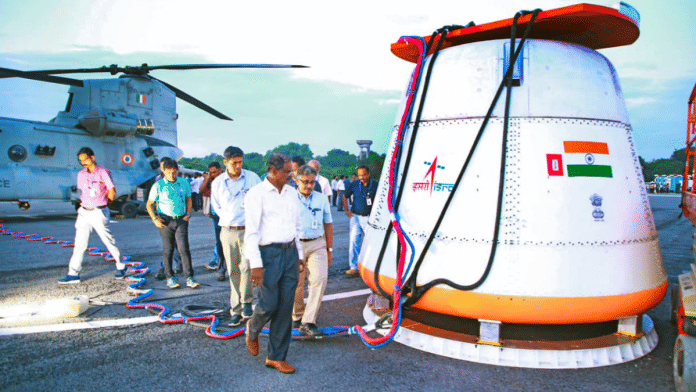



New Delhi: From the first uncrewed Gaganyaan mission to the first industry-made PSLV launch, Indian Space Research Organisation (ISRO) and the country’s space sector have an ambitious roadmap for the upcoming year 2026.
The year is expected to see some launches from the private sector, including Skyroot Aerospace’s Vikram-1, which will be the first rocket sent to Low-Earth Orbit (LEO) by a private Indian company.
On Wednesday, ISRO successfully launched the US-based private company ATS SpaceMobile’s BlueBird Block-2 satellite, the largest private communications satellite, in the Low-Earth Orbit. Launched aboard the Launch Vehicle Mark-3 (LVM-3), called the ‘Bahubali’ satellite, the mission further increased confidence in ISRO’s abilities for heavy-duty launches in the future.
“I can proudly say as an Indian, we’re rubbing shoulders with developed countries in the space sector,” said ISRO chairperson V. Narayanan told news agency ANI. “This success gives further confidence for going ahead with the Gaganyaan Mission.”
Gaganyaan uncrewed mission
The largest and most exciting event for ISRO is the first uncrewed Gaganyaan test flight, which will set the stage for the human spaceflight mission in 2027. Gaganyaan is India’s first human spaceflight mission, which plans to send three Indian astronauts to Low-Earth Orbit and back.
The uncrewed mission will be a test run before the actual launch. It will be an ‘end-to-end’ flight involving the humanoid robot Vyomitra, unveiled by ISRO in 2024. Vyomitra is a robot that will be used to test all human safety dynamics and contingencies in the Gaganyaan mission, to ensure it is accurate and safe for the three astronauts to travel.
Along with human safety measures, the uncrewed Gaganyaan mission will test other flight capabilities, including the rocket LVM-3, ISRO’s heavy-duty launch vehicle, as well as the aerodynamics of the spacecraft, re-entry of the modules, and the recovery of the crew module once it lands safely on the Earth.
Initially scheduled for 2026, the Gaganyaan mission was delayed as the ISRO team continued to work on ensuring the complete safety and reliability of all systems of the mission. There are expected to be two uncrewed missions in 2026 according to ISRO, and the final Gaganyaan mission is scheduled for 2027.
Also Read: A 65-day polar night has started in an Alaska town. What it is and how people cope
Industry-made PSLV and Ocean-Sat launch
2026 will also see the first-ever launch of the Polar Satellite Launch Vehicle (PSLV), built by industry players Hindustan Aeronautics Limited (HAL) and Larsen & Toubro (L&T), after receiving the contract from ISRO in 2023. The PSLV is a reliable, versatile launch system that was built by ISRO and has launched multiple missions, including Chandrayaan-1.
In a bid to bring in other stakeholders in space production and free up ISRO’s time to focus on R&D, the government decided to allow players like Hindustan Aeronautics Limited (HAL) to produce PSLV and supply it to ISRO.
The first such privately built PSLV is expected to launch in the first quarter of 2026 with the Oceansat-3A (EOS10). This Earth observation satellite is part of a series launched by ISRO that aims to study different parts of the land and sea to help with cartography, fishing, forest cover, weather monitoring and other functions.
Oceansat-3A will mainly help with oceanographic applications, and will be equipped with instruments like an Ocean Colour Monitor and Sea Surface Temperature Monitor to study marine ecosystems, ocean winds and coastal zone management.
Tech demonstration satellite
Another major plan is to launch a technology demonstration satellite, which is essentially a test bed for trying out new technologies for future space missions. The TDS-1, which is planned to be launched aboard a PSLV launch vehicle, will demonstrate three main kinds of technologies: a high Thrust Electric Propulsion System, an indigenous Travelling Wave Tube amplifier, and Quantum Key Distribution.
The first one is a type of propulsion system for rockets that uses electric power instead of chemical fuel, which will be more fuel-efficient and lighter for future missions.
An indigenous travelling wave tube (TWT) amplifier, on the other hand, is used in satellite transponders for communications with the Earth. By building an indigenous version of this technology, India will be reducing reliance on imports for communication satellites.
Finally, Quantum Key Distribution is a cutting-edge technology to share encrypted information and ‘keys’ using quantum technology, rather than normal encryption. This is a game-changing method for secure data transmission and communication, and is a ‘future-proof’ method. ISRO has already conducted some quantum key distribution experiments on the Earth at a distance of 300 m, but this will be the first satellite demonstration of this technology.
Private satellites, other launches
In the private sector, Skyroot Aerospace is close to launching its first rocket, Vikram-1, making it India’s first private company to have a launch vehicle with the ability to reach LEO.
Though the launch date for Vikram-1 has not yet been determined, the website confirms that it will launch in 2026. Vikram-1 is set to host customer satellites from national and international companies and launch them into the Low-Earth Orbit, thus providing a faster, cheaper option for companies to access the space through private satellites.
There are also other launches and space events, like the Indo-Mauritius Joint Satellite (IMJS), which will be aboard the industry-built PSLV. This IMJS is a mission that was approved in 2024, and an MoU was signed between the two nations.
While the cost of the satellite was borne by the Indian government, the satellite building process involved engineers from both ISRO and Mauritius Research and Innovation Council. It is expected that a small satellite with imagery capabilities will be launched by 2026.
(Edited by Tony Rai)
Also Read: What is NASA’s ESCAPADE mission to Mars? Twin satellites to study red planet’s magnetic field