








New Delhi: Deep in the dense forests of South Andaman, where the sea meets thick mangroves, the Onge have lived for centuries as hunter-gatherers—tracking animals barefoot, gathering honey, and surviving in near-total isolation from the modern world. Today, that life is beginning to shift in small but telling ways.
Raja and Jhaj, both in their 20s, grew up in isolation. Members of the Onge tribe—one of the world’s smallest indigenous communities with a population of around 250—they spent their early years hunting in forests and foraging along the creeks of Dugong (Tugong) Creek. Like many in their community, they had never held a formal job, opened a bank account, or received structured schooling.
But in 2025, their lives took an unexpected turn. They traded bows and arrows for khaki uniforms and police boots, becoming among the first members of a Particularly Vulnerable Tribal Group (PVTG) to join active field patrols as Home Guard volunteers in the Andaman and Nicobar Islands.
The transition has been as symbolic as it is practical. The same instincts that once helped them track animals now guide them through forest patrols alongside the police. “The jungle is their home. Their understanding of terrain is unmatched,” said a police officer posted in the islands.
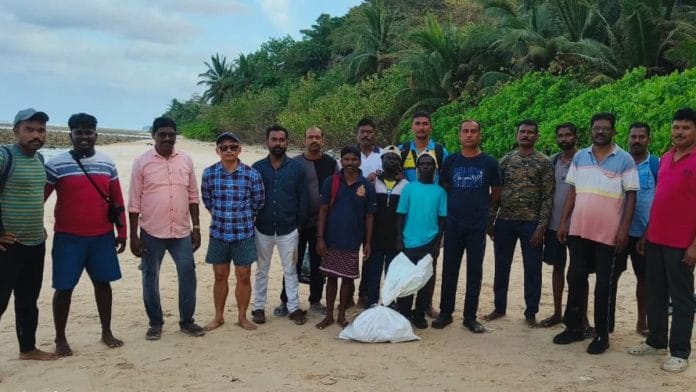
That familiarity proved critical earlier this year. On 16 January, while on patrol in the dense Panga Mundi forest, Raja and Jhaj noticed something unusual. To others, it looked like the usual sand. To them, it looked suspicious.
They stopped, dug into the ground, and uncovered plastic packets buried under sand and dry foliage. Inside was nearly 7 kg of high-grade methamphetamine.
“They played a pivotal role in detecting and recovering the narcotics, concealed beneath sand and dry foliage in dense forest terrain,” said South Andaman Superintendent of Police Shweta K. Sugathan, crediting their “keen observation” and deep knowledge of the land.
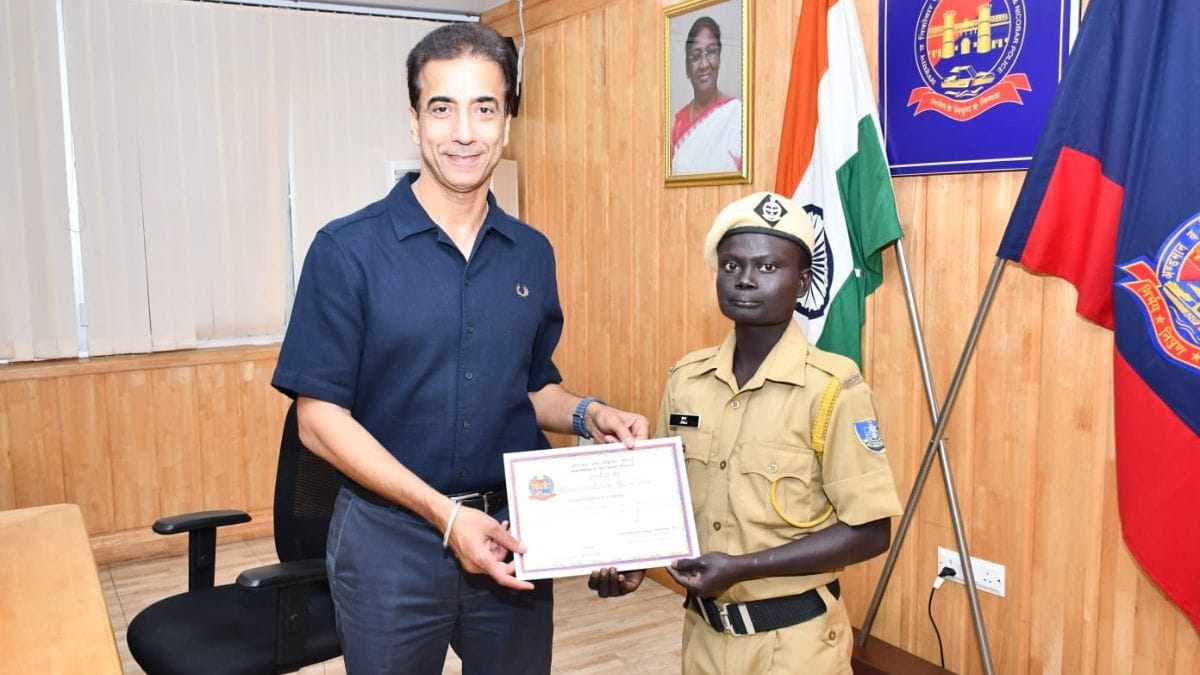
For their role, the two were felicitated by the Director General of Police on 24 February and awarded Rs 10,000 each—significant in a community where cash income is rare.
Bridging civilisations
Their journey from forest dwellers to uniformed volunteers began months earlier, when the Andaman and Nicobar Police inducted eight tribal men as Home Guards, including four Onges. It marked a first: Members of a PVTG stepping into structured roles in active policing, albeit in limited capacities.
Training them meant bridging civilisations. At the Hut Bay Police Station, instructors focused on basics—how to wear a uniform, lace up boots, salute seniors, and handle a lathi. “The challenge we had at hand was to teach modern discipline to a primitive group of people,” an officer said.
The training lasted a month. While the recruits spoke Hindi fluently, most could not read or write. Yet, their curiosity and motivation stood out. “They wanted to protect their land—from poachers, from drugs,” the officer added.
Their roles remain clearly defined. They are not involved in conventional policing such as investigations or law-and-order duties. Instead, they patrol forests—areas where their traditional knowledge offers an edge that modern policing cannot reach.
For the Onge, the move is not just about service, but also survival. As Home Guard volunteers, they earn over Rs 25,000 a month, providing a steady income that brings access to healthcare, medicines, and education for their families—amenities so far always out of reach.
“The money provides them with a stable environment,” an officer said. “Their families now have access to facilities they didn’t earlier.”
So far, eight people from different tribes have been deployed on the ground. Police say they are an inspiration for many other tribal groups and people to come forward, and protect their land.
The initiative is supported by the Andaman Adim Janjati Vikas Samiti (AAJVS), which works on the welfare of indigenous communities in the islands. Officials say the programme is being approached cautiously, mindful of the delicate balance between integration and preservation.
“It is a challenge to explain to tribal groups that their life will remain the same, that their culture will not be disturbed,” the officer said. “There is always a fear that stepping into the mainstream could change everything.”
Across the Andaman and Nicobar Islands, indigenous communities are at different stages of contact with the outside world. While groups like the Nicobarese have integrated significantly—with members serving as police officers and doctors—others, such as the Sentinelese and Shompen, remain largely isolated.
The Onge stand somewhere in between: Rooted in tradition, yet cautiously engaging with the modern world.
Meanwhile there are tribes like North Sentinelese that remain unconnected, isolated, and there is no approach, police said. “Even the administration cannot approach them, and if anybody attempts, they attack them with bows and weapons,” the officer added.
Even the Shompen tribe has not been in contact with the mainland. “Slowly, the police are trying, without disturbing their civilisation.”
For Raja and Jhaj, that balance now plays out daily—between the forest paths they have always known and the patrol routes they now walk in uniform. In their footsteps lies a quiet shift, one that reflects both the pressures of change and the resilience of a people adapting on their own terms.
(Edited by Viny Mishra)
Also read: Govt doesn’t name tribal lands on maps for megaprojects