








Kozhikode/Thiruvananthapuram: When 33-year-old Benu Das was forced to leave his village in West Bengal’s Dakshin Tajpur eight years ago for better earnings, he had one option in mind: the Uralungal Labour Contract Co-operative Society (ULCCS) in Kerala.
After a fellow villager told him about the better working conditions there, Das arrived in the Kozhikode district and headed for ULCCS’s Ramanattukara flyover construction site in search of work. Within two days, he was hired—and he hasn’t been unemployed since.
“He (fellow villager) told me that food is there at the site, room and medical assistance are there, and they are good,” said Das, who has been a ULCCS construction worker since then. He is now employed at the construction site of a new MLA hostel in the state capital, Thiruvananthapuram, with nearly 145 others.
The former farm labourer and the 100-odd interstate workers at the site earn Rs 1,030 a day, (after deductions), besides medical health insurance, and a yearly bonus of 12 percent of their total salary. They also get free food and lodging.
Das said the society also provided him with free quarantine facilities, vaccination, and free lodging during the pandemic—making for compelling reasons he hasn’t left ULCCS since he landed in Kerala.
Das is one of nearly 18,000 workers employed by the ULCCS. About 70 percent of them are Malayalees.
Headquartered in Vatakara in Kozhikode district, the worker-owned cooperative was founded in 1925 to provide employment and dignity in a system marked by discrimination.
A century later, ULCCS it is one of the country’s largest labour cooperatives, where s worker-welfare is non-negotiable and workers still hold all the shares. Since 2019, ULCCS has consistently ranked among the world’s top three cooperatives in the International Cooperative Alliance’s (ICA) World Cooperative Monitor under the Industry and Utilities category.
But that’s not all.
At a time when cooperative structures in India face multiple hurdles, ULCCS has not only survived but also expanded aggressively beyond construction.
The society has diversified into technology, building North Kerala’s first IT Park, along with ventures in tourism and hospitality. It has also ensured workers’ rights and rolled out initiatives for the elderly and intellectually challenged.
Looking to expand scale beyond Kerala, last year, ULCCS launched U-Sphere, a vertical focused on futuristic construction and new markets.
According to its 2024-24 annual report, the cooperative recorded revenue of around Rs 2,007.87 crore, of which nearly Rs 100 crore went for remuneration and welfare.
“Whatever our initial aim was, we didn’t change that. The work culture too remains the same. Our aim is to create employment. But we want to have a culture of dignity and rights for workers,” said Rameshan Palery, a former supervisor who is now the chairman of ULCCS.
Palery said the cooperative’s reputation was built on a culture with no corruption and quality—capabilities that earned it the support of the state government and the public.
He said the society holds monthly meetings and an annual general body to ensure transparency. He recalled that the body had once taken action against an employee who was found embezzling Rs 400.
Also Read: Inside Oscar-nominated Homebound boys’ village in UP—a heavy burden of memory
Fight for dignity
The origins of ULCCS lie in a social reform movement.
In 1917, when social inequalities were prevalent, a few villagers from Kozhikode’s Uralungal village went to attend a speech by Philosopher and social reformer Vagbhatananda in Mahe, Puducherry.
Inspired by the speech, the villagers invited him to visit their village, which led to the formation of the social reform organisation, Atma Vidya Sangam, that year.
In their quest to fight untouchability and find labour with dignity, 14 Atma Vidya Sangam members founded the ULCCS in 1925. The founding president of the cooperative was Chappayil Kunjyeku Gurukkal.
According to ULCCS, its first project was to rebuild farmland bunds that had collapsed in the 1924 floods in the Malabar region.
This slowly expanded into pathways connecting villages, the widening of Kozhikode’s culturally significant Canoli Canal, and gradually into bypasses, highways and government projects.
Now, the cooperative has a 13-member board of directors selected through internal discussions. Three of them are professionally qualified and have long experience in the society, and the rest are long-term workers.
The firm also has managements for different projects, recruited based on expertise and academic qualifications. Palery was chosen as the ninth chairman in 1995.
Among the society’s notable projects are the 39-km Thalappadi-Chengala section of NH-66, the Valiyazhikkal Bridge, and the Sarovaram project, across Kerala.
The society had earned national recognition, including the Ministry of Road Transport and Highways’ National Highways Excellence Award in 2023 and a best performer award in 2024.
“In Kerala, ULCCS is the only organisation that qualifies to bid for such projects. And in India, ULCCS is the only cooperative organisation working in National Highway development. We compete with international companies like Adani. It is the workers who back us,” said Kishor Kumar T.K., chief project coordinator at ULCCS.
Kumar said the Rs 1,704-crore tender for the six-lane highway and a service road was completed in July 2025 and handed over to the Centre.
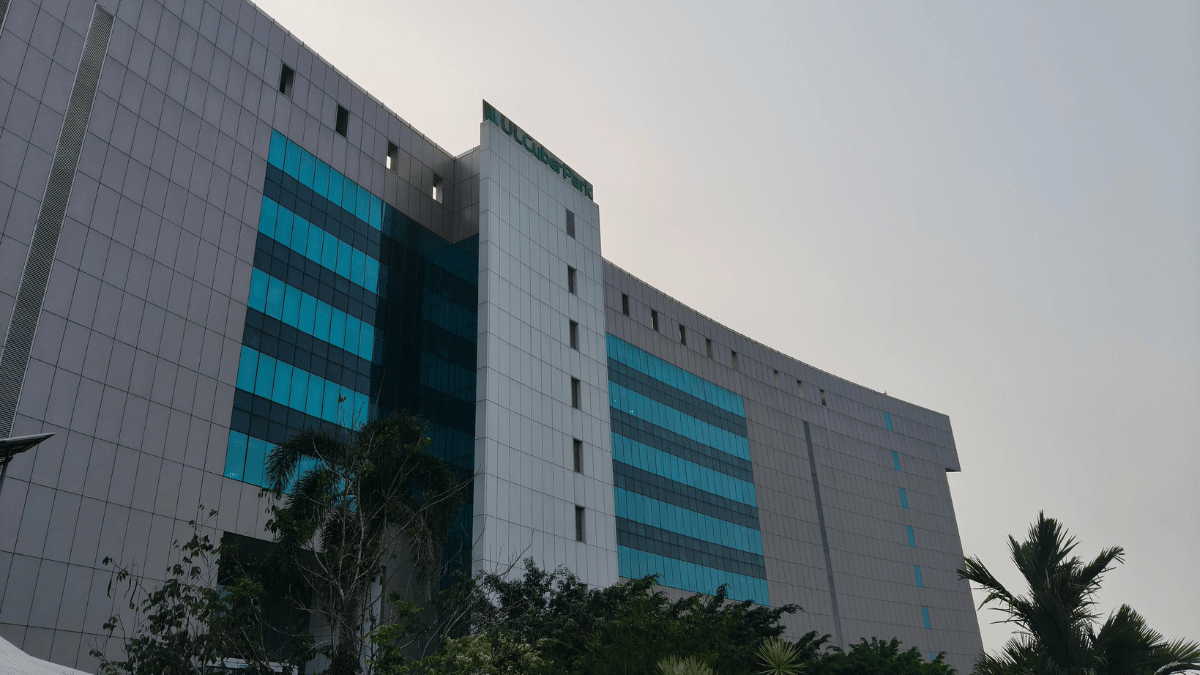
As part of its diversification strategy, the cooperative developed UL Cyberpark in Kozhikode in 2016, the first in the district, with an investment of Rs 180 crore. The cyberpark is the first Special Economic Zone (SEZ) by a cooperative in India and the only IT Park owned by workers in the world. UL Cyberpark has yet to make a significant profit due to a pending loan. Around 2,700 people work in 93 companies and startups there.
Kumar said the idea came up in 2007 when the leadership identified a major gap in northern Kerala compared with the state’s southern district of Thiruvananthapuram, home to Technopark, and central Kerala’s Kochi, which had Infopark.
“We have been working sleeplessly since then to get permission. One IT company told us to go and sleep. Initially, we were mocked by many, as the cooperative consisted mostly of construction workers,” he said.
Kumar said ULCCS is trying to keep pace with the evolving landscape through several projects such as the cyberpark.
Besides this, ULCCS also owns Matter Lab, which focuses on materials testing, chemical analysis and microbiological examination of water and food products, environmental testing, metallurgical (steel) testing, non-destructive concrete testing and forensic investigation of concrete structures.
“In the beginning, the society was just disciplined. After 1995, we were open to taking calculated risks,” Kumar said.
One such risk led to the launch of U-Sphere in February 2025, a subsidiary aimed at meeting futuristic and fast construction needs, focusing on steel and pre-engineered buildings for quicker completion.
The U-Sphere team, consisting of around 20 workers, focuses on private clients and targets work outside the state.
Rohit Prabhakar, a member of U-Sphere, said they aim to deliver projects in half the time within the expected budget.
“ULCCS is a firm with a 100-year legacy and trust. But most of our projects are for the state government. U-Sphere 100 percent targets private clients, and we aim for geographical expansion beyond Kerala,” Prabhakar said.
According to Prabhakar, U-Sphere already has bookings worth Rs 50 crore within a year of its formation. They include a hospitality project in Bengaluru, an IT company in Thiruvananthapuram, and projects in Delhi and Andhra Pradesh.
Besides this, U-Sphere is also constructing Unity Mall, a central government initiative, set to be inaugurated in Thiruvananthapuram.
From elderly care to crafts village
ULCCS is also involved in humanitarian work.
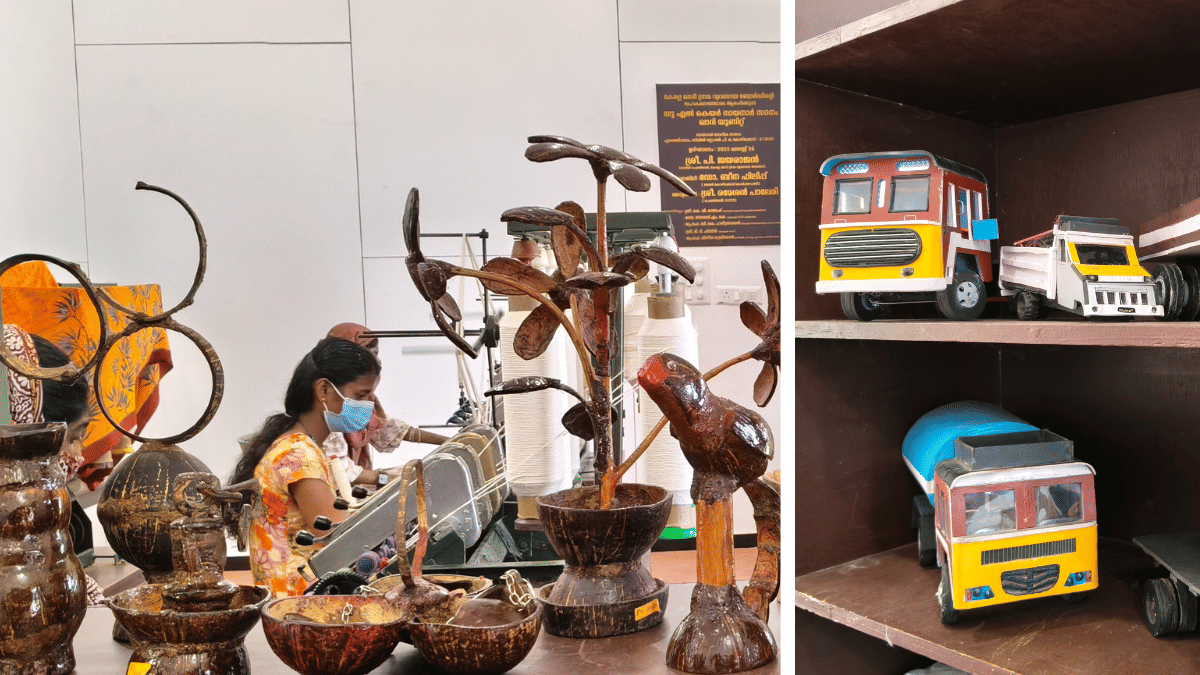
At the UL Care Nayanar Sadanam in Kozhikode city, 23-year-old Shafeeq carved hemispherical coconut shells using a coconut shell cutting machine. As the edges fell, a beautiful petal remained in his hands.
The intellectually challenged youth from the district then glued those petals together to make a beautiful flower, while four of his friends polished the shell under the supervision of their trainer, Dinu C.P.
In an open cupboard in the room, flowers, bottles, even models of trucks and other vehicles made of coconut shell and foam board stand as testimony to their talents.
While Shafeeq and his friends carved beautiful items out of shells, in nearby rooms, nearly 85 intellectually challenged adults above the age of 18 were engaged in other work, including making khadi threads, paper bags and maintaining a nursery at UL Care Nayanar Sadanam in the Kozhikode city.
The ULCCS-managed institution provides curriculum-based training through eight senior special educators, focusing on life skills such as communication, punctuality, discipline, and time management, and places them in jobs.
The organisation is supported by many local shops and establishments, including hospitals, that are willing to place them. As many as 22 alumni are working at KMCT Medical College.
The ULCCS Foundation, the social responsibility initiative of the cooperative, conducts regular follow-ups with its alumni.
Dr M.K. Jayaraj, director of ULCCS Foundation, said it was started after the then Kozhikode district administration reached out to him to initiate something for the intellectually challenged, following requests from many parents. When the official began the work, ULCCS came forward to shoulder it. The foundation was inaugurated in 2005.
“Our initial aim was to find jobs for 25 people, but we have been able to place nearly 170 in the last five years,” he said, adding that ULCCS supports the foundation through donations from members though the company does not have a CSR fund.
“There are sheltered employment options for the intellectually and developmentally disabled. But nobody could successfully do open employment, as it is difficult. When we began it, there was a lot of apprehension,” he said.
Nayanar Sadanam is one of the welfare initiatives of ULCCS.
Besides this, the society runs UL Care Sargaalaya, a handicraft outlet for women with Down Syndrome trained by the Sadanam, jointly initiated by the Down Syndrome Trust, Kozhikode (DOST), the ULCCS Foundation, and Madithattu, two day-care facilities for the elderly, one in Vadakara near the ULCCS headquarters and another in Kozhikode city.
In Madithattu, senior citizens from nearby villages are picked up around 10 am and dropped back around 5 pm. The day begins with exercise and yoga, followed by prayer and games. A teacher, who stays with them full-time, reads newspapers to the inmates, and full-time doctor consultations are available.
The service is free for people associated with ULCCS or those who meet their income criteria.
In the same building, physiotherapy services and two permanent doctors, a paediatrician and another specialist, are available regularly, with consultations costing just Rs 50 and physiotherapy costing Rs 150.
For 77-year-old Sreemati Maliyekkal, staying at Madithattu is better than being at home after her family members leave for work.
“When we are here, it’s much more fun,” she said.
Jayaraj said ULCCCS decided to intervene in these two areas for a reason.
“We chose these two areas, elder care and intellectual and developmental disability, because these issues are increasingly affecting the state. We selected these primarily as they need early intervention,” he said.
He added that the foundation focuses on the quality and happiness of people’s lives, and treats them as individuals rather than as part of welfare activities.
Nearly 14 km from Madithattu lies Sargaalaya Kerala Arts and Crafts Village in Iringal, a Kerala Tourism Department initiative managed by ULCCS, which aims to be an experiential tourism destination.
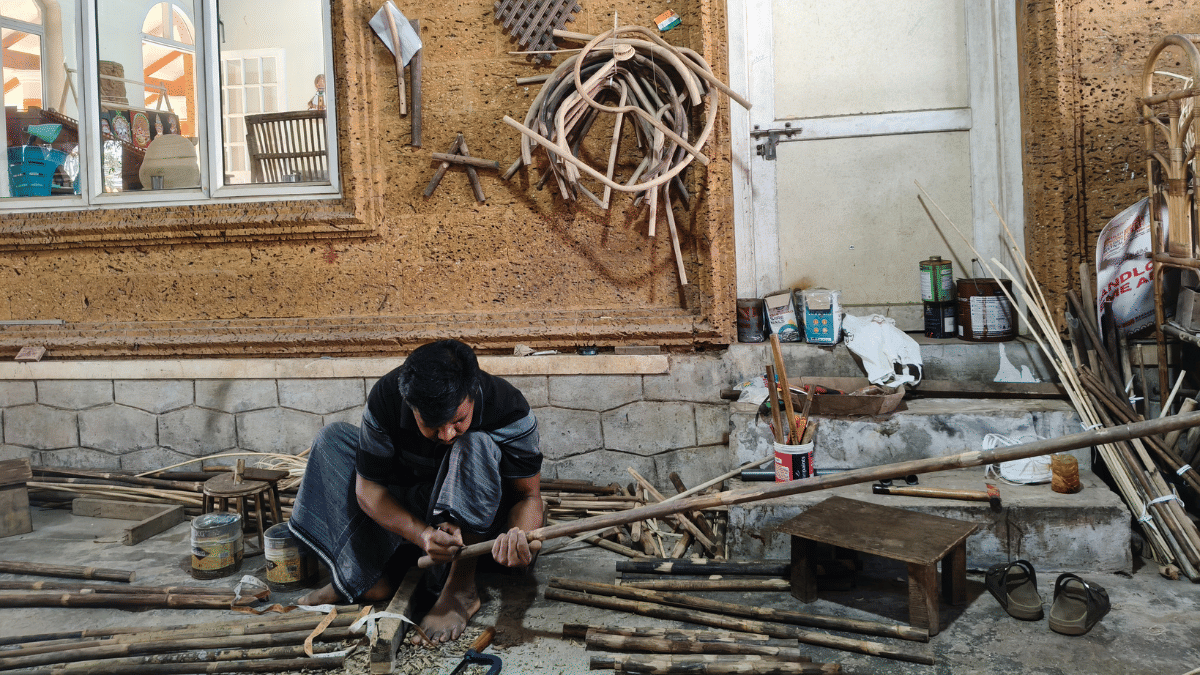
Spread across a 20-acre campus, which was a former wasteland, tourists can see and buy crafts made by over 100 artisans from across the state at Sargaalaya.
Along with crafts and art, the campus also offers boating and other activities, an auditorium for social events, and facilities for destination weddings.
The village hosts over two lakh visitors annually.
For craftsmen, it serves as a studio with international exposure and collaboration, along with design support.
“We are focusing on products and aiming for the revival of this business and exposure to international markets,” said Rajesh T.K., senior general manager at Sargaalaya.
The craft village also hosts a 20-day annual international arts and crafts festival and participates in select exhibitions and events, including branding, soft launches, and raw material sourcing. Some artists also receive projects beyond orders, including state government projects.
“We ensure steady and rightful payment, revenue, and dignity for artisans in the craft sector,” Rajesh said, adding that artists have a say in all decisions taken by the institution, and a share of up to 15 percent from sales goes to craftsmen.
Naveen Kumar, a mural artist from Kozhikode, said Sargaalaya not only provided him with a studio but also a steady income and opportunities to learn about the market.
“For an artist, a studio is important, especially one that people visit. I like the constant interaction and learning,” Kumar said.
(Edited by Sugita Katyal)
Also Read: 47% rise in Budget outlay won’t revive co-operatives without internal stock-taking, reform