





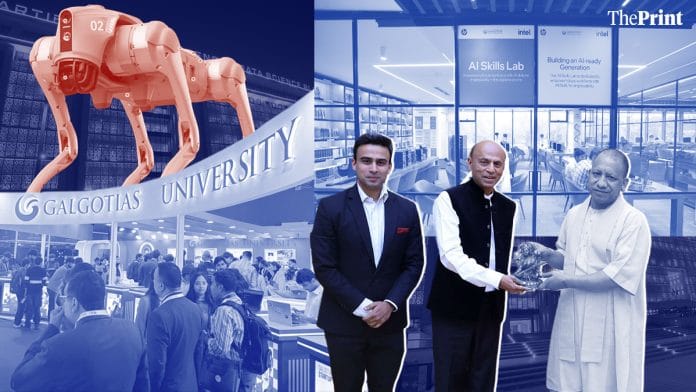



New Delhi: In the early 1930s—when India was still over a decade from Independence—there was a modest bookstore called E.D. Galgotia & Sons in Connaught Place, Delhi. Decades later, that family’s name—Galgotias—sits atop a 52-acre university campus along the Yamuna Expressway in Greater Noida.
The private university, its official website says, comprises multiple schools, state-of-the-art laboratories, incubation centres and hostels, among other facilities. Over the years, it also hosted influential leaders, including chief ministers and a clutch of Union Cabinet ministers.
But, as of this week, it was involved in one of the more embarrassing moments for Indian higher education: a Chinese-made robot presented to the world as the university’s own innovation.
The robot dog fiasco wasn’t the first time Galgotias University set off a meme fest. In 2024, a group of students from the university protested in Delhi, reportedly over remarks by the Congress’s Sam Pitroda regarding ‘inheritance tax’. When a reporter asked them why they were protesting, the students cluelessly glanced at their placards, and one of them mispronounced “urban naxalism” as “urban Maxwell”.
The robot that wasn’t in-house
At the ongoing India AI Impact Summit in New Delhi, communications professor Neha Singh gestured toward a quadruped robot at the Galgotias University stall, and described it as having been “developed by the Centre of Excellence at Galgotias University”.
The robot, she told a TV anchor, was evidence of the university’s AI research capabilities and was given the name ‘Orion’, a heroic hunter in Greek mythology on whom a constellation of stars is named.
Independent observers and social media users needed only a few hours to identify the robot as Unitree Go2, a product of Chinese manufacturer Unitree Robotics, available commercially for roughly Rs 2–3 lakh.
Such was the online mockery that the central government Wednesday asked the university to remove its exhibit from the AI Summit. Galgotias subsequently released a statement clarifying that it had never claimed to have built the robot and that it had been acquired as part of its investments in artificial intelligence infrastructure for student learning.
The clarification was noted, but the damage could not be undone.
The AI Summit episode was not the first time a robot displayed by Galgotias at an Expo turned out to be a commercially available product.
TEMI, an AI-enabled assistant robot showcased at the university’s pavilion at the Bharat Shiksha Expo 2025, was also an off-the-shelf product manufactured by a US-based company. Only, in this case, the university did not publicly claim it was developed on campus.
The pavilion, which also featured “student-designed” electric vehicles, sustainability prototypes and entrepreneurial showcases developed at the university’s incubation centres, won the Best Exhibitor Award among more than 100 participating institutions at the Expo.
The university did not respond to multiple requests for comment till Thursday evening.
A paper on thaalis & Covid
Besides robots, Galgotias’s claims to academic achievement have attracted scepticism in the past.
In 2020, a paper authored by a professor from the university’s Department of Pharmacy—titled ‘Corona Virus Killed by Sound Vibrations Produced by Thali or Ghanti: A Potential Hypothesis’—proposed that sound vibrations from metallic plates or bells could affect the coronavirus.
The paper–published in the Journal of Molecular Pharmaceuticals and Regulatory Affairs–drew widespread ridicule and was later retracted for being misleading. (The journal, which is run by MAT Journals, says all papers published by it are peer-reviewed, but watchdogs and experts have in the past said it is unreliable).
Ministers, experts & influencers
Galgotias has attracted senior politicians and industry leaders to several campus events, photos of which are displayed prominently on its website.
In early 2014, then Gujarat Chief Minister Narendra Modi presented an award called the DQ-ICT Award for ‘Top Private University in Academics and Global Linkages’ to Chancellor Suneel Galgotia.
In May last year, Union Minister of Commerce and Industry Piyush Goyal was chief guest at the university’s 11th convocation ceremony, alongside UP Deputy Chief Minister Brajesh Pathak, Gautam Budh Nagar MP Dr Mahesh Sharma, Jewar MLA Dhirendra Singh, All India Universities President Prof. Vinay Kumar Pathak, and Aman Gupta, co-founder and CMO of audio products brand boAt.
Suneel Galgotia, and his son and CEO Dhruv Galgotia were at the event too.
The same day, Goyal inaugurated the university’s “state-of-the-art” AI Education Lab. The minister praised the university for ranking third in India for patent filings and for hosting approximately 100 active startups. “This reflects a true spirit of inquiry — the ability to generate and implement new ideas,” he said, a video of the purported event shows.
Then, in September, Galgotias partnered with AIIMS-Delhi to mark World Suicide Prevention Day. AIIMS launched ‘Never Alone’, an AI-based programme that offers students web and app-based personalised screening tools and access to professional consultation, at the event. The launch was attended by AIIMS-Delhi Director Prof (Dr) M. Srinivas, NITI Aayog member Prof (Dr) Vinod K. Paul, and the Galgotia family.
Wellness influencer Deepak Chopra, who was more recently named in the Epstein Files, delivered a virtual address for the event. (Epstein Files are US investigative files related to millionaire-financier and convicted sex offender Jeffrey Epstein)
Months later, in December 2025, Uttar Pradesh Chief Minister Yogi Adityanath too visited the Greater Noida campus, and described the university as a “model for other institutions in the state’s education sector”.
BJP MP and the party’s north-east coordinator Sambit Patra is another politician known to have attended university events.
Making of the university
A section titled ‘The Galgotias Story’ on the university website says that Suneel Galgotia was “forced” to “walk away” from his family’s bookstore after his father’s death.
Suneel went into publishing and launched Galgotia Publications in the 1980s. By the early 2000s, he turned to another field—higher education, and established a network of engineering and management colleges in Greater Noida.
The colleges were formally given the university tag in 2011, under the Galgotias University, Uttar Pradesh Act.
Academic operations began in the 2015–16 session, with approximately 1,590 students. By 2024–25, according to the official website, the university offered more than 350 programmes spanning undergraduate, postgraduate and doctoral degrees across engineering, computer science and artificial intelligence, management, law, pharmacy, agriculture and biosciences, media, liberal arts and teacher education.
In 2024, 5,089 students graduated from the university.
Rankings, students & faculty
In QS World University Rankings 2026, Galgotias entered the global 1,201–1,400 band, placing 15th among private Indian universities and 43rd among all Indian higher education institutions.
The university fared better in national rankings. The National Institutional Ranking Framework (NIRF) 2025 placed Galgotias in the 101-150 range in its overall category. Its law school was 36th, pharmacy was 55th, and the university featured among the top 50 in ‘innovation’.
In 2023, the university reported having filed 1,089 patent applications, a figure that placed it third nationally by volume that year.
Asked about the university, an alumnus who spoke on the condition of anonymity told ThePrint that Galgotias is “like any other private university in Noida”, more focused on spectacle than substance.
Glossy events are routinely organised, and are often attended by celebrities, known personalities and politicians, the alumnus, who studied at Galgotias a decade ago, said.
He drew a distinction between the group’s initial college, which conducted admissions through the competitive Uttar Pradesh Technical University exam and the newer private university schools.
“The university was essentially built on the back of the college’s reputation. But it admits virtually everyone who has the money to pay,” he said.
BTech tuition fees at Galgotias ranges between Rs 4.8 lakh and Rs 6.99 lakh for the full course, with annual fees between RS 1.2 lakh and Rs 1.75 lakh. Hostel costs range from Rs 1.26 lakh to Rs 1.71 lakh per year.
The university reports participation by more than 900 recruiters in its placement drives, with companies including Amazon, Accenture, Cognizant, Deloitte, Tech Mahindra and Bosch. The highest salary package reported is approximately Rs 39 lakh per annum, with average packages between Rs 5 lakh and Rs 6 lakh.
Last December, Dr Ankush Mittal—an IIT Delhi alumnus with a PhD from the National University of Singapore—was appointed Vice-Chancellor of the university.
The university, on its official website, lists most of its faculty members as PhD scholars. But it does not name the institutions from which those degrees were obtained.
For instance, among the 32 faculty members in the Department of Artificial Intelligence, six have PhD, 11 are pursuing PhD, and the remaining are postgraduates in computer science, IT or related fields. The exact details of education and professional experience is listed for the head of the department, and few others, but not for most professors.
The alumnus quoted above told ThePrint that faculty used to be well-qualified in the early years of the university, but he isn’t sure if that’s the case now.
Ownership & companies
The university is owned by the Smt. Shakuntala Educational & Welfare Society, controlled by the Galgotia family.
While Suneel Galgotia serves as Chancellor, operational leadership has passed increasingly to the next generation: his son Dhruv Galgotia is the chief executive officer, representing the university at national events and industry forums, while daughter Aradhana Galgotia holds a governance role within the management.
Financial disclosures by the Galgotias for 2023–24 show total operational expenditure of Rs 209.51 crore, of which Rs 140.9 crore was spent on salaries and Rs 33.67 crore on capital expenditure.
The family also owns Galgotias Hotels & Resorts Pvt Ltd, through which it runs a four-star hotel and restaurant called ‘The Galgotias’ in Gurugram, and Galgotia Publications Pvt Ltd.
In 2024, the Galgotias announced that it will open Ayodhya’s first mall for locals and tourists alike. Additionally, it said it will construct a five-star hotel with 200 rooms, a convention centre, and a daily prayer room for bhajans and kirtans.
The journey to success has not been without turbulence for the family.
In 2017, the Shakuntla Society found itself before the Delhi High Court after defaulting on Rs 37.6 crore in loans taken from UP-based S.E. Investments Ltd. The High Court ruled largely in favour of the investor and told Shakuntala Society to pay the dues.
The AI pivot
The past two years have seen Galgotias invest heavily in constructing an AI-focused identity.
Ahead of the AI Summit,the university announced that it will invest more than Rs 350 crore in artificial intelligence technology and infrastructure. This, it said, was one of the largest such investments by any private higher education institution in India.
The same pledge was published as a prominent advertisement in Indian newspapers Thursday, in the aftermath of the robot controversy.
Central to this infrastructure is the deployment of the NVIDIA DGX H200 system, intended to support advanced computing across generative AI, deep machine learning and data science.
The university has established Centres of Excellence with HCLTech, Tech Mahindra and Cisco, and will set up an iOS Development Lab in partnership with Apple Inc. The lab will be equipped with 100 iMac workstations and Apple development devices.
Its AI academic portfolio includes a B.Tech in Computer Science and Engineering with Artificial Intelligence and Machine Learning, alongside B.Sc. programmes in AI-Data Science and AI-Healthcare, supported by an HP-Intel AI Workforce Lab and industry-linked training pathways.
The university registrar did not respond to queries sent by ThePrint.
Experts told ThePrint that the robot incident was indicative of the larger question of education in India.
The rise of private education is in response to a growing demand, and governments “giving up” their responsibilities”, said Furqan Qamar, chief adviser at Integral University in Lucknow.
He pointed out that declining quality in public institutions has fueled the proliferation of private colleges.
Qamar emphasised that the real issue was not public versus private education, but “improving quality and promoting excellence in higher education across the board”.
He warned that both public and private institutions have increasingly focused on rankings, accreditation and publicity stunts, often cutting corners on quality and standards.
“It is high time they concentrate on substantive issues such as attracting quality faculty, delivering meaningful education and investing in genuine research, rather than “gaming the system for short-term visibility,” he said.
(Edited by Prerna Madan)