








Mumbai: For thousands of children in Mumbai’s municipal schools, the journey that begins in a crowded classroom in Class 1 often fades before the finish line. A new report has found that less than half the students who start their schooling in Brihanmumbai Municipal Corporation (BMC) schools stay in the system until Class 10—raising concerns about gaps in the city’s public education.
The report, titled ‘State of Municipal Education in Mumbai 2026’, was brought out by the Praja Foundation, which, according to its website, is a “non-partisan organisation working towards enabling accountable governance”. The report states that a mere 48 per cent of the students who enrolled in class 1 in 2015-16 in BMC schools remained in the system till class 10 in 2024-25.
The report’s analysis of retention rates from classes 1 to 10 shows that while a majority of students remain in school during the primary years, retention begins to decline steadily after Class 7. It attributes this trend partly to the limited number of municipal schools offering secondary education.
“Retention rates from 1st to 10th standard show that after the 7th standard, there is a continuous fall, which could likely be due to a shortage of BMC schools for secondary education (from 8th standard),” the report states.
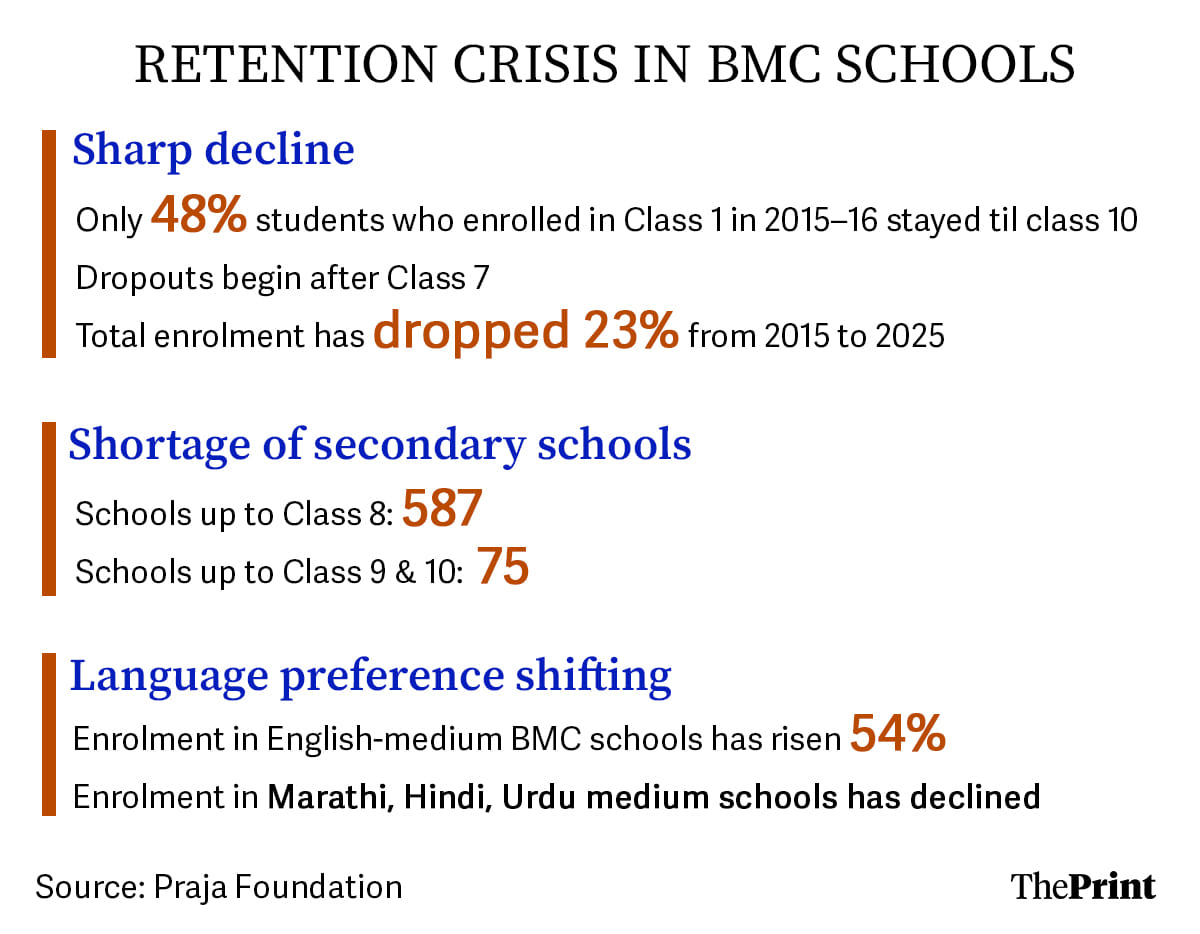
It also shows that out of the many BMC-run schools in the city, 587 offer classes from grades 1 to 8, while only 75 schools provide education for grades 9 and 10. This structural gap means that a large number of students completing primary or upper-primary schooling in municipal institutions must shift to other schools to continue their education, increasing the risk of dropouts.
On Friday, at a press conference organised by Praja Foundation for the release of the report, Deputy Municipal Commissioner (Education), Prachi Jambhekar said, “The retention rate, I find to be quite alarming. It seems that many students tend to migrate to government schools offering classes for the 9th and 10th standards. Our absolute top priority should be to prevent student dropouts. Under no circumstances should a child drop out of school prematurely; they must, at the very least, complete their education up to the 10th grade.”
She further said, “I have requested that the next time data is compiled, it should specifically track whether students are indeed continuing their studies through the 9th and 10th grades. Perhaps the board could provide certification regarding this, specifically, how many students appeared for the 10th grade examinations.”
The report also raises concerns over the lack of consistent official data on student dropouts.
The report says: “Despite national initiatives like Sarva Shiksha Abhiyan, RTE (2009), and National Education Policy (2020) aimed at reducing school dropouts, the BMC Education Department does not have a centralised system to maintain granular ward-wise, school-wise, standard-wise or gender-wise data.”
“Over the years, Praja has been filing RTIs to acquire the number of dropout students in BMC schools. However, for the year 2019-2020, the information provided was incomplete; while for the years 2022-23 and 2023-24, the information on dropout was not provided,” the report adds.
Avinash Dhakne, Additional Municipal Commissioner of the BMC, underlined the need for more open-sourced data. “The report highlights more good than bad, but these points on retention rate and dropouts are important ones to be worked on. It is crucial for us to understand where the students are going. It is not that difficult to track. Data needs to be both tracked and provided to the public.”
Preference for English
The Praja Foundation’s report also highlights a significant shift in the language preference of students enrolled in municipal schools. Between 2015-16 and 2024-25, the share of total school enrolment accounted for by BMC schools increased slightly from 41 per cent to 44 per cent, indicating that municipal schools continue to serve a large section of the city’s students.
However, the medium of education has undergone a clear change.
During the same period, student enrolment in Marathi-medium BMC schools declined by 34 per cent, in Hindi-medium schools by 39 per cent, and Urdu-medium schools by 30 per cent. In contrast, English-medium municipal schools recorded a 54 per cent rise in enrolment, reflecting a growing preference among parents for English-language education within the public system.
The report suggests that the expansion of English-medium sections in municipal schools may be influencing this shift. “Student preference is shifting toward English medium and structured board schools, leading to higher average enrolment in those categories,” it stated.
Despite the slight increase in BMC schools’ share of total enrolment across all schools in Mumbai, overall student numbers in Mumbai’s school system have declined sharply over the past decade, the report says. According to the report, total enrolment across all schools in the city fell from 9,24,933 in 2015–16 to 7,08,763 in 2024–25, marking a 23 per cent decline.
“Out of the total school categories, 83 per cent of schools follow the semi-English pattern, accounting for 65 per cent of the total enrolment. In comparison, English medium schools constitute 13 per cent of the total schools, but account for 35 per cent of the total student enrolment,” the report states.
Milind Mhaske, CEO of Praja Foundation said, “With elected representatives now in place, councillors have a crucial role in strengthening School Management Committees and preparation of School Development Plan and ensuring that schools receive focused attention at the ward level. Strengthening the local institutional mechanisms will be key to improving the functioning of BMC schools and rebuilding public trust in the municipal education system.”
(Edited by Viny Mishra)
Also read: Mergers, addressing teacher shortage—NITI Aayog report on improving India’s public schools