





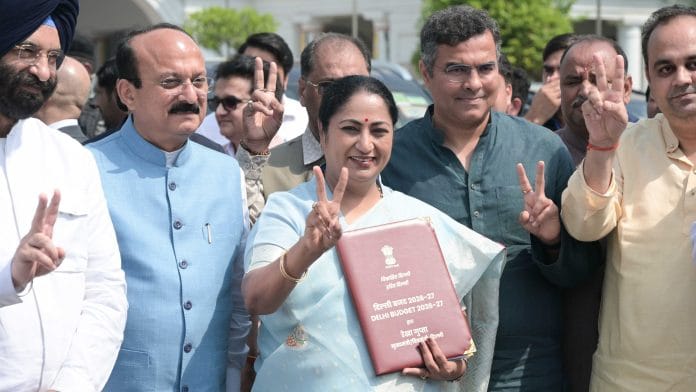



New Delhi: The Delhi Budget for 2026-27, presented in the Legislative Assembly on 24 March, proposed an outlay of Rs one crore to develop a Drone Policy for the city. The proposed budget aims to attract investments and support start-ups to make Delhi a “hub in the drone ecosystem”.
The Budget also proposed another Rs one crore to be allocated for developing the city’s Semiconductor Policy, as part of a larger push to develop Delhi’s economy and attract investments in the information technology sector.
“Our government is committed to transforming Delhi into a production-driven and growth-oriented economy,” said Chief Minister Rekha Gupta while introducing the Budget.
The Budget highlighted investment in artificial intelligence research and development, following Delhi’s hosting of India’s first-ever AI Impact Summit. According to the 2026-27 Budget, Rs 8.20 crore is being allocated to develop two Artificial Intelligence Centres of Excellence (AI-COEs), which will serve as research hubs. The focus of these centres would be to work on AI-based solutions for governance, healthcare, education, urban mobility, and public service delivery.
Aside from investments in the information technology sector, the government also announced an allocation of Rs 48 crore for constructing Common Facility Centres, which are shared workshops and laboratories for small and medium enterprises (MSMEs). The objective, according to Gupta, is to improve competitiveness among Delhi’s MSMEs and also provide them with infrastructural facilities.
Additional support for MSMEs included in the new budget is Rs 10 crore for a new Warehousing Policy, as well as the first-ever implementation of the Raising and Accelerating MSME Performance (RAMP) scheme in Delhi.
In her speech, Gupta stated the government will train 32,000 MSMEs under the RAMP and help integrate over 15,000 small businesses with digital platforms, allowing them access to national markets.
“We do not wish to limit Delhi merely to being a service economy; rather, we aim to establish it as an innovation-driven, industrial powerhouse,” the CM said while introducing the twin policies of Drone and Semiconductor Policy for Delhi.
Delhi is not the first state to introduce a semiconductor policy – Gujarat, Odisha, Uttar Pradesh, Tamil Nadu and Karnataka have all introduced such policies in the past to attract investments for the manufacturing and supporting start-ups in this sphere.
While Delhi’s Semiconductor Policy is yet to be clearly defined, the Budget highlights mentioned how the government plans to support the design, innovation and technology development of semiconductors in the city.
“We are not merely addressing the needs of the present; we are also preparing for the economy of the future,” Gupta added.
(Edited by Insha Jalil Waziri)