





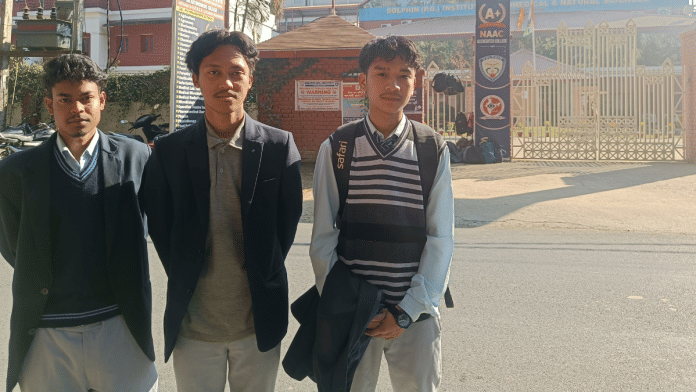



Dehradun: Safety was the primary reason Tripura resident Ristom Debbarma chose Dehradun for his higher studies. But that is not the case anymore, he says. “If this becomes a trend here also, where will we go,” asks Debbarma, referring to the racial attack that claimed the life of 24-year-old Anjel Chakma, also from Tripura, earlier this month.
“There are many reasons why I chose Dehradun. This is one of the safest places for Northeastern people, and the pahadi identity attracts us to this area, while in the rest of the country, we might face racial discrimination,” 22-year-old Debbarma told ThePrint outside his college Dolphin Institute in Dehradun. Debbarma has spent three years in Dehradun, but what happened on 26 December has left him deeply shocked, and worried.
Anjel Chakma was assaulted on 9 December by six people as he objected to being called ‘Chinese’, ‘Chinki’, and ‘momo’, Anjel’s brother Michael told the police. Anjel succumbed at a hospital 17 days later. His death stirred protests, fear as well as concern.
Uttarakhand is known not only for its centres of spirituality or tourism, but also for its educational institutions, which attract thousands of students from across the country—especially from the Northeast.
Ristom Debbarma is pursuing BSc (Agriculture) at Dolphin Institute. Speaking to ThePrint, he recounted some instances when he also faced discrimination in the city. “Chinki, Chinese are common words we face,” said Debbarma. “We are also Indians, not outsiders.”
Over the last two decades, Uttarakhand’s capital city Dehradun has grown to become an education hub, with a mushrooming of institutions that offer degrees in a wide range of fields such as medical, engineering and social sciences.
“Chakma incident is wake-up call & authorities should take stringent steps. For years, students from NE come to Dehradun, because they feel safe here. But now fear has gripped us,” says Rishikesh Baruah, president of NE Students Union, Dehradun Chapter.
To attract students from outside the state, these institutions conduct aggressive outreach programmes, putting in advertisements outside the states, and even hiring counsellors.
But after the fatal racial attack on Chakma, students from the Northeast say they are worried about their safety, and want a strict law to tackle racial discrimination.

“The Chakma incident is a wake-up call and the authorities should take stringent steps. For years, students from the northeast come to Dehradun for education, because they feel safe here. But now fear has gripped us,” said Rishikesh Baruah, president of Northeast Students’ Union, Dehradun Chapter.
Also Read: Welcome to justice in India. Rules are different for Sengar, Asaram, Akhlaq’s killers
How Dehradun became education hub
Dehradun is home to more than 200 educational institutes, both private and government, making it a major education hub in the region. Currently, more than 2,000 students from Northeast are studying in Dehradun, Baruah said.
Some of the prominent institutes are Doon University, Graphic Era University, DBS Global University, Jigyasa University and Dolphin Institute of Biomedical and Natural Sciences. Dehradun’s pleasant climate, scenic beauty and proximity to the Himalayas make it an attractive destination for educational institutes.
Pre-independence, the British established the Doon School in 1935, setting the stage for the city’s growth as an educational center. This trajectory continued post-Independence, but the real impetus came after Uttarakhand was carved out of Uttar Pradesh as a separate state in 2000.
The University of Petroleum and Energy Studies (UPES) was set up in 2002, and the Doon University in 2004.
Lakhs of students came to Uttarakhand’s capital over the past two decades for higher studies, said Malti Sawhney, a faculty member at Dolphin Institute. “Dehradun’s journey of becoming an education hub is of around two decades. The region is peaceful and the climate suits the students,” she said.

Sawhney said hundreds of students at her institute are from the Northeast, and there has never been any incident of racial discrimination. “The Anjel Chakma incident is unfortunate but this is just an isolated case. We don’t see the incident as part of some pattern.”
ThePrint spoke to many students of Dolphin institute who said they don’t face any discrimination on the campus, but they could not say the same thing about the city.
“The reason behind choosing Dehradun is the pahadi identity because we are also from hill areas and we look similar to how people in Uttarakhand do,” said Bomke Karcho, a 22-year-old student from Arunachal Pradesh.
Karcho said they came to know about the educational institutes of Dehradun through seniors and relatives. ”Also counsellors of colleges reached out to us.”
Sawhney added that every institute in Dehradun hires counsellors and sends them to the Northeast as the region has limited resources for education “We advertise through Radio and put posters in the region too.” Sawhney said some students chose other states as there are limited seats in Uttarakhand. “Agriculture and forest courses are among the favourites for them. As a hill state, we offer these courses.”
Uday Mahato, a 23-yr-old student from West Bengal, said discrimination on the basis of region is unacceptable. “We all are Indians. People from the northeast are very good and peaceful. I have many friends from there and we never fought on these topics.”
(Edited by Ajeet Tiwari)
Also Read: Dehradun, Bareilly, Tamil Nadu attack—Indians are turning violent. Don’t keep blaming politics