








New Delhi: More than seven years after Nishant Agarwal was first arrested and booked under the Official Secrets Act (OSA), a division bench of the Bombay High Court Monday quashed the life imprisonment awarded to the former BrahMos Aerospace scientist.
In doing so, the high court held that the prosecution failed to establish beyond a reasonable doubt that Agarwal willfully communicated or used the material found on his laptop for the benefit of any foreign power or in any other manner prejudicial to the safety of the State. The Nagpur bench of Justices Anil Kilor and Pravin Patil also noted that the prosecution could not prove that Agarwal willfully failed to comply with any direction issued by any lawful authority with regard to return or for disposal of such material.
The division bench overturned his conviction under Section 66(f) of the Information Technology Act—which defines the punishment for acts of cyber terrorism—and other provisions of the Official Secrets Act. At the same time, it upheld Nishant Agarwal’s conviction under Section 5(1)(d) of the OSA, with lighter sentencing.
Agarwal has already served his three-year sentence in this case.
Section 5(1)(d) deals with unauthorised possession of official documents or information in situations where a person fails to take reasonable care or acts in a way that may endanger the safety of official secrets.
A former scientist with BrahMos Aerospace, Agarwal was accused of leaking to Pakistan’s Inter-Services Intelligence (ISI) sensitive information pertaining to India’s missile programmes. This, it was alleged, was done through fake Facebook and LinkedIn accounts being operated from Islamabad. Last year, a Nagpur court convicted Agarwal for cyber terrorism under Section 66(F) of the IT Act and various sections of the OSA.
It sentenced him to life imprisonment, plus a 14-year rigorous imprisonment term.
Agarwal challenged the conviction, which the Nagpur bench of Bombay HC has now overturned, paving the way for his release from jail.
Posted in the technical research section of BrahMos Aerospace in Hyderabad from 1 July, 2013 to 24 August, 2014, Agarwal had won the DRDO Young Scientist Award in 2018.
He was an executive trainee until December 2013, when he was appointed system engineer. He was transferred to Nagpur in August 2014. Court records reveal that Agarwal’s Annual Confidential Report (ACRs), written by his reporting officer Kranti Kumar, referred to him as ‘very good’ and ‘outstanding’. Agarwal was part of the core team dealing with the delivery of 70 to 80 BrahMos missiles to the Indian armed forces in the 2014-2018 period.
Arrested in 2018, Agarwal was granted bail in April 2023 but again sent to prison in 2024.
Also Read: India and Indonesia inch closer to BrahMos deal, defence ties to ramp up
UP ATS probe & malware on laptop
The prosecution’s case against Nishant Agarwal dates back to 2018 when an inspector with the Uttar Pradesh Anti Terrorist Squad (ATS) came across two Facebook accounts, operating under the names ‘Neha Sharma’ and ‘Pooja Ranjan’. The IPs for both these accounts, allegedly being used to honey trap defence personnel, were traced to Islamabad.
Based on this initial probe, an FIR was registered under relevant sections of the OSA, IT Act and Indian Penal Code.
Upon further investigation, it was found that Nishant Agarwal was added as a friend by both Facebook accounts. He was arrested in October 2018. Court records show that the Investigating Officer (IO) found 19 files on Agarwal’s personal laptop. The prosecution claimed 16 of these files were confidential, and three were restricted.
Agarwal was further accused of disclosing his identity to the operator of another Pakistan-based LinkedIn account, operating under the name ‘Sejal Kapoor’.
The defence argued that Agarwal shared his personal information with the account since he was looking for job opportunities and “unintentionally downloaded” malware links shared by the LinkedIn account.
According to the prosecution, forensic analysis of Agarwal’s laptop and personal hard drive indicated the presence of data-stealing malware—Chat 2 Hire, Q-Whisper and an updated version of Trust-X.
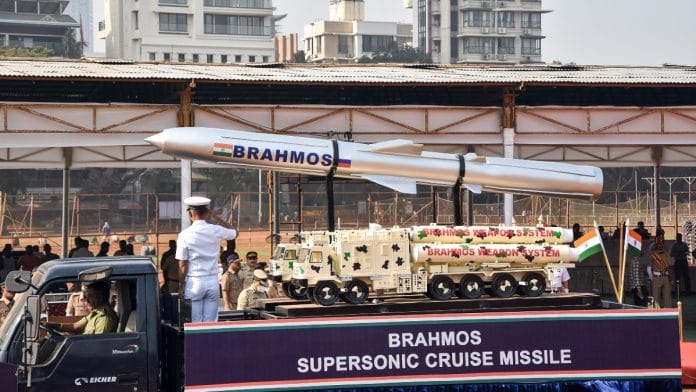
Agarwal was also accused of copying ‘secret’ and ‘restricted’ files to his personal devices without permission. The data was related to BrahMos supersonic cruise missiles, which are a critical part of India’s military arsenal.
The defence contended that none of the files were secret, restricted or classified.
‘Prosecution has failed to prove…’
The prosecution’s allegation that Agarwal copied ‘secret’ and ‘classified’ information to his personal devices relates to the period between 1 July, 2013 and 30 December, 2013.
The high court court noted that the first chat between Agarwal and the LinkedIn account (‘Sejal’) put on record by the prosecution was in 2017, but the prosecution failed to establish that “there was any intention” of the accused to copy information from official systems in 2013 for the purpose of leaking it to ‘Sejal’ in 2018. The HC also noted that there is “not a single observation or finding recorded by the learned trial court” on this.
Further, the high court relied on a prosecution witness’s statement that Agarwal had access to sensitive information when he joined his posting in Nagpur where he was in the know about delivery locations. Moreover, this prosecution witness told the court that when in Nagpur Agarwal had access to ‘more secret and classified information’ than he did in 2013.
While overturning the sentence handed to Agarwal by the lower court, the high court noted that for Section 66F(1)(A)(ii) of the IT act to apply, it must be established that an official computer system was accessed without prior authorisation with an intention to threaten India’s unity, integrity, security or sovereignty, or to create terror.
The prosecution, the high court observed, could not prove that Agarwal had such an intent when the data was allegedly copied between 1 July, 2013 and 30 December, 2013.
“In the circumstances, it is difficult to say that the prosecution has established beyond reasonable doubt that the accused is guilty of the offence punishable under Sections 66F of the Act of 2000 and Section 5(1)(a)(b)(c) and 5(3) of the Act of 1923,” the bench noted.
The high court also noted that while the prosecution relied on the secrecy undertaking Agarwal signed, which asked of him to keep company information confidential, no evidence was presented to show he knowingly or intentionally shared any confidential information in his possession.
To add to that, the bench of Justices Anil Kilor and Pravin Patil pointed to the fact that no chats were between Agarwal and the two Facebook accounts, operating under the names ‘Neha Sharma’ and ‘Pooja Ranjan’.
Agarwal did converse with the LinkedIn account operating under the name ‘Sejal Kapoor’ but this was only with respect to a job in the UK, it noted.
“Having observed so, it can be said that the prosecution has failed to prove the circumstances or the conduct of the accused or his known character to show purpose prejudicial to the safety or interest of the State,” the high court said in its order.
(Edited by Amrtansh Arora)