





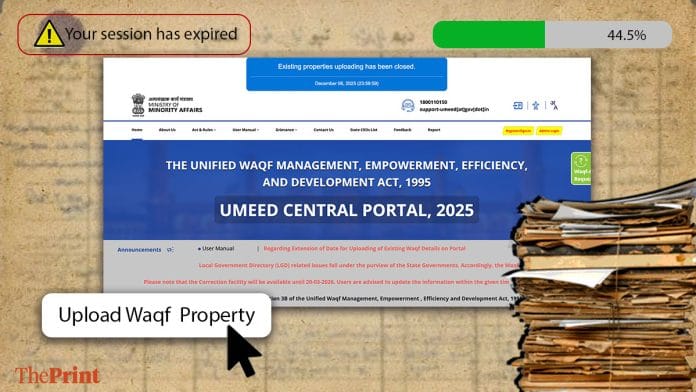



New Delhi: In the final days before the 6 December, 2025 deadline for mandatory upload of waqf properties on Umeed Central Portal, the Punjab Waqf Board sent an urgent email to the Ministry of Minority Affairs.
Fifty-two data operators were trying to upload records of waqf estates in the state. The portal was running so slow that staff could not complete a single entry in two hours. Captchas were not loading. Documents were not uploading. When data checkers tried to verify completed entries, the screen would flash “session out”.
“Staff is feeling mentally stressed,” the board wrote. “This problem has become more severe in the last two-three days. Therefore, it is requested to do the needful in the matter so the board’s staff can work in a healthy manner,” stated the email.
Under the amended Waqf Act, 1995, waqf is permanent dedication by a person professing Islam (waqif) of any movable or immovable property for purposes recognised by Muslim law as pious, religious or charitable. Once established, the waqf becomes perpetual and non-transferable, meaning it cannot be sold, gifted or inherited.
In India, waqf property is managed by a mutawalli (who does not own it) and is under supervision of the state waqf board.
In Bihar, a mutawalli named Burhanuddin Ahmad was trying to register a waqf estate created in 1717.
The Umeed portal asked Burhanuddin for the waqif’s mobile number. It asked for bank details. It required a survey date. The estate covered an entire village—more than 500 individual plots, over 2,000 acres, every one of them waqf property. The portal required each plot to be uploaded individually.
“It is not possible to upload those properties individually,” the mutawalli wrote to the portal’s helpdesk, “and even you cannot upload the same without support”.
These are just two examples of hundreds of officially reported problems during waqf uploads on the grievance helpdesk of the Umeed portal, perused by ThePrint.
While the portal closed for uploads three months ago, the waqf digitisation exercise is less than halfway done after the Waqf (Amendment) Bill was passed in April 2025 aiming to ensure mandatory registration, digital mapping, greater transparency and stronger regulatory oversight of waqf properties across India.
Section 3B (1) of the Act, formally renamed the Unified Waqf Management, Empowerment, Efficiency, and Development (UMEED) Act, mandates that every waqf registered prior to the Act’s commencement “shall file the details of the waqf and the property dedicated to the waqf on the portal and database, within a period of six months from such commencement”. The UMEED Central Portal was launched on 6 June, 2025.
The law further allows mutawallis to apply to a tribunal for extension of up to six months for waqf registration post the deadline if they can demonstrate sufficient cause. The intent behind the mandatory upload and verification was to bring transparency to a vast, historically underdocumented estate—to create, for the first time, a single verified national record of who administers what waqf property, where, and under what title.
ThePrint reviewed data from the minority affairs ministry, generated in late February this year, covering waqf registration on Umeed portal from all state waqf boards.
According to the data, 6,24,300 waqf properties were formally submitted to the portal for verification and approval in the six-month period, and only 2,78,152 or 44.5 percent have been fully approved so far.
Nearly 38,000 properties have been rejected outright and over 3,00,000 sit frozen at various bureaucratic checkpoints.
The ministry data covers properties at five stages: initiated for entry by Maker (field-level data operators), pending with Checker, pending with Approver, Approved and Rejected. The data shows 50,535 properties pending at Maker stage, 2,22,887 with Checker and 34,733 with Approver.
Prior to the Umeed portal, waqf records were maintained for over a century in district ledgers, in Urdu and Arabic, and then, from 2009 onward, on the Waqf Assets Management System of India, or WAMSI.
By WAMSI count, approximately 8.72 lakh immovable waqf properties are spread across more than 38 lakh acres in India, with an estimated value of Rs 1.2 lakh crore. These properties comprise mosques, graveyards, agricultural land, commercial buildings. The government has described India as the largest holder of waqf property in the world, surpassed domestically in land holdings only by the armed forces and Indian Railways.
Of the 8.72 lakh existing waqf record, 6.24 lakh properties have now entered the verification and registration pipeline through Umeed. That also means nearly 2.5 lakh waqf properties have not been submitted.
The stakes of an incomplete registry extend beyond administration. The UMEED Act introduced a 12-year limitation period for initiating proceedings regarding encroachments on waqf properties. According to WAMSI data, 58,898 properties are already identified as unlawfully occupied. So, if a property is outside the digital registry, it may create evidentiary and procedural disadvantages.
Speaking to ThePrint, a ministry official said the government has been extending full support to state waqf boards throughout the digitisation exercise—troubleshooting on portal issues, conducting multiple training sessions and holding capacity-building meetings to help board staff and mutawallis navigate the upload process.
On the question of the missed deadline, the official explained that waqf tribunals have granted blanket extensions to boards across states, giving them additional time to complete the filing process under the Umeed Act.
“The focus is on getting this done correctly, not just quickly. Every effort is being made to ensure boards have what they need.”
Also Read: How Modi govt is proposing to amend Waqf Act & why critics call it harbinger of ‘Collector Raj’
A look at states
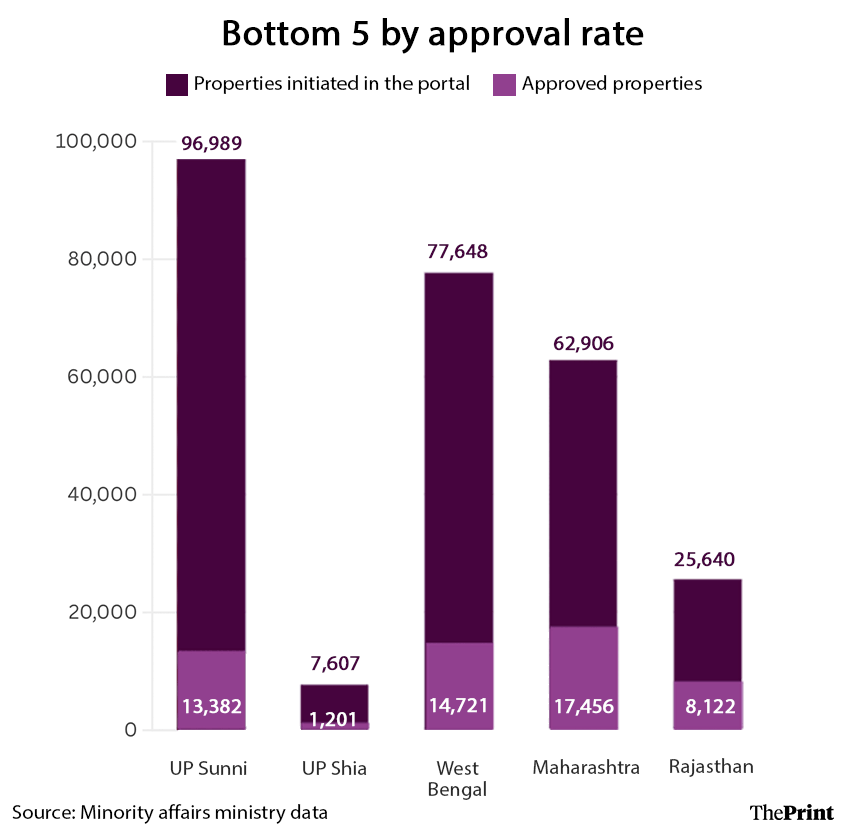
The UP Sunni Waqf Board administers the single largest concentration of waqf property in India—over 2.17 lakh properties maintained under WAMSI. However, of its 96,989 entries in the current digitisation pipeline, only 13,382 have been fully approved—a completion rate of 14 percent. Nearly 68,000 records are stuck with Checker. The state’s Shia sect has 7,607 entries on the portal and 1,201 approvals—16 percent completion rate.
West Bengal, for months, did not issue guidelines for implementation of the UMEED Act.
Chief Minister Mamata Banerjee initially declared the law would not be implemented in the state at all. Protests against the Act in Murshidabad district turned violent—three people died and over 100 were reported arrested. Banerjee’s government challenged the law in court and did not get a favourable ruling.
Then, in late November last year, less than 10 days before the 6 December deadline for Umeed registration, West Bengal’s minority development department secretary sent a letter to all district magistrates instructing them to upload waqf property data on the portal.
Government data from the portal perused by ThePrint shows that West Bengal has 77,648 entries—the second-highest in the country—and only 14,721 have been approved. A 19 percent completion rate. The Checker backlog stands at 50,816.
Punjab presents a contrasting picture. Of 26,187 total entries, 25,216—roughly 96 percent—have been fully approved. Punjab’s approval rate is the highest for any major state waqf board. It is also the state whose formal complaints most vividly document the conditions under which that figure was achieved.
In one complaint on the portal, the Punjab Waqf Board calculated that over 24,000 property entries, the checker and approver process—requiring 138 mandatory Yes/No checkboxes per property—amounted to over 66 lakh total clicks across both verification tiers.
“A significant operational bottleneck consuming excessive time,” the board wrote, with no bulk-action alternative available.
Its other complaint described the portal in the final days before the deadline.
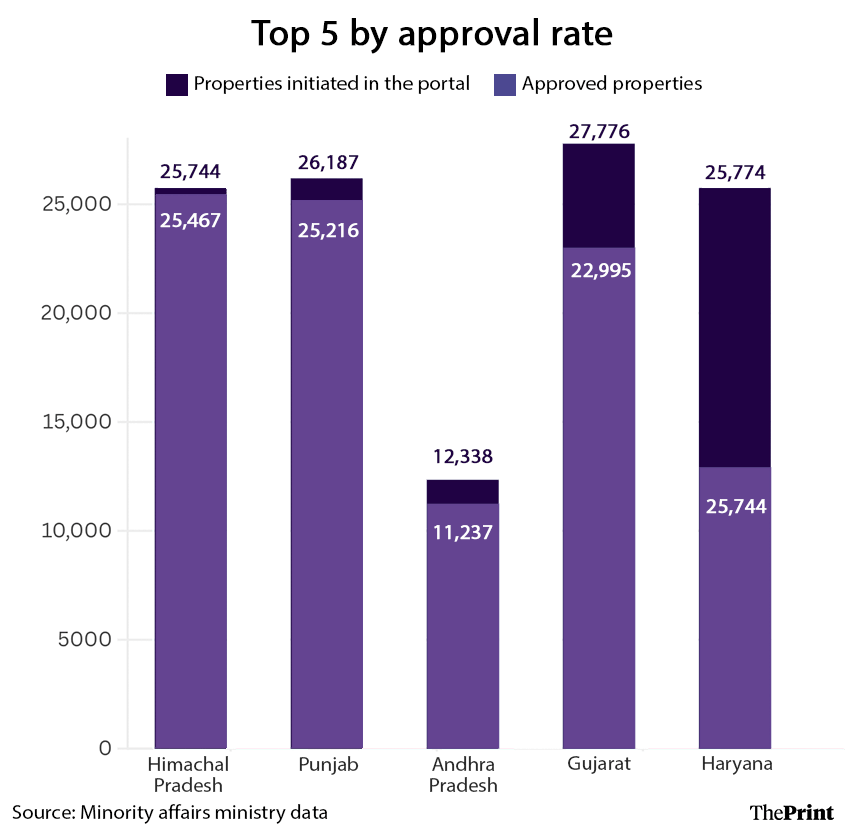
In other data from the ministry, Telangana has 62,917 entries on the portal with 26,574 approved—a 42 percent completion rate, with 10,118 rejections. The rejection rate for the state stands at 16 percent against the national average of 6 percent. Maharashtra has 62,906 entries with 17,456 approved (28 percent); Gujarat has 27,776 with 22,995 approved (83 percent). Andhra Pradesh had an approval rate of 91 percent.
Also Read: ‘Even Parliament could’ve been claimed as Waqf property’: Kiren Rijiju defends amendment bill in LS
A look at complaints
While the ministry data from the portal captures output figures, the record of formal complaints on the portal by state waqf boards and individual mutawallis documents the conditions under which those figures were produced.
The CEO of the Andhra Pradesh State Waqf Board wrote that “the portal frequently displays ‘UNDER MAINTENANCE’ notices, and often throws unexpected errors, even after multiple attempts”.
The complaint noted that “the registration of even a single Maker is taking an entire day, which is highly impractical and counterproductive given the strict timelines fixed by the ministry”. AP has one of the better completion rates on the portal.
The Odisha Board of Waqf flagged a structural problem: when a mutawalli managing more than one waqf tried to register a second property, the portal returned an error—“user already exists with same mobile number and email-ID”—effectively blocking any mutawalli overseeing multiple properties from completing their legal obligation under the Act.
The Bihar State Sunni Waqf Board reported being unable to begin work at all for an extended period because “the list of village names is still not being reflected in the address of applicant”. The board also reported being locked out of the portal’s administrative backend.
Maharashtra’s nodal officer documented that fields marked as non-mandatory on the form, including annual accounts and audit reports, were nonetheless blocking final submission.
The state also reported that over 5,000 registered cash and movable waqf properties could not be uploaded at all: the portal mandates land area and survey number fields that do not exist for non-immovable assets. The ministry’s response, according to the complaint, was: “Register after 05.12.2025”, post the deadline.
Other complaints on record document major urban areas—including Jaipur within Jaipur district, and Muzaffarnagar Municipal in UP—not appearing in the portal’s location dropdowns because they are absent from the underlying LGD (Local Government Directory) database the portal depends on; and properties being auto-assigned to the wrong state board because the system reads the mutawalli’s residential address rather than the property’s location.
And in Bihar, Burhanuddin Ahmad, mutawalli of a waqf created when Aurangzeb had been dead for a decade, was still writing to the helpdesk, unable to upload a waqf village.
The larger picture
The UMEED Act was passed by the Lok Sabha at midnight in April last year and by the Rajya Sabha two days later, after a 17-hour debate. More than 65 Supreme Court petitions challenging it led to a partial stay on two provisions in September.
A separate analysis of WAMSI data, the portal that preceded Umeed, shows that only 9,279 ownership documents have been uploaded for 8.72 lakh properties, and only 1,083 waqf deeds are available digitally. The status of 50 percent of properties is simply unknown. Approximately 7 percent are recorded as encroached upon and 2 percent under active litigation.
Umeed data from the ministry does not assess portal functionality, complaint resolution or the accuracy of approved entries. It records, board by board and state by state, the distance between properties entered and properties cleared. By that measure, three months after the statutory deadline: 44.5 percent waqf properties have been approved nationally; 14 percent in the country’s largest waqf state; and 96 percent in Punjab, the highest approval for any state.
The complaint record documents the difficult conditions under which those numbers were produced.
(Edited by Nida Fatima Siddiqui)
Also Read: Govt intent to ‘reform’ waqf is suspicious. Consult Muslims first