









Hyderabad: Over a decade ago, an NRI couple raising a child with autism and struggling to conceive returned from the US to their home in Hyderabad, then in undivided Andhra Pradesh. There, they sought the help of gynaecologist Dr Pachipala Namratha, whose fertility clinic in Secunderabad had a reputation for successful outcomes.
The couple, in October 2014, welcomed a son, born—they believed—through in-vitro fertilisation (IVF) and surrogacy. The boy was loved and celebrated, and introduced to the extended family with a grand Annaprasana ceremony (when the child is fed solid food as a rite of passage).
The first sign that something was amiss came nine months later, not in a hospital room but in the waiting area of the US Consulate in Hyderabad. The couple, by then planning to return to the US, had to apply for his passport. Because the child was born through surrogacy, American authorities mandated a DNA test.
The results did not match.
When they confronted Namratha, she allegedly called it a “very common” medical mistake and offered them a resolution: return the baby, and she would provide another child “free of cost”, according to the police charge sheet.
That exchange, and the years of anguish that followed for the couple, would prove to be not an aberration but an introduction—an early glimpse into what investigators now describe as a decade-long criminal enterprise spanning two states, involving dozens of ‘agents’, hundreds of falsified documents, and an unknown number of newborns stripped from impoverished families and sold to couples under the guise of surrogacy.
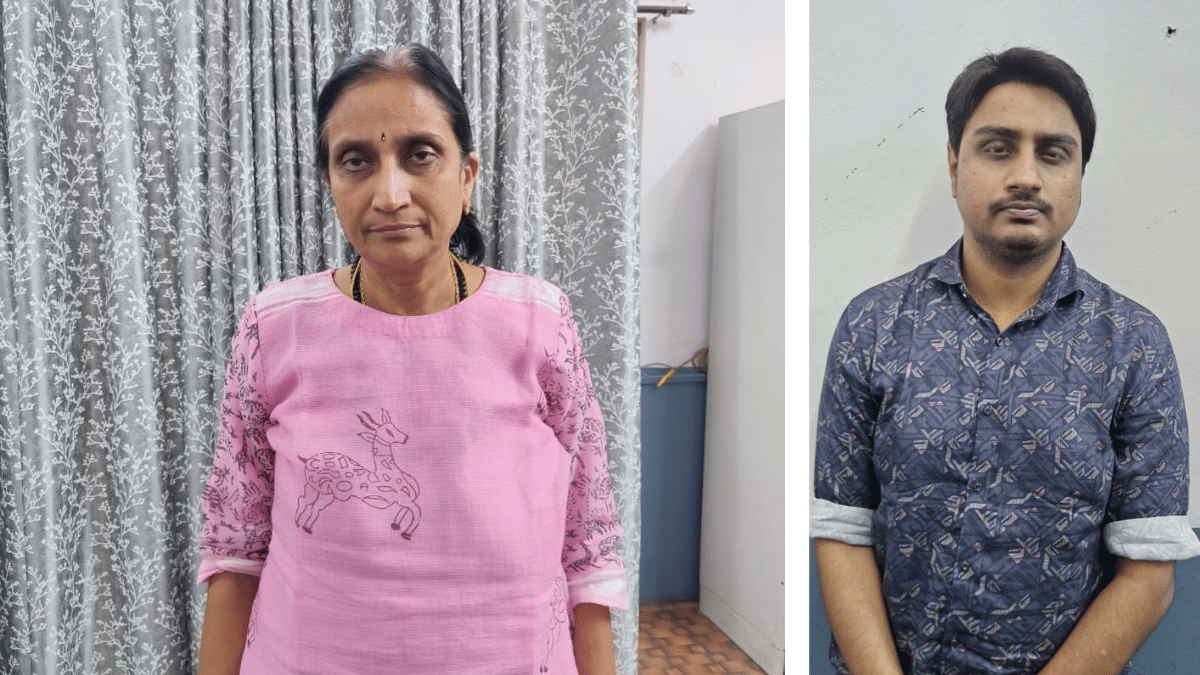
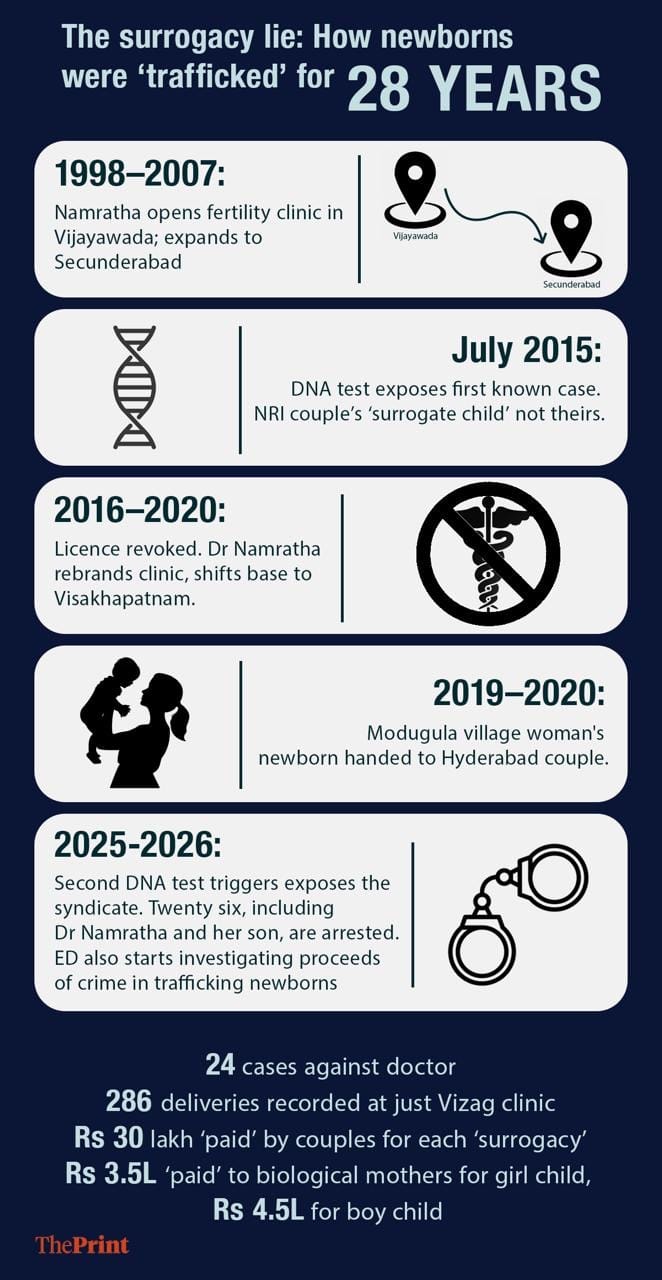
A case was filed at the time, but it was a second DNA report in July 2025, a decade later, which finally blew the lid off the syndicate. In the weeks that followed, Hyderabad police arrested Namratha, her son and 24 others after a couple from Rajasthan’s Jhunjhunu reported a similar fraud.
The doctor spent four months in custody and secured bail in November last year—only for the Enforcement Directorate to arrest her on charges of laundering the proceeds of her trafficking operation earlier this month.
A Special Investigation Team (SIT) of Telangana Police and the ED are now following financial trails, tracing the movement of funds, and tracking down couples and biological parents of children who were allegedly trafficked.
Namratha’s counsel Y. Soma Srinath Reddy said his team is in the process of filing applications. “We are taking steps in accordance with the law and appropriate applications will be filed before appropriate forum,” Reddy told ThePrint.
Also Read: Couples who had frozen embryos before enactment of surrogacy law not bound by age bar, says SC
Case filed, practice continued
Based on the 2015 complaint, Namratha was charged under sections 406 (criminal breach of trust), 415 and 420 (cheating), and 506 (criminal intimidation) of the Indian Penal Code—none of which are non-bailable offences, and she was never arrested.
The Telangana State Medical Council revoked her licence in 2016, but Namratha challenged the decision before the Telangana High Court, which directed a fresh consideration. The council reaffirmed the suspension, which held until 2020.
On 30 May 2018, even as the legal battle played out, Namratha’s clinic transformed on paper: Srusti Test Tube Baby became Universal Srushti Fertility and Research Centre. By then, she was running two clinics–one each in Secunderabad and Visakhapatnam.
In 2021, a year after being arrested briefly in a second trafficking case, Namratha surrendered permissions granted for surrogacy at her Secunderabad facility. From there on, the syndicate’s base operation shifted to Visakhapatnam, police said.
“The practice never stopped. It had only gone up,” an investigator in Hyderabad told ThePrint.
Namratha was born and raised in Vijayawada. She moved to Visakhapatnam for her MBBS, and completed an MD in Gynaecology from J.J.M. Medical College in Karnataka’s Davanagere.
During interrogations, police said, Namratha told them she had opened her first fertility centre in 1998 in Vijayawada, and expanded to Secunderabad around 2007, before the latest shift to Visakhapatnam.
Over the years, she extended her reach to consultancy centres in Kolkata (West Bengal) and Bhubaneshwar (Odisha), though Visakhapatnam remained the nerve centre of the operation.
100% success rate, database & targets
The operation was self-contained and methodical.
It began with marketing. Advertisements promising 100 percent success rate were circulated across social media and on the internet, drawing couples—many of them childless for years—to Namratha’s clinics. Once a couple agreed to proceed, a parallel and entirely separate process was set in motion, police found.
“People such as staff and drivers at her centres were encouraged to find pregnant women from the vulnerable and marginalised sections of society to cater to the childless couples coming to her clinic after being blinded by her 100 percent success rate advertisement and campaigns over social media and the internet,” a police officer involved in the investigation told ThePrint.
Investigators allege that Namratha never actually used the gametes collected from couples for IVF or surrogacy. Instead, her agents—a network that allegedly included ASHA workers, clinic employees and independent contractors—maintained a running database of pregnant women. Women primarily from rural areas near Vizag and Vijayawada were targeted, as well as from government hospitals and OPDs across Hyderabad.
The mechanism, police said, was timed with precision.
Once a couple confirmed its commitment and provided biological samples, Namratha’s clinics would match the couple’s committed delivery date against their own database of pregnant women.
“After the collection of samples and confirming with the couple about the conclusion of the process of embryo formation, Namratha used to alert her agents on prospective women who could deliver a child in the timeframe when the couple was given a commitment for delivery of their biological child,” a second police officer explained.
When timing was critical, according to an ED submission to a Hyderabad court earlier this month, medication was administered to induce labour and advance delivery to match the promised date.
In some other cases, women from poorer backgrounds were allegedly cheated into giving up their child.
In the case that led to Namratha’s arrest in 2020, a woman from Modugula village of Visakhapatnam accused the fertility clinic in the coastal city of selling her newborn.
In her statement to the police, made part of the charge sheet, the woman said her pregnancy was the result of a relationship she’d gotten into with a man from her village years after her husband died. A confrontation ensued when her family found out about this.
In her eighth month of pregnancy, she confided in ASHA workers Kodi Venkata Lakshmi and Botta Annapurna about the family dispute.
Investigators said Lakshmi and Annapurna were both doubling as paid agents for Namratha’s clinics.
On their advice, the woman was brought to Namratha’s Visakhapatnam facility in February 2020.
Namratha allegedly instructed ASHA worker Kodi to ensure the woman remained at the hospital until 8 March that year on the pretext of offering free delivery care. The newborn was handed over to a Kolkata-based couple immediately after birth, the charge sheet filed in the case said. It added that the local woman was unaware of the transaction, though it did not specify how.
A police case was registered only after an anganwadi worker in Modugula noticed that the woman had returned to the village without a child, and alerted the authorities.
While probing this case, police drew similarities to the 2015 NRI complaint.
“Investigation revealed that A1 (Namratha) used to conduct medical camps at rural areas where she advertised her hospital success rate and attracted innocent & hopeful couples. She also activated the agents by providing financial benefits,” the charge sheet said.
In other instances, children were simply bought from poor families, police said.
According to case records, biological parents were given on average Rs 3.5 lakh for a girl child and Rs 4.5 lakh for a boy child. The agents allegedly received approximately Rs 50,000 per newborn. And the couples who went home with the children paid as much as Rs 30 lakh to the clinics.
A law ignored, paperwork choreographed
In India, the Surrogacy (Regulation) Act, 2021, bans commercial surrogacy involving an unrelated surrogate mother and stipulates that only a close relative of the ‘intending couple’ can serve as surrogate, provided there is no monetary compensation involved.
The law initially banned the use of donor sperm or eggs, though the restriction was later lifted through a 2024 amendment for couples with medical conditions, as well as divorced or widowed women.
For Namratha’s syndicate, none of the norms were heeded.
To ensure that no records established the existence of biological parents, forged birth certificates were prepared directly in the names of recipient couples and no DNA tests were ever conducted, investigators said.
The entire process mandated under the surrogacy law—including a medical certificate of infertility from the district medical board, an order from the local magistrate court, and certificates of essentiality and eligibility for both the couple and the surrogate—were all forged.
“This was a plain child trafficking scheme disguised as surrogacy and legal process. There was no inclination to even try the surrogacy methods to deliver results. The accused searched for prospective women whose delivery dates matched the dates she committed to the couples, intending for surrogacy and handed the newborns to them with forged birth certificates in their name without any DNA test,” a second investigator said.
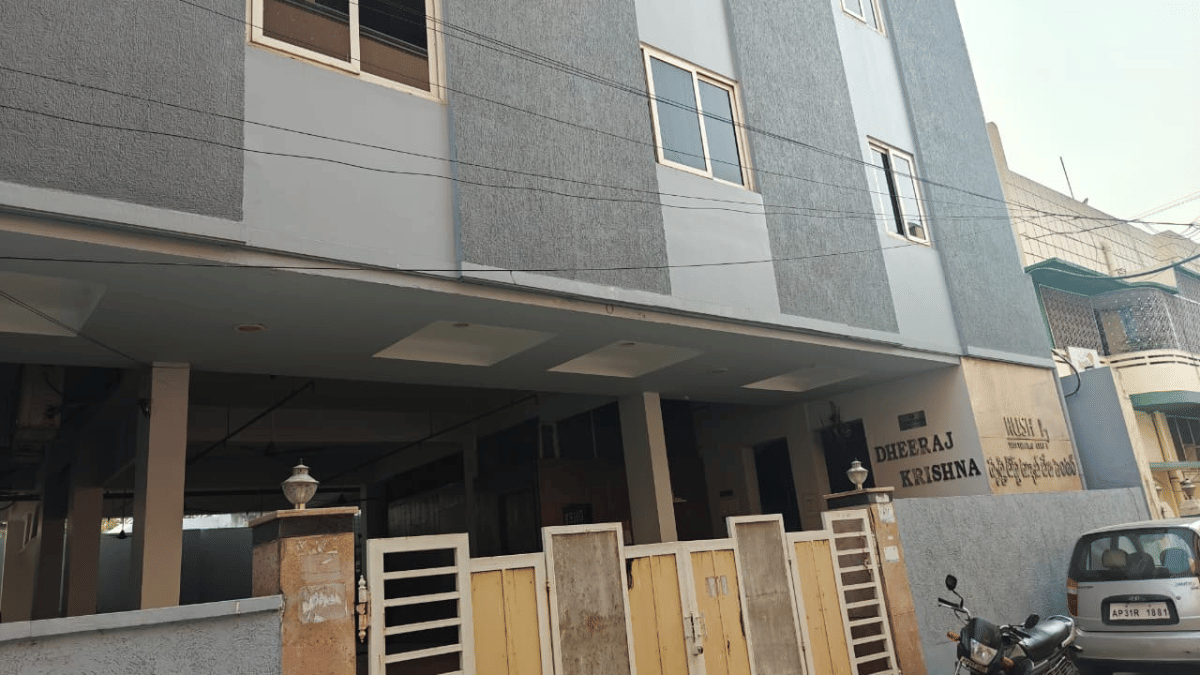
This legal scaffolding was set up within the family, police said, pointing out that Namratha’s son and lawyer Pachipala S.S. Jayanth Krishna ran his office from the same premises as the Secunderabad clinic.
When a 49-year-old Hyderabad resident—a private-sector employee who got married in 2017 and whose wife was unable to conceive for years—approached her clinic, Namratha invoked her son’s authority to provide reassurance: “…that entire process is legal, me and my son Jayanth Krishna will look after all your surrogacy legal procedures,” she allegedly told the couple, according to the investigation.
Agents on the ground
Police said some of the ‘agents’ began as donors at Namratha’s clinics.
One of the key accused named by police is Dhanasri Santoshi. The SIT formed last year told a Hyderabad court that Santoshi supplied a list of pregnant women to Namratha clinic.
Santoshi allegedly began as an egg donor for Namratha’s clinic before joining the syndicate as a field agent in 2024. Maharashtra Police arrested Santoshi in a separate child trafficking case the same year, police said.
CCTV footage, the SIT alleged, documents her active role in the network.
Starting January 2024, Namratha transferred approximately Rs 20 lakh to Santoshi in multiple tranches—funds that were quickly channelled into other bank accounts belonging to Santoshi or to women who had agreed to give away their newborns, a third investigator told ThePrint.
Another accused is Harsha Roy, who was arrested for allegedly being involved in Namratha’s operations by Hyderabad Police in July 2025 and was granted bail soon after. Months later, in December, she was arrested again, this time by the Cyberabad Police in a similar child trafficking case.
Balagam Saroj, identified by investigators as another one of Namratha’s agents, allegedly got three pregnant women to give up their newborns. This included a woman named Karuna, whose newborn was handed over to a couple in Hyderabad, the SIT told the court last year.
This couple went on to register a complaint against Namratha in August 2025.
A mother-daughter pair of Kadoor Ratnam and Kona Meenakshi from Hyderabad were also identified as agents, with investigators flagging fund transfers from Namratha to their accounts.
Meenakshi, like Santoshi, was initially an egg donor before assuming a more operational role, the SIT said. Shahina, from RangaReddy district of Telangana, followed the same trajectory. She, too, was arrested once previously by the Suryapet Rural district police before her arrest in the Namratha case.
All of the suspected agents are out on bail currently.
24 cases, scale unknown
Overall, at least 24 police cases and the money laundering case have been registered against Namratha and her associates in Telangana and Andhra Pradesh.
Investigators estimate that at least 286 deliveries were recorded at the Visakhapatnam hospital alone. They suspect the actual numbers for trafficking may be a lot more.
“There are no definitive numbers of newborns that Namratha and her syndicate may have trafficked for money, but surely whatever has been found so far is unfortunately just the tip of an iceberg,” a third police officer said.
The officer added, “The tricky thing with cases like these is that victims do not come forward, citing embarrassment or family pressure. Even if some of them might have doubts about the lineage of the child they obtained in the name of surrogacy from Namratha. That’s why we get one FIR followed by several more, and then nothing in between.”
Separately, the ED case hinges on immovable assets worth crores of rupees–flats, plots and commercial spaces–allegedly accumulated by Namratha. The agency is yet to issue an attachment order.
Namratha remains in judicial custody in the ED case and is lodged at Chanchalguda jail in Hyderabad. Her son, arrested in the 2025 trafficking case, is out on bail.
It isn’t clear what happened with the children whose DNA tests were carried out in 2015 and 2025. Police said there’s a possibility that some children may have been sent to shelter homes, while some couples may have decided to keep the babies who weren’t biologically theirs.
The multi-storey building in Secunderabad where the fertility clinic once operated now wears a deserted look—the signboard is faded, and letters on it are gone. For the families who passed through its doors, on both sides of the transaction, the damage endures.
(Edited by Prerna Madan)
Also Read: What happens to sex workers after police raid? New book breaks shelter home myths