





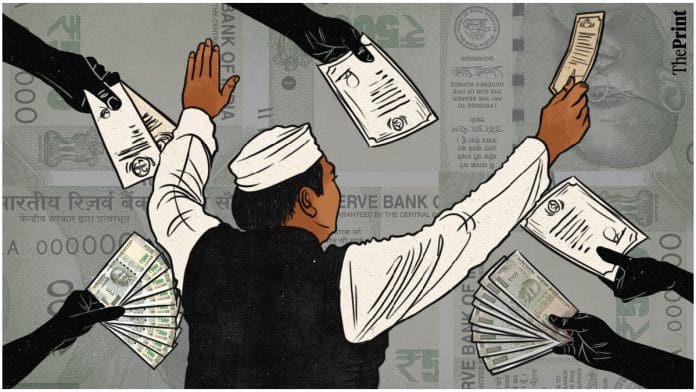


New Delhi: Electoral trusts have once again become the go-to channel for corporate political donations after the Supreme Court invalidated electoral bonds, ruling that their blanket anonymity violated voters’ right to information under Article 19(1)(a).
In FY25, donations channeled through political trusts tripled to ₹3,811 crore from ₹1,218 crore the previous financial year, with nine active trusts channeling 98 percent of funds through just three dominant vehicles. The BJP’s total FY25 donations hit ₹6,654 crore (including trusts), dwarfing Congress’s ₹539 crore.
The Supreme Court had in February 2024 struck down electoral bonds, saying they enabled unlimited anonymous contributions, shielded potential quid pro quo from public view and undermined informed electoral decisions.
Post-verdict, corporates faced a binary: revert to direct donations—capped at ₹20,000 per donor for anonymity, per ECI rules—or risk non-compliance. This prompted a rush to trusts as the only scalable, tax-efficient bridge still standing under Electoral Trusts Scheme, 2013.
The shift to electoral bonds was largely substitute-driven, with bonds having captured 90 percent of corporate funding pre-2024 due to their bearer-like ease (bearer instrument sold solely via SBI), but their demise funneled donors back to trusts, which had lain dormant at low volumes (e.g., five trusts in FY 23-24). Under the tax incentive, Section 80GGB of the Income Tax Act, full deductions are available for corporate trust donations, while trusts’ 95 percent pass-through rule ensures a relatively quick deployment to parties ahead of polls.
ThePrint explains how electoral trusts work and how they are different from electoral bonds.
Also Read: What is ‘electoral bonds extortion’ complaint that led to FIR against Sitharaman, BJP office-bearers
Bonds vs trusts
Electoral bonds were interest-free bearer instruments issued by the State Bank of India in fixed denominations (₹1,000 to ₹1 crore), bought by donors and encashed only by parties within 15 days, with no public record of buyer or recipient linkage.
Trusts, by contrast, are non-profit companies registered under Section 8 of the Companies Act (post-2013), collecting via traceable modes (cheque/electronic transfer) from PAN-verified Indian entities or citizens, then disbursing 95 percent annually to RPA-registered parties via board decisions.
The critical difference is that electoral bonds required no public disclosure whatsoever, either the purchaser or the redeeming party, thus making them fully opaque to the electorate.
Trusts, meanwhile, mandate annual filings with the Election Commission and tax authorities that list all donor entities by name and all party recipients, yet the filings do not spell out how much each donor gave to each party.
This creates what critics call “anonymity-lite”. The donor knows they gave to a trust, the trust knows the party received funds, but the public cannot draw a direct line from specific corporate donors to specific party payouts, particularly when a single trust pools money from dozens of companies and then distributes to multiple parties.
Further, electoral bonds could theoretically be bought by foreign entities using shell companies (though nominally barred), whereas trusts are restricted to Indian citizens and India-registered firms, closing a loophole that could have enabled foreign indirect influence.
Who can donate to trusts?
Eligible contributors include Indian citizens (with PAN), India-registered companies, firms, HUFs, or associations of persons.
NRIs need passport numbers and foreign entities are outright barred to prevent overseas influence.
Donations must flow through banking channels; cash is prohibited under the scheme, and contributors must self-certify that funds are not proceeds of illicit activity.
Who receives funds through trusts?
Only parties registered under Section 29A of the Representation of the People Act, 1951, qualify, with trusts’ boards deciding allocations based on internal consultations that mirror donor preferences without explicit mandates.
Smaller parties and those without institutional backing find it harder to access trust funds, since donors often informally signal their preferred recipients, and trust boards tend to align allocations accordingly.
How many trusts exist?
As of FY25, 19 electoral trusts were registered; 13 had filed reports by December 2025, nine made substantial donations, and four reported nil contributions.
This shows episodic use tied to election cycles. Some trusts remain dormant for years. There is a spike in activity before major polls, suggesting they function as “on-demand” channels as seen in the 2014 Lok Sabha polls when 14 new trusts were activated as elections neared.
In FY25, nine electoral trusts reported contributions totaling ₹3,811 crore to political parties. Three trusts, Prudent, Progressive, and New Democratic, accounted for 98 percent of all trust donations in this period.
Prudent Electoral Trust was by far the largest, receiving ₹2,668 crore from companies including L&T (via Elevated Realty, ₹500 crore), Jindal Steel, Megha Engineering, Aurobindo Pharma, and Torrent Pharma. Prudent then distributed ₹2,181 crore to political parties, with the BJP receiving the bulk of these funds.
Progressive Electoral Trust, of which Tata Group companies are a part, received ₹915 crore and distributed approximately the same amount, again with the BJP as the primary beneficiary of the corpus.
New Democratic Electoral Trust, of which Mahindra Group is a part, received ₹160 crore and distributed it similarly, though at a smaller scale.
At the party level, the BJP received approximately ₹3,112 crore via electoral trusts in FY25, representing 82 percent of total trust donations.
The Congress received approximately ₹299 crore, less than 8 percent of the total. Remaining opposition parties and regional outfits (TMC, YSRCP, AIMIM, and others) collectively received under 10 percent of trust funds.
When combined with direct donations and other channels, BJP’s total political funding in FY25 reached ₹6,654 crore, more than twelve times the Congress’s ₹539 crore.
The post-bonds trust surge arrives in the backdrop of India’s electoral calendar tightening around 2026 state elections.
The Election Commission has remained publicly silent on trust reform, issuing no guidance beyond the existing disclosure rules under the 2013 scheme.
As reported by The Indian Express, Congress leader Rahul Gandhi, speaking from Berlin on 23 December, alleged that the ED and CBI were pressuring businessmen who support the Opposition. His remarks came amid Election Commission disclosures showing the BJP received ₹3,112 crore via electoral trusts, compared with ₹299 crore for the Congress.
Hrishikesh Aiyer is an intern with ThePrint
(Edited by Varnika Dhawan)
Also Read: Fewer ‘political consequences’, can help curb black money — why SC prefers electoral trusts to bonds