





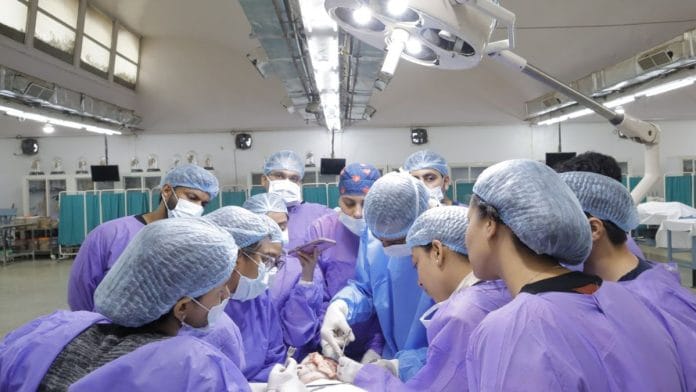



New Delhi: More than a vehicle for breathing, smelling, speaking, seeing, tasting, drinking and chewing, our face is our identity—it is how we are recognised and how we recognise ourselves. At the All India Institute of Medical Sciences (AIIMS), New Delhi, surgeons are preparing to attempt what fewer than 50 teams worldwide have achieved—replace a face to restore a life.
If successful, the programme will not just add a new procedure to India’s surgical repertoire. It could redefine what is possible in restorative medicine: Where the goal is not a new look, but the return of everyday human functions we take for granted.
The AIIMS programme will be led by the Department of Plastic, Reconstructive & Burns Surgery, which became operational in 2021. According to AIIMS, the department performs over 8,000 procedures annually and more than 250 complex microsurgical reconstructions each year.
Addressing a press conference, Dr Maneesh Singhal, Head of the Department, Plastic, Reconstructive and Burns Surgery, AIIMS, said the surgery is being planned for patients with severe facial disfigurement due to burns, trauma or congenital conditions, where multiple reconstructive surgeries have failed to deliver satisfactory results.
“In spite of very advanced reconstruction procedures, there are patients for whom we are not able to achieve the result they want. For some of them, face transplant may be the only option,” he said.
Singhal stressed that the procedure is not meant to improve appearance alone. “These patients cannot eat properly, cannot speak, cannot close their eyelids, and live with pain. The aim is to restore function,” he said.
Globally, around 50 face transplants have been performed, largely in the United States. In Asia, the procedure has been reported in Turkey and China. “No centre in India currently runs a full face transplant programme,” AIIMS officials said.
Doctors said the first transplant at AIIMS could take up to a year, depending on recipient registration, donor availability and regulatory approvals.
Also read: Hand transplant surgeries to now be regulated centrally through a nationwide database
Face reconstruction vs face transplant
A face transplant is considered for patients with severe facial disfigurement due to burns, accidents or birth defects. The surgery can involve replacement of facial skin, nose and nasal structures, eyelids, lips, arteries and veins, muscles required for facial movement, sensory nerves and, in some cases, portions of bone that support facial features.
The recipient, in a face transplant, does not acquire an entirely new look.
“In most cases, donor tissues are grafted onto the patient’s existing bone structure, so the final appearance does not change significantly,” Dr Singhal said.
Beyond aesthetic considerations, the primary goal is functional restoration.
Dr Singhal explained that the procedure can help restore chewing, swallowing, speaking, smelling, blinking and facial sensation. These are abilities often severely compromised in patients with extensive facial damage.
The Department of Plastic, Reconstructive & Burns Surgery at AIIMS has already been conducting facial reconstruction surgeries in survivors of acid violence. However, face transplant differs from facial reconstruction.
Reconstruction typically involves moving a patient’s own tissue from areas such as the thigh, back or chest to rebuild damaged facial regions over multiple surgeries in stages. These surgeries are typically done to restore structure and function, and are not useful in cases of extensive tissue loss.
However, in face transplant, doctors explained, large segments of damaged tissue are replaced with donor tissue in a single, highly complex procedure, particularly when repeated reconstructive efforts have failed.
Donor matching, lifelong follow-up key challenges
The surgery involves harvesting skin, blood vessels, nerves and sometimes bone from a brain-dead donor and transplanting them to a recipient. As in other organ transplants, the donor must be declared brain dead.
“But it is not easy to find a suitable donor,” Dr Singhal told ThePrint. “Matching goes beyond blood group and tissue compatibility. It also requires skin colour match,” he said.
AIIMS is yet to apply for a licence from the state organ transplant authority, though preparations and inter-department discussions have been underway for months.
“We would aim to register at least 10 to 20 potential recipients over the next six months and will soon get a licence,” Dr Singhal said.
Dr Indranil Sinha, Associate Chief of Plastic Surgery at Brigham and Women’s Hospital (Harvard Medical School), Boston, who visited AIIMS Friday, said that patients who undergo face transplantation require lifelong immunosuppression, similar to kidney or heart transplant recipients, and rejection remains a major concern.
“Some people reject at one month, three months, six months. We monitor them closely,” he said.
Dr Dipankar Bhowmick, Professor and Head, Department of Nephrology, said that AIIMS has experience managing transplant rejection in kidney patients. “The anti-rejection drugs are the same. We use a triple-drug regimen—steroid, tacrolimus and mycophenolate,” he said. These medicines increase the risk of infections and kidney damage and require regular monitoring.
Months of planning before surgery
Dr Sinha, who has been part of 10 face transplants in the US, said the operation typically lasts between 16 and 24 hours because of the complexity involved in connecting multiple blood vessels, nerves, muscles and sometimes bone in a single sitting. He emphasised that months of preparation precede the actual surgery.
Explaining the pre-procedure preparations, he said that potential recipients are first evaluated by a transplant surgery team to assess whether the procedure is technically feasible.
“Psychiatrists assess the patient’s mental preparedness and ability to adhere to lifelong medication and follow-up. Immunology specialists examine the risk of rejection and determine compatibility with potential donors and detailed CT scans are studied to map blood vessels and plan how donor and recipient structures will be connected,” Dr Sinha told ThePrint.
He said that surgeons also conduct rehearsal exercises to practise the sequence of steps and anticipate technical challenges before operating on a live patient.
AIIMS officials said the surgery would require a multidisciplinary team because it is not confined to plastic surgery alone. Anaesthesiologists are responsible for keeping the patient stable during the long operation, which can last many hours. ENT specialists help manage the airway and assist with parts of the face that are linked to breathing. Transplant immunology experts check whether the donor and recipient are compatible and later give guidance for medicines needed to prevent the body from rejecting the new face.
Besides, pathologists examine tissues to ensure they are healthy and suitable for transplantation. Meanwhile, organ retrieval teams coordinate with the donor hospital to carefully remove and preserve the facial tissue within a limited time window.
“A harvested face skin only survives for two hours,” Dr Singhal said.
Doctors say organising such a surgery requires the same level of coordination and planning as major organ transplants like heart or liver.
(Edited by Viny Mishra)
Also read: A US man lived two days without lungs. Why it can revolutionise transplant practice