








New Delhi: India needs Rs 2.25 lakh crore more every year to bridge gaps in public health service delivery, and another Rs 1.31 lakh crore to meet shortfalls in health infrastructure, according to a study commissioned by the 16th Finance Commission.
The estimates were prepared by the National Health Systems Resource Centre (NHSRC). The study analysed government health spending using data on health infrastructure standards, staff shortages, and what households spend on medicines and diagnostic tests.
It found that government funding remains insufficient to meet population needs and reduce dependence on out-of-pocket spending by households.
“There is a consensus at the global level on the importance of public spending on health for progress towards Universal Health Coverage (UHC),” the study notes. “India’s government plays a crucial role in advancing progress towards UHC.”
Finance Minister Nirmala Sitharaman had tabled the 16th Finance Commission report in Parliament on 1 February, alongside the Union Budget. The Union Budget 2026-27 saw an allocation of Rs 1.06 lakh crore for the health sector, a nearly 10 percent rise over 2025-26.
The Economic Survey 2023–24 had reported that government health spending reached 1.9 percent of GDP by FY24, which is a meagre improvement from 2021-22. The National Health Policy, 2017, had set a target of increasing public health expenditure to 2.5 per cent of GDP by 2025, a goal India has already missed.
Structuring existing gaps
The study said that evidence from the National Health Accounts (NHA) indicates a gradual increase in public spending on health.
According to the NHA data, which is available only till 2021-22, government health expenditure (GHE) as a share of GDP rose from 1.13 percent in 2014-15 to 1.84 percent in 2021–22. Its share in total government spending also went up from 3.9 percent to 6.12 percent during the same period.
The share of government spending in total health expenditure increased from 29 percent to 48 percent in the same period, the report said.
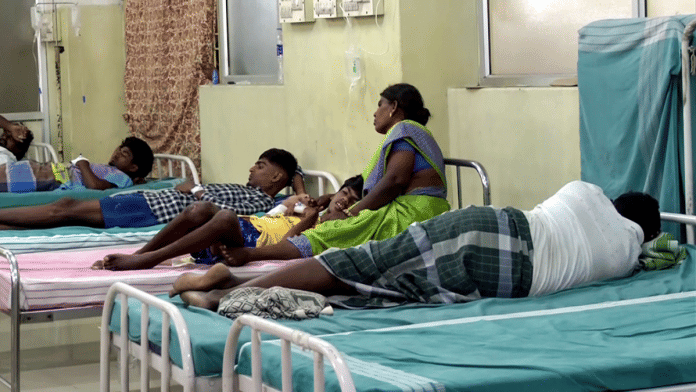
However, this has not eliminated structural gaps. “Despite the progress, problems persist in terms of both the adequate availability of government health infrastructure and the delivery of services in government facilities,” the report stated.
Households continue to pay a large share of healthcare costs, as out-of-pocket expenditure (OOPE) still accounts for around 45 percent of current health expenditure, according to NHA data cited in the report.
“OOPE on health is considered a regressive form of payment as it leads to economic vulnerabilities for households,” the study authors mention.
The study uses a mixed-method approach, combining infrastructure norms under the Indian Public Health Standards (IPHS) with household spending data from the National Sample Survey’s Comprehensive Annual Modular Survey 2022–23.
It examines two parts of the public health system: infrastructure and service delivery. Infrastructure costs cover building sub-health centres, primary health centres, and community health centres. Staff salaries and spending on medicines and diagnostic tests come among others under service delivery costs
The analysis excludes tertiary care such as medical colleges and focuses only on primary and secondary care.
To estimate the funding gap, the study models two scenarios. The first looks only at people who use public health facilities. The other covers the entire population, using household spending on medicines and diagnostics as a measure of unmet public health services.
In the first scenario—limited to people using public facilities—the service delivery gap is estimated at Rs 56,594 crore, or about Rs 409 per capita. When it comes to covering the entire population, the gap rises sharply to Rs 2.25 lakh crore, or Rs 1,627 per capita.
“There exists a wide variation across states in terms of the resources required for ensuring adequate service delivery components,” the study says.
Uttar Pradesh alone accounts for over 16 percent of the national service delivery gap in the second scenario, followed by West Bengal and Maharashtra.
Based on IPHS population norms and current facility shortfalls, the study estimates the total infrastructure gap at Rs 1.31 lakh crore. This gap is unevenly distributed across states. Bihar, UP, Madhya Pradesh, Maharashtra and West Bengal together account for more than half of the total infrastructure shortfall.
In per capita terms, the national average infrastructure gap works out to Rs 945 per person, with wide inter-state variation.
The study finds that government-led health service delivery remains key to improving access to healthcare and reducing financial strain on households. “Health service delivery by the government can be instrumental in ensuring an accessible healthcare system for all.”
Both capital and revenue spending need attention, the authors say, adding that India faces both infrastructure shortages and underfunded health services.
(Edited by Tony Rai)