





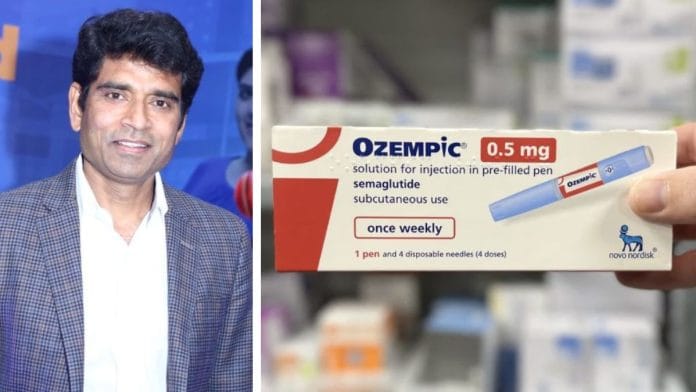



New Delhi: Vikrant Shrotriya is not particularly troubled by the generics.
As Semaglutide—the active ingredient in diabetes and anti-obesity medicines Ozempic and Wegovy—lost patent protection in India and made way for cheaper alternatives, Novo Nordisk’s India managing director said the Danish drugmaker has already moved on.
“Patent expiry is a natural part of the pharmaceutical product lifecycle, and we are well-positioned to navigate this evolving landscape,” Shrotriya told ThePrint in an exclusive interview.
The company’s gaze, he explained, is fixed further ahead: on higher-dose semaglutide, oral formulations and two new therapies—CagriSema and Zenagamtide (Amycretin)—which are advancing under the banner of what it calls cardiometabolic care.
Understanding obesity
The patent expiry is, by any measure, a significant moment for Indian patients. According to Shrotriya, at 250 million, India carries a large burden of obesity. Yet, he said, only around two lakh patients are on GLP-1 treatment today, less than 0.1 percent of those who could potentially benefit.
GLP-1, or glucagon-like peptide-1, is the drug class that mimics a gut hormone to regulate blood sugar and suppress appetite; Semaglutide is its most prominent member.
Cheaper generics are expected to widen access. But Shrotriya argued that price has never been the primary obstacle to adoption in India. “The real challenge is not the price, but a limited understanding of obesity as a disease,” he said.
The commercial wave that followed Ozempic and Wegovy’s global rise arrived more slowly to India, Shrotriya acknowledged, slowed in part by that knowledge gap among patients and, until recently, among clinicians too.
“We have received a positive response from healthcare professionals who are increasingly understanding the value this innovative molecule brings beyond blood sugar control and weight management,” he said, noting that Semaglutide is a recent addition to the cardiometabolic care landscape in India.
Novo Nordisk has nonetheless moved on cost. The company said it reduced injectable Semaglutide prices in India by 37 percent last year, entered partnerships with Indian pharmaceutical companies to launch second brands across both diabetes and obesity injectables, and tied up with telehealth platforms to extend reach.
“We have taken proactive measures to ensure improved access in the local market,” Shrotriya said, adding that the company has a localised pricing strategy and partnerships in place to offer its full Semaglutide portfolio to as many patients as possible.
Novo Nordisk, he said, aims to achieve a meaningful shift through continuous awareness, education and coordinated effort across the Indian pharmaceutical ecosystem. “We welcome players who are motivated to provide scientific, sustainable and patient-centric solutions to collectively help bend the obesity curve in India,” he said.
A new generation already in motion
Oral semaglutide for weight management is already approved and widely available in the US, Shrotriya noted.
Then, on 19 March—the day before Semaglutide lost its Indian patent—the US Food and Drug Administration approved Wegovy HD: a once-weekly injection that delivers Semaglutide at 7.2 mg, nearly three times the standard 2.4 mg dose, for long-term excess body weight reduction.
Next in line is CagriSema, which pairs Semaglutide with Cagrilintide—an amylin (hormone) compound that slows digestion and reduces appetite. This class of drugs target obesity through two hormonal pathways instead of one.
In a 68-week clinical trial, patients on CagriSema lost up to 14.2 percent of their body weight, against 10.2 percent for those on Semaglutide alone. It also outperformed on glycaemic control, reducing HbA1c—a marker of long-term blood glucose levels—by nearly two percentage points on average, compared with 1.76 percentage points for Semaglutide.
Novo Nordisk submitted CagriSema for weight management to the US FDA in December 2025, based on two trials. A regulatory decision is expected by the end of this year.
“The REDEFINE 11 phase 3 trial exploring CagriSema 2.4/2.4 mg full weight-loss potential in obesity is expected to report data in 2027, while initiation of the phase 3 CagriSema higher-dose trial is planned soon,” Shrotriya said.
Further along the horizon is Zenagamtide, also known as Amycretin. Where CagriSema combines two separate molecules, Zenagamtide is engineered as a single molecule designed to activate both GLP-1 and amylin receptors simultaneously—the next frontier in appetite suppression. Phase 2 trials for both subcutaneous and oral forms have been completed; Phase 3 for both is expected in 2026.
“We have invested nearly $20 billion to enhance our manufacturing facilities and R&D globally. We remain steadfast in our leadership in scientific rigour, depth of evidence, patient-centred support and long-term health outcomes,” Shrotriya said.
A crowded market
The prospect of affordable generics flooding a market where obesity is poorly understood as a clinical condition has already drawn regulatory attention. The Central Drugs Standard Control Organisation (CDSCO), India’s apex drug regulator, recently issued an advisory warning against misleading promotion of prescription anti-obesity drugs.
Shrotriya was direct: Semaglutide is a prescription-only medicine, and Novo Nordisk discourages self-medication or any use beyond what is indicated on the label.
“We encourage patients to seek professional advice from doctors who can tailor-make a care regime comprising healthy diet, regular exercise and medical intervention when necessary. It is essential that the regime suits an individual basis their diagnosis, lifestyle requirement and convenience,” he said.
As a patient-centric healthcare company, Novo Nordisk abides by a robust legal, compliance and regulatory framework, Shrotriya said. “The patients are at our very core, and we acknowledge our responsibility towards them.”
(Edited by Prerna Madan)