








New Delhi: Two years after the National Medical Commission (NMC)—India’s apex medical education and regulatory body—set out to create a national register of 13 lakh allopathic doctors, the commission has now said that it is working to speed up the project.
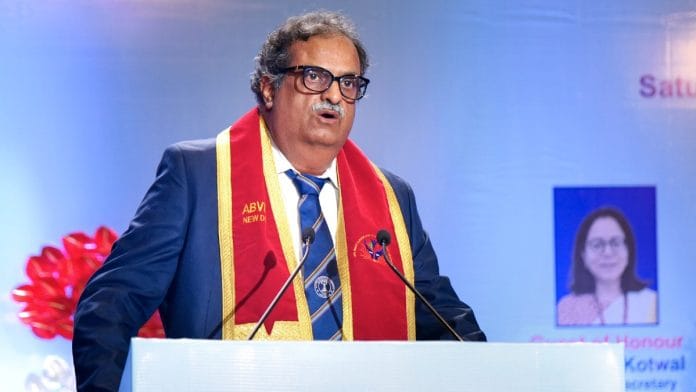
In an interview with ThePrint, NMC chairman Dr Abhijat Chandrakant Sheth said the commission has reviewed the progress of the project.
Dr Sheth also spoke about staffing gaps at NMC, action taken against medical colleges for non-compliance, MBBS fee regulation, and the rollout of the National Exit Test (NExT).
“The commission has finalised a modified plan to move the project forward more quickly and to build momentum,” he said, referring to the National Medical Register (NMR)—a centralised database mandated under the National Medical Commission Act, 2019, to record all licensed allopathic doctors in India.
Launched in August 2024, it is intended to create a single national database of registered medical practitioners, enabling verification of credentials, improving regulatory oversight and enhancing transparency for patients, healthcare institutions and regulators.
Dr Sheth added that the platform will also integrate data from state medical councils, ensuring that all licensed practitioners are reflected in a unified digital register.
While there are an estimated 13 lakh doctors in India, only 10,411 total applications were received by the NMC in the first eight months after NMR was launched.
Of these, 98 percent (10,237) were not approved, NMC had earlier said in response to an RTI query filed by Dr K.V. Babu, a Kerala-based ophthalmologist.
In September last year, the commission had asked all practicing doctors to register on the portal, but many reported technical issues, including Aadhaar mismatches and verification queries.
Dr Babu, who filed multiple RTI queries on this issue, told ThePrint that the idea of a national registry is supported by doctors, but the application system is riddled with technical issues. “I was probably the first person to apply for NMR registration in the country. I applied early in the morning, at 4 o’clock, just as the portal was launched, but it did not happen. I am still not registered,” he said.
He explained that many documents needed for the application are from the pre-Aadhaar period which is why names of many doctors in their Aadhaar card, degrees and state medical council records do not match. In these cases, doctors are asked to file affidavits.
Changes in the names and affiliations of the universities, medical colleges and state medical councils add another layer of difficulty. Following these irregularities, in August 2025, the Union Health Ministry, in a written reply in the Lok Sabha, said that the NMR registrations have been made voluntary and are not mandatory.
Also Read: ‘Calculated step’, or ‘disastrous’ in long run? NMC relaxes medical faculty recruitment norms
NExT rollout to follow wider consultations
On the National Exit Test (NExT)—a proposed examination intended to streamline medical licensing and postgraduate admissions—Dr Sheth said that the Commission is continuing consultations with stakeholders. The NMC had earlier deferred the examination, following feedback from students, medical institutions and other stakeholders.
“The technical framework has largely been worked out. The next stage involves wider consultations to ensure acceptability and smooth implementation,” Dr Sheth said.
He added that the commission intends to proceed in a consensus-based manner, taking into account preparedness across institutions and the concerns raised by students and the medical community. Regarding the 2022 advisory recommending that private medical colleges keep 50 percent of MBBS seats at fees comparable to government colleges, Dr Sheth noted that fee regulation primarily falls within the jurisdiction of state governments.
“NMC has issued the advisory to all states. However, the final decision on fee regulation is taken by the respective state authorities,” he said. The guidelines issued by the Commission under Section 10(1) of NMC Act have also been challenged by some stakeholders in various courts and are presently sub-judice.
Some states, including Telangana, have implemented the recommendation, while others have adopted modified fee structures.
Non-compliance, PPP models
The NMC has also taken regulatory action where institutions were found to be non-compliant with prescribed standards, Dr Sheth said. “The majority of institutions are compliant. A few institutions are not compliant, and action will be taken.”
He added that most non-compliance cases are related to deficiencies in academic teaching resources, support infrastructure and logistical resources.
Dr Sheth said the competency-based medical education (CBME) curriculum, which was introduced to shift from the traditional theory-heavy medical training model to a competency-based approach, has been implemented across colleges. The NMC plans to add mandatory training in basic clinical procedures for undergraduate students. These may include intravenous access, catheterisation and nasogastric tube insertion, he said.
He added that the expansion of medical education through public-private partnership (PPP) models could help address capacity and cost issues.
According to him, several government hospitals already have significant patient load and infrastructure, but are not part of medical education. “If hospitals integrate with education through PPP models, it will help expand training capacity.”
The NMC, which replaced the Medical Council of India (MCI) in 2020, is meant to function through four autonomous boards overseeing undergraduate education, postgraduate education, medical assessment and rating, and ethics and registration.
However, several key posts in the commission and its boards have remained vacant for long periods, slowing decision-making on issues such as medical college approvals, curriculum reforms, and regulatory actions.
Dr Sheth said the process to fill these positions is underway. “The government is in the process of ensuring that the vacancies are filled with the right set of people,” he said, adding that the posts are expected to be filled in due course.
(Edited by Amrtansh Arora)
Also Read: Why NEET-PG’s percentile cut-off was lowered to 0, and why doctors are angry