








New Delhi: India’s breast cancer burden has multiplied dramatically over the past three decades, with new cases rising nearly fivefold since 1990—a surge that mirrors an alarming global trend—a new global analysis published Tuesday in The Lancet Oncology has said.
By examining 2023 data—using cancer registries, government records, and interviews with families of deceased women—researchers who authored the study found a significant increase in both breast cancer diagnoses and death rates since 1990.
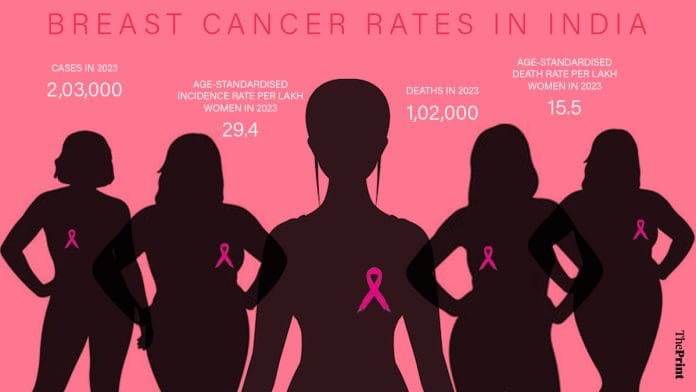
India logged nearly 2.03 lakh new breast cancer cases in 2023, marking a 477.8 percent rise compared to 1990. In the same period, breast cancer deaths reached 1.02 lakh, a 352.3 percent increase.
The age-standardized incidence rate in 2023—what’s obtained after adjusting for population growth and aging—was more than 29 (29.4) new cases per one lakh women, reflecting a 126.9 percent rise in incidence compared to 1990. The age-standardised death rate was over 15 (15.5) deaths per one lakh women, representing a 74 percent rise over three decades.
The study was conducted across 204 countries and territories.
Global—and developing world—pressure
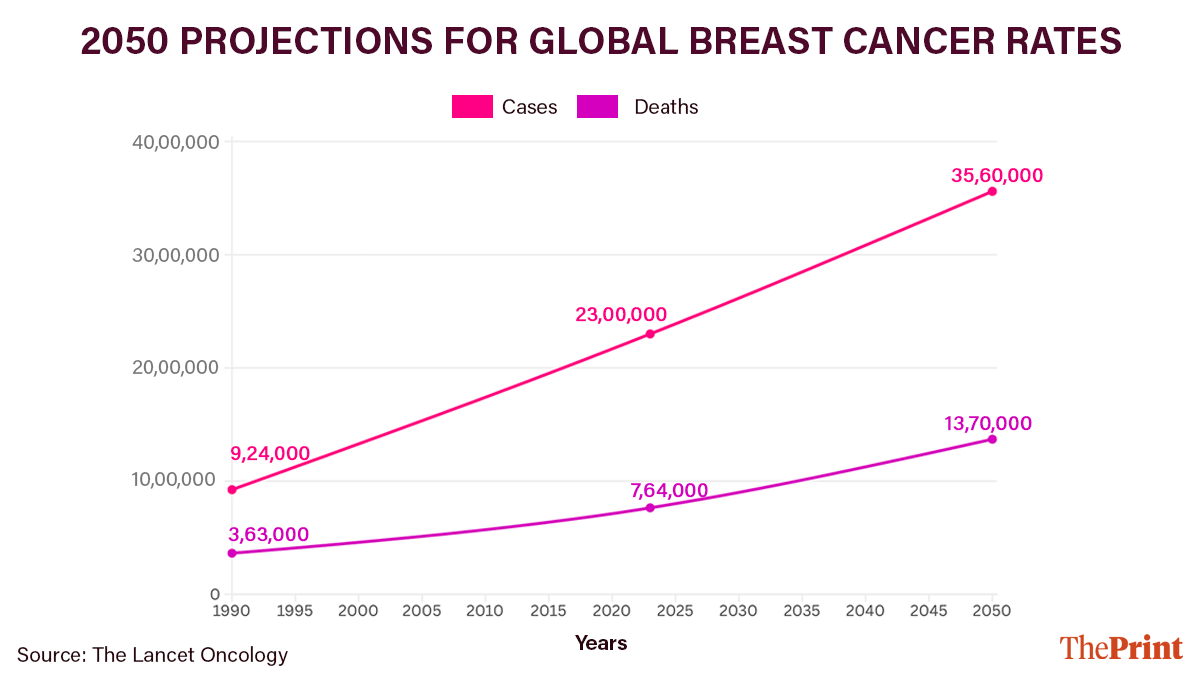
According to the study, breast cancer cases across the world are projected to increase by nearly a third, from 23 lakh in 2023 to more than 35 lakh by 2050. Annual deaths are expected to surge from 7.64 lakh to nearly 14 lakh during the same period.
The projections come when breast cancer is already the most commonly diagnosed cancer among women globally and a leading cause of cancer-related deaths. According to the World Health Organisation, it was the most common cancer among women in 157 of 185 countries in 2022, causing an estimated six lakh deaths a year.
India’s trajectory fits a broader pattern seen across low- and middle-income countries (LMICs), where breast cancer incidence and deaths are climbing rapidly. In contrast, many high-income countries have stabilised incidence rates and reduced mortality via widespread screening and better treatment access.
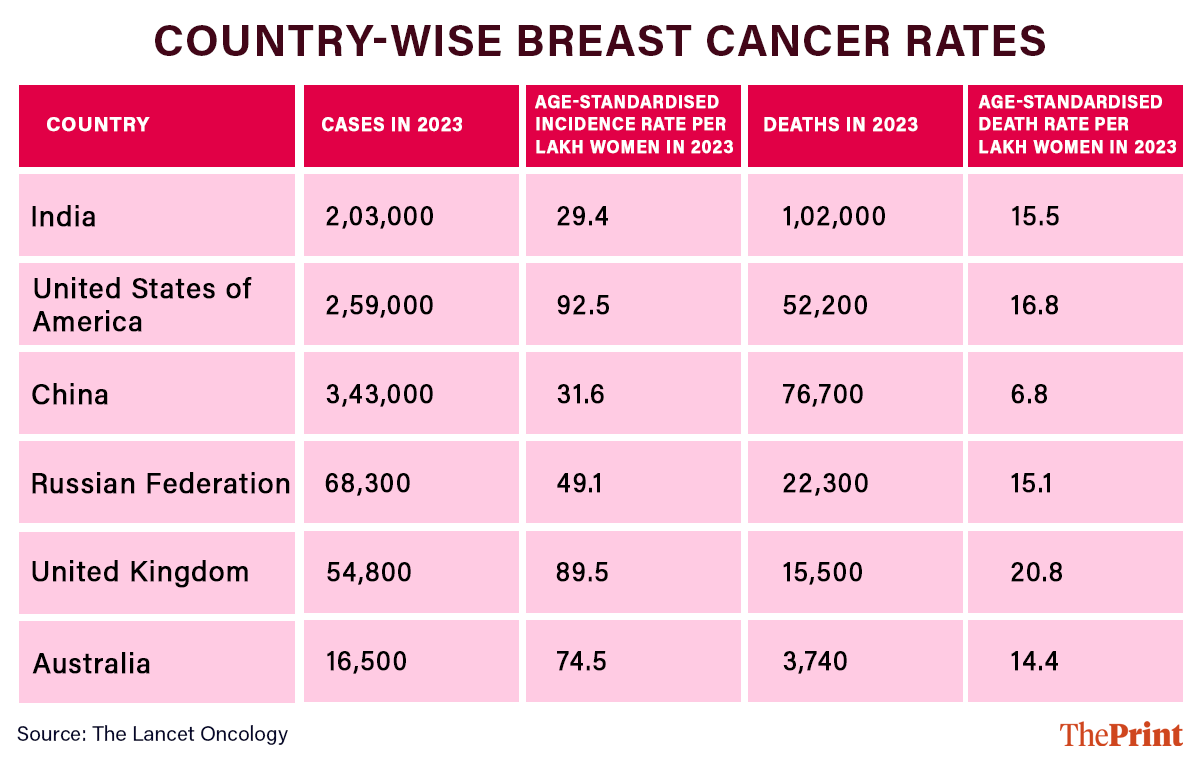
For instance, in 2023, high-income countries (HICs), such as Monaco, Andorra, France, Germany, and Ireland, reported more than 100 new cases per lakh women. Lower-income countries, such as Afghanistan, Somalia, and Mozambique, reported 13 or fewer cases per lakh women.
However, despite having some of the highest incidence rates globally, richer countries are also showing higher detection rates, while poorer countries are witnessing the fastest growth.
Since 1990, new breast cancer cases have increased by 147 percent on average in low-income countries. Meanwhile, death rates have fallen by nearly 30 percent in high-income nations. It, however, nearly doubled in low-income countries, reaching 24 deaths per lakh women.
In 2023 alone, women in low- and lower-middle-income countries accounted for just 27 percent of new global cases but over 45 percent of total years of healthy life lost—nearly 11 million years.
“LMICs are hit hardest by the escalating breast cancer burden as many of these nations grapple with lifestyle and demographic changes alongside health systems that are less equipped than ideal to respond, with shortages of radiotherapy machines, chemotherapy drugs, and pathology labs, and standard treatments that can be quite costly,” said co-author Dr Olayinka Ilesanmi, a physician and epidemiologist from Nigeria working for the Africa Centres for Disease Control and Prevention.
“Although survival continues to improve in HICs, reflecting success in breast cancer screening, diagnosis, and treatment, even within HICs, outcomes can still depend on where a woman lives.”
Also Read: Cancer striking and claiming more lives among Indian women than men, shows ICMR study
Younger women are at risk too
While breast cancer remains more common in older women, younger women are increasingly at risk.
In 2023, there were an estimated 161 new cases per lakh women aged 55 and above, compared to 50 new cases per lakh among women aged 20 to 54.
Globally, since 1990, the incidence among younger women has risen by 29 percent, while rates among older women have largely stabilised.
There are similar trends in Indian clinics, doctors say.
Dr Shipra Gupta, Consultant Medical Oncologist at Paras Hospital in Gurugram, told ThePrint that breast cancer—once largely associated with older women—was now frequently diagnosed in younger patients.
“Women are having children later, we’re seeing more obesity, more insulin resistance, very sedentary lifestyles, and a lot more consumption of processed and sugar-heavy food, along with increasing alcohol and tobacco use. All of this together is adding to the rise in breast cancer cases, in a way that has never been seen before,” she told ThePrint.
‘Lifestyles driving surge’
The global study estimated that 28 percent of the 2023 breast cancer burden was linked to six modifiable lifestyle risk factors. High consumption of red meat showed the strongest association, followed by tobacco use. High blood sugar, obesity, alcohol use, and low physical activity were also linked to a higher risk.
“With more than a quarter of the global breast cancer burden linked to six modifiable lifestyle factors, there are tremendous opportunities to alter the trajectory of breast cancer risk for the next generation,” said co-senior author Dr Marie Ng from the Institute for Health Metrics and Evaluation and National University of Singapore, speaking to ThePrint.
Back in India, official figures underline the urgency in recent years. Data from the National Cancer Registry Programme—tabled in Parliament last month—showed that breast cancer cases had risen from nearly 2.13 lakh in 2021 to 2.4 lakh in 2025. Deaths increased from 91,704 in 2021 to over 1.03 lakh in 2025.
Dr Mandeep Singh Malhotra, Director of Surgical Oncology at CK Birla Hospital in Delhi, told ThePrint, “We need to focus on prevention, early detection, and access to treatment. Lifestyle changes, healthier diets, more physical activity, and reduced substance use are critical.”
“Widespread awareness of breast self-examination and improved access to screening tools like mammography and AI-based imaging can help detect cancer early. Timely and equitable access to standard treatment is equally essential,” he added.
(Edited by Madhurita Goswami)