





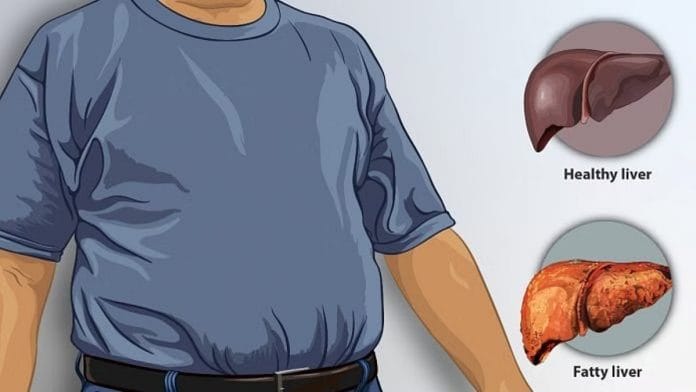



New Delhi: Changing lifestyles, rising metabolic risk, and rapid urbanisation are fuelling an alarming prevalence of non-alcoholic fatty liver disease in India, according to a new study. Nearly four in 10 adults screened across 27 Indian cities met the criteria for the condition, which if left unaddressed could translate into a substantial future burden of cirrhosis, liver cancer, and transplant demand.
Published last month in The Lancet Regional Health–Southeast Asia, the study found that 39 per cent of 7,764 adults screened had non-alcoholic fatty liver disease (NAFLD), also known as metabolic dysfunction-associated steatotic liver disease (MASLD).
NAFLD develops when excess fat accumulates in the liver in people who consume little or no alcohol. When fat accounts for more than 5-10 per cent of liver weight, it is classified as steatosis, the earliest stage of fatty liver disease.
Researchers screened permanent staff members and their spouses from 37 Council of Scientific and Industrial Research (CSIR) laboratories for liver stiffness and cardiometabolic risk factors.
“Most prior studies have been hospital-based or restricted to specific high-risk groups, making it difficult to estimate the broader burden. The Phenome India–CSIR Health Cohort provided a unique opportunity to address this gap. It reduces socioeconomic variability while allowing us to examine regional differences in cardiometabolic risk within a standardised and well-characterised population,” said Shantanu Sengupta of the CSIR-Institute of Genomics and Integrative Biology, the study’s lead investigator.
The team assessed obesity, body mass index, diabetes, cholesterol levels, blood pressure, and liver stiffness or fibrosis, and examined how these were associated with the disease. The findings showed that although obesity was common among those with the disease, the presence of diabetes and hypertension made them more susceptible.
“The finding underscores the need for early detection strategies and targeted resource allocation toward high-risk groups, both demographically and geographically, rather than a one-size-fits-all approach,” Sengupta added.
A 2022 study, ‘Epidemiology of Liver Diseases in India’, noted that the “cultural-lifestyle transition that India is passing through” has caused a “rapid switch” in the country’s liver disease profile toward alcoholic liver disease and non-alcoholic fatty liver disease over viral causes such as hepatitis.
Also Read: Adult vaccination can reduce dementia risk. Here’s what emerging research reveals
Fatty liver at lower BMIs among Indians
Globally, NAFLD affects roughly one in four adults, with prevalence estimates ranging from 25-35 per cent depending on ethnicity, diet, socioeconomic factors, and genetics.
Genome-wide association studies in European and Asian populations, including Indians, suggest that certain genetic variants increase both risk and disease progression. Variations in genes such as PNPLA3, which encodes proteins in fat and liver cells, for instance, increase the risk of developing NAFLD and are linked to more severe liver fat accumulation in populations in West Bengal.
South Asians also appear to develop NAFLD at a lower body mass index (BMI). Individuals may have a normal BMI yet carry excess abdominal fat, a pattern strongly linked to metabolic risk. Higher levels of visceral fat are closely associated with fatty liver, liver inflammation, and fibrosis. This lean NAFLD phenotype complicates detection and challenges conventional reliance on BMI alone as a screening tool.
In some cases, NAFLD progresses to non-alcoholic steatohepatitis (NASH), a more severe form marked by inflammation and liver cell injury. Over time, this can advance to fibrosis and cirrhosis, significantly impairing liver function and increasing the risk of liver cancer and certain gastrointestinal cancers.
“We are witnessing a steady rise in MASLD, driven largely by increasing rates of visceral obesity and Type 2 diabetes. At the same time, improved awareness and better screening practices are helping us detect more cases,” said Charles Panackel, senior consultant, Aster Integrated Liver Care, Aster Medcity, Kochi.
Panackel cautioned that the implications extend beyond prevalence estimates.
“MASLD has become a leading indication for liver transplantation in India. The figure does not mean that 30-40 per cent of people will develop cirrhosis — but it does signal that India is likely heading toward a sustained rise in advanced liver disease, liver cancer, and transplant demand.”
Also Read: 84% of Indian IT employees have fatty liver disease. Cutting calories won’t fix it
How is fatty liver disease detected?
A major challenge is that the disease progresses silently. Liver fat and even significant fibrosis can remain asymptomatic for years, and routine liver function tests may appear normal in the early stages. Ultrasound, commonly used in screening, detects only moderate to severe fat accumulation, said Panackel.
General population screening is not currently recommended. Instead, doctors use a structured, risk-based approach.
“We follow case-finding in high-risk groups such as Type 2 diabetes, obesity, metabolic syndrome, and persistently abnormal liver enzymes,” Panackel said.
Without coordinated action spanning healthcare, policy, and community awareness, India’s metabolic transition may leave a lasting imprint on liver health for decades to come. Prevention, experts argue, will depend as much on tackling obesity, promoting healthier diets, and addressing sedentary lifestyles as on clinical vigilance.
In 2024, the Union Ministry of Health and Family Welfare integrated NAFLD into the National Programme for Prevention and Control of Non-Communicable Diseases and released revised operational guidelines and a national training module to strengthen early detection and management at the primary-care level.
Sengupta, however, argued that a more proactive strategy may be warranted to catch NAFLD early.
“In our view, structured risk-based screening should be considered, particularly for adults above 35 years of age, with periodic assessment every few years using non-invasive tools — even in individuals who may not yet have overt metabolic disease,” he said. “Early identification could allow lifestyle interventions at a reversible stage and potentially prevent progression to advanced liver disease.”
(Edited by Asavari Singh)
It is surprising that only four out of 10 Indians are affected fatty liver despite eating oil curry, samosa, batura, vada, jalebi, ghee, and drinking alcohol.