





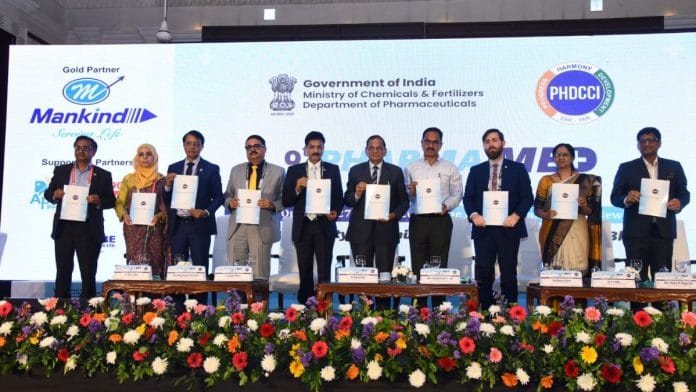



New Delhi: India should move beyond its role as a global hub for generic medicines and build a pharmaceutical ecosystem driven by innovation that is “feasible and sustainable”, the country’s top drug regulator said Friday.
Speaking at the 9th edition of PharmaMed 2026, organised by the PHD Chamber of Commerce and Industry in collaboration with the Department of Pharmaceuticals, Ministry of Chemicals and Fertilisers in New Delhi, Dr Annam Visala, joint drugs controller at the Central Drugs Standard Control Organisation, the country’s national regulatory authority for drugs, medical devices and cosmetics, said, “India needs to move towards innovation, with sustainability emerging as a key priority in the production of key starting materials (KSMs) and active pharmaceutical ingredients (APIs).”
APIs are the compounds in medicines that deliver the intended therapeutic effect, while KSMs are the basic chemical building blocks used to manufacture these APIs.
Visala noted that a large share of APIs imported into India are antibiotics and fermentation-based products, along with niche chemicals used in areas such as reproductive health, highlighting gaps in domestic manufacturing.
The comments come at a time when India accounts for about one-fifth of global generic drug supply and nearly 40 per cent of generics used in the United States. However, this strength in finished formulations continues to rely on imported APIs.
A report, ‘National API Capacity Building—Vision 2047’, released by the PHD Chamber of Commerce and Industry at the event, highlights the scale of the challenge. China’s share in India’s API imports has risen from less than 1 per cent in 1990-91 to about 68 per cent in 2020-21. For commonly used generic medicines such as penicillin, ciprofloxacin and paracetamol, dependence exceeds 90 per cent.
Visala said there is significant scope for improvement through research in sustainability and green chemistry, particularly by reducing the use of solvents in drug manufacturing and making the process more environmentally friendly.
The PHDCCI report attributes this dependence to structural shifts over the past three decades. Until the 1990s, India was largely self-sufficient in API production, supported by policies such as the Patents Act, 1970. However, economic liberalisation made imports cheaper due to lower tariffs and fewer restrictions, prompting companies to shift towards higher-margin finished formulations.
At the same time, China scaled up manufacturing with lower costs, cheaper financing and stronger state support, producing APIs at 35–40 per cent lower costs than India.
Alongside supply-side concerns, policymakers also highlighted the need to build a stronger innovation ecosystem. Satyaprakash T. L., Joint Secretary at the Department of Pharmaceuticals, said plans to establish 1,000 clinical trial sites would improve efficiency and reduce costs while strengthening research capacity.
“Dependence on imported bulk drugs should be addressed through indigenous enzymatic engineering, and leveraging 8,000+ STEM (Science, Technology, Engineering, and Mathematics) institutions and 3,00,000 researchers,” he said.
Visala said regulatory reforms—such as updated rules for new drugs and clinical trials, faster approval processes, and stricter manufacturing standards aligned with global norms—were introduced to support this shift and became mandatory from January 2026. She also said India could become a hub for global clinical trials due to its large and diverse patient population and new rules requiring registration of contract research organisations.
She also noted that the regulator has brought in legislation mandating the registration of contract research organisations (CROs) and other stakeholders involved in clinical research.
“It’s not just the bioavailability and bioequivalence (BA/BE) study centres, but all sponsors involved in clinical research are required to register,” she said.
CROs are companies that conduct and manage clinical trials on behalf of pharmaceutical firms, while BA/BE studies are tests that check how a drug is absorbed and performs in the body compared to a reference medicine. The requirement ensures greater oversight and accountability across all entities involved in clinical research.
“Medicines account for a significant share of out-of-pocket healthcare expenses, making the pharmaceutical industry central to equity and financial protection,” said Dr Vinod K. Paul of NITI Aayog at the event. He added that with a stronger focus on research and innovation, India has the potential to lead globally.
To address the issue, the government has launched schemes such as the Production Linked Incentive (PLI) and bulk drug parks to boost local manufacturing.
The PLI scheme offers financial incentives to pharmaceutical companies based on how much they produce within India. The idea is to make domestic manufacturing more competitive by rewarding firms for scaling up production of key drug ingredients.
Bulk drug parks, on the other hand, are large, dedicated industrial zones where companies can manufacture these ingredients with shared infrastructure, such as common utilities, waste treatment, and testing facilities. This helps reduce costs and improves efficiency, especially for smaller manufacturers.
However, progress has been uneven. The PHDCCI report says that around 35 per cent of participating firms have exited the PLI scheme, and China’s share in imports increased from 70 per cent to 72 per cent between 2019 and 2022.
The report says that financial incentives alone won’t be enough. India will need increased investment in research, support for smaller manufacturers, faster approvals, and stronger collaboration between industry and academia.
The success, the report says, could add Rs 30,000–40,000 crore a year to government revenue, create over 5 lakh jobs, and cut $4–6 billion in foreign exchange spending.
(Edited by Viny Mishra)
Also read: Govt planning regulatory sandboxes for pharma sector to fast-track approvals & drug development