





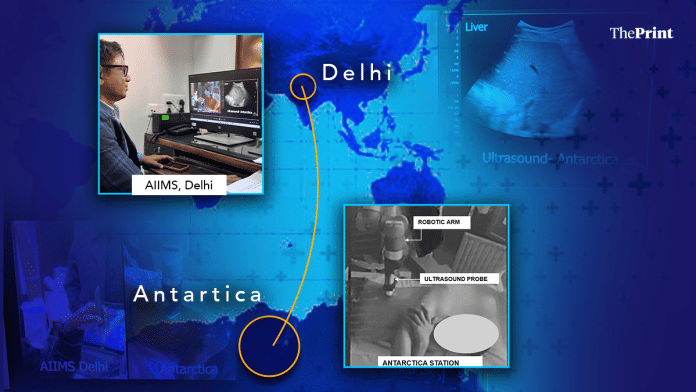



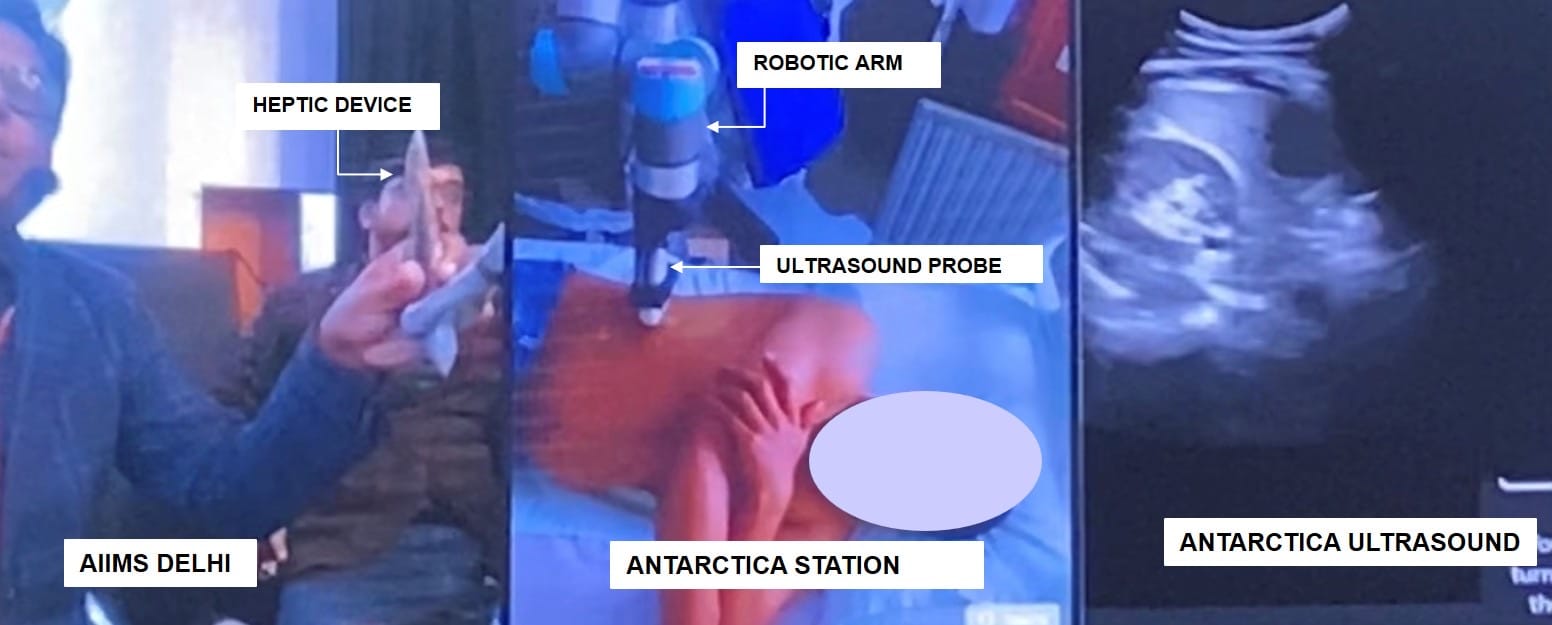
New Delhi: In January, a doctor at the All India Institute of Medical Sciences (AIIMS) here moved a handheld device. Over 12,000 km away, at an Indian research station in Antarctica, a robotic arm holding an ultrasound probe over a human body copied his movements. The ultrasound images appeared on the doctor’s screen in real time.
This was a telerobotic ultrasound, performed remotely in one of the most isolated places on Earth.
The idea to deploy it in Antarctica came from doctors familiar with the Indian Antarctic Programme.
A tried-and-tested technique, it is currently in use, with clinical trials, feasibility studies, and commercial applications dating back several years.
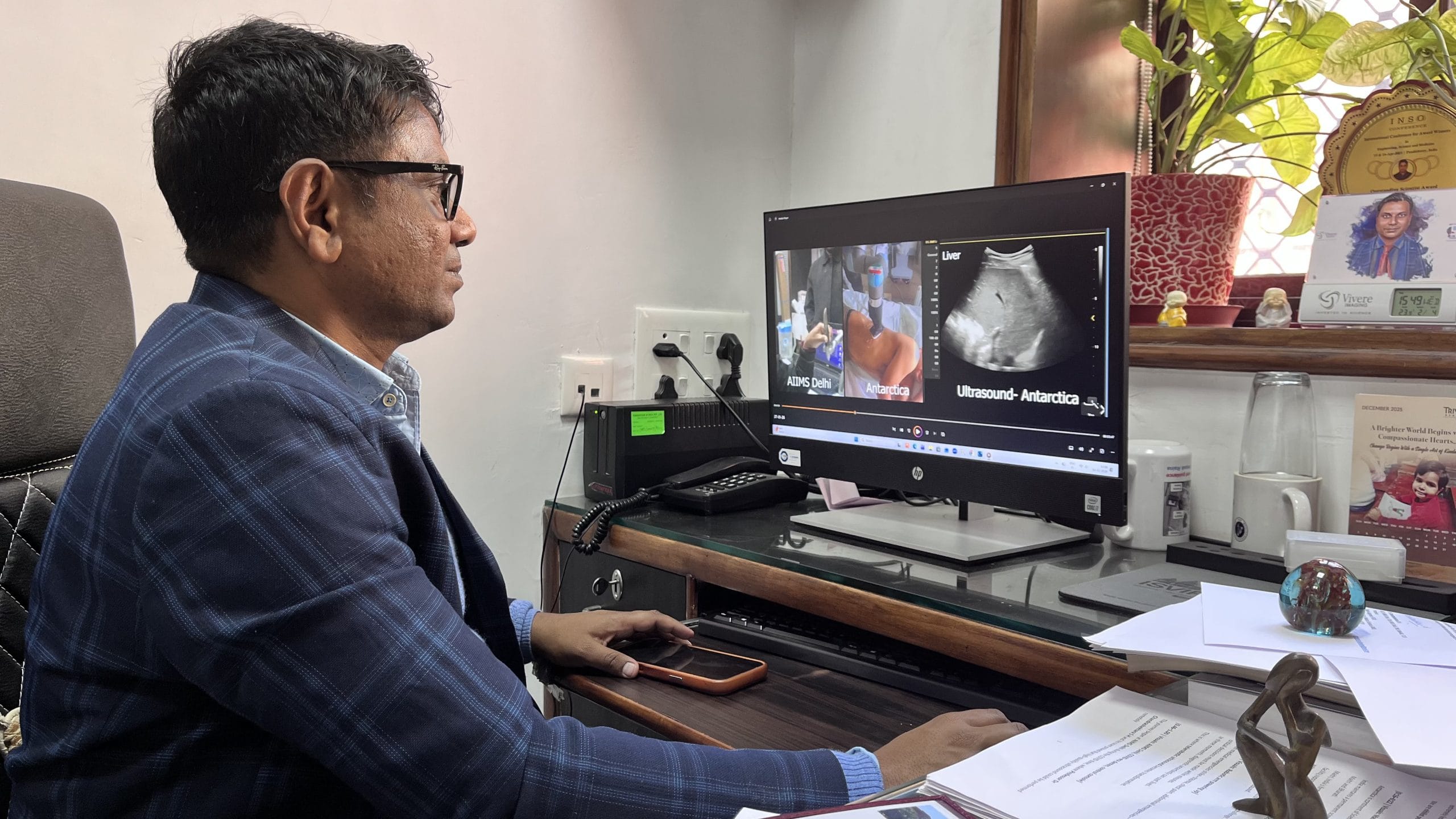
Prof Dr Chandrashekhara S.H., who led the project at AIIMS, said the problem they were trying to solve here was practical.
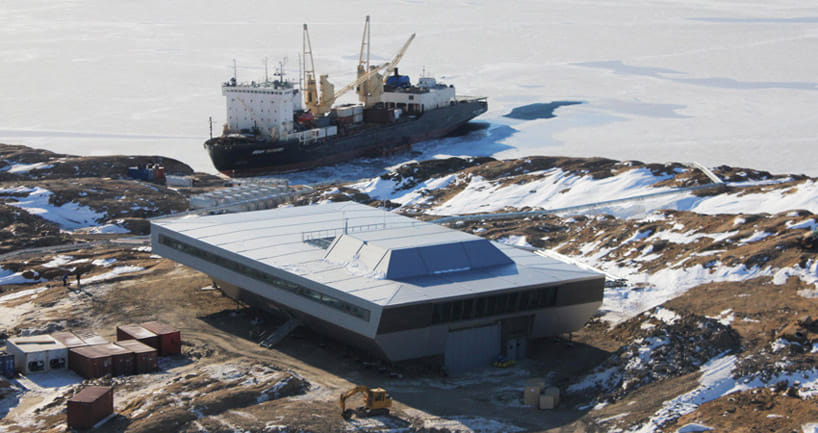
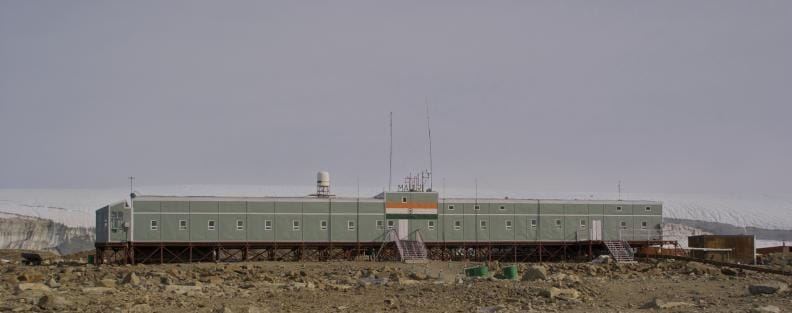
Bharati and Maitri are India’s operational research stations in Antarctica, dedicated to advancing polar and climate science.
The temperature there drops to extreme degrees, and medical facilities at these stations are limited. Two medical doctors, a surgeon, an anaesthetist, and a staff nurse are deputed at each station.
National Centre for Polar and Ocean Research, or NCPOR, also has remote support from AIIMS. Medical officers and specialists, including Dr Pradip Malhotra from NCPOR and Dr Vikas Dogra from Rajiv Gandhi Super Speciality Hospital, also provide remote support.
At these stations, X-ray and USG (Ultrasonography) scanners are capable of data transfer to any desired medical practitioner.
“When an emergency strikes, a diagnosis must be made within minutes. Diagnostic uncertainty may cause a delay in medical management,” Dr Chandrashekhara told The Print. In these situations, telerobotic ultrasound becomes transformative, he said.
Also Read: From AIIMS to small town hospitals: How robotic surgeries are becoming common across operating rooms
How telerobotic ultrasound works
The telerobotic ultrasound technology relies on a haptic (mechatronic) device in Delhi and a robotic arm in Antarctica.
When the doctor moves the haptic device at AIIMS, the robotic arm in Antarctica mirrors the movement. If the probe presses against the body, the doctor feels resistance through force feedback. This allows the scan to be conducted as if the doctor were physically present at the spot.
Connectivity is provided through the internet. At the Antarctic research station, satellite-based Starlink internet was used. Dr Chandrashekhara said the system can work wherever a stable internet is available.
“Over multiple trials since December 2025, abdominal scans, heart scans, Doppler studies and trauma-related FAST scans were performed on volunteers at the research station,” he said.
However, Dr Chandrashekhar explained that the robotic arm used was not originally designed for medicine. It is an industrial robot, commonly used in factories. The innovation, he said, was in combining existing hardware with new control systems and clinical workflows.
He added that the team has completed feasibility trials and plans to build its own medical-grade robot in the next phase.
The challenge of time
India follows Indian Standard Time (IST), while Antarctica has no fixed time zone. Research stations use local or home-country time zones, so the difference varies. Indian stations Bharati and Maitri are usually 1.5 to 5.5 hours ahead or behind IST, depending on location and season.
Dr Subir Kumar Saha, professor at IIT Delhi and project director at the institute’s innovation hub, I-Hub Foundation for Cobotics (IHFC), explained that the hardest part was not connecting two devices.
“The main challenge was control. The robot had to behave like a human hand. If the doctor tilted the probe by 10 degrees, the robot had to tilt by exactly the same amount,” Dr Saha told ThePrint. He was involved in developing and refining the telerobotic ultrasound system, ensuring precision control, robustness, and reliable remote operation.
Time delay was another major issue. Signals sent from Delhi reach Antarctica with a delay of about 100 milliseconds, and the video feed returns with a similar delay.
Dr Saha said this gap can cause the robot to overshoot or apply more pressure than intended if not handled properly. To manage this, the team developed control algorithms that predict motion and stabilise the system.
Force feedback was the third challenge. In ultrasound, image quality depends on how much pressure is applied. The doctor must feel how hard the probe is pressing. Dr Saha said the system was designed so that force applied in Antarctica is transmitted back to the doctor’s hand in Delhi.
Safety measures were also built in at multiple levels. Dr Chandrashekhar explained that sensors stop the robot if it encounters resistance. Emergency buttons are available to both the patient and the doctor. If communication ceases, the robot returns to a safe position.
‘Even a missing screw could halt operations’
In 2008, Europe’s Mobile And Robotised Tele-echography (MARTE) project conducted the first robotised tele-ultrasound via satellite.
Using a telerobotic system, specialists in France remotely performed an ultrasound on a patient aboard a ship in the Mediterranean, transmitting images in real time through satellite communication.
Studies over the past two decades have shown that ultrasound scans can be guided remotely. Research from Canada, Europe and the US has shown it can work in rural and disaster settings.
The technology also expanded during the COVID-19 pandemic.
Robotic tele-ultrasound systems were also tested on the International Space Station (ISS) as early as 2010.
Apart from the distance, what makes the Indian demonstration notable is the environment. Dr Saha said many countries have the technology, but few have attempted deployment in Antarctica because time delay and signal reliability make control difficult. According to him, this was the first time tele-operated ultrasound diagnostics were performed by any country with the actual examination being conducted in Antarctica.
The project involved AIIMS, IIT Delhi, IHFC, the National Centre for Polar and Ocean Research (NCPOR), and other partners.
This is an updated version of the report
(Edited by Amrtansh Arora)
Also Read: No incisions, no pain—AIIMS Delhi 1st govt hospital to treat neuro conditions with ultrasonic beams