








New Delhi: There was a time when academics would abandon teaching posts at Ivy League universities, leading DU colleges and submerge themselves in intellectual freedom and dogged rigour at the Centre for the Study of Developing Societies. They’d come to Rajpur Road in New Delhi and turn thinking into a full-time profession.
But over the last few months, the research institute, an awning under which once sat India’s best and brightest minds, has been in a state of soundless turmoil. At one level, it’s business as usual—there are scholars in the library, professors in their offices, and seminars that continue to be held. Work is ongoing. But from being India’s most influential research institute, known for larger-than-life thinkers like Rajni Kothari, Ashis Nandy, and Dhirubhai Sheth, who built an India-centric political theory and reupholstered ideas of media and democracy, it’s now another crucial space trapped under the weight of its laurels and history—as well as a country that’s changed irrevocably.
It started with a tweet. After Lokniti Director Sanjay Kumar “sincerely apologised” for mistakes in Centre for the Study of Developing Societies’ (CSDS) election data, a political firestorm ensued. The Indian Council of Social Sciences Research (ICSSR), the government body which funds several research institutes, including CSDS, slapped the Centre with a show-cause notice. The Centre responded, and ICSSR established a committee to assess the response. In between this void, suspended in limbo, is a grant held in “abeyance”—the sum of money that sustains CSDS.
“We are hopeful that our issues will be resolved. The critical thing is for our scholars to be able to work,” said CSDS director and environmental historian Awadhendra Sharan. “It is in the life of institutions to go through ups and downs.”
But CSDS is currently under a wave of scrutiny it has never seen before, not even during the Emergency, when it served as one of former Prime Minister Indira Gandhi’s harshest critics. Moreover, the life of the Centre precedes the ICSSR, and CSDS founder Rajni Kothari was its chairman.
“Lately we have become somewhat constrained by the retirement of several senior colleagues, a funding crunch that has hit the humanities and social sciences globally, and the difficulties of retaining our autonomy (something that has defined CSDS for the past six to seven decades) in the prevalent political environment,” said Ananya Vajpeyi, a professor at CSDS, who held teaching positions at Columbia University and the University of Massachusetts.
Vajpeyi was initially supposed to be at the centre for a year. But one year has since turned into fourteen. She resigned from a tenure-track position at the University of Massachusetts, trading it in for an entirely different rhythm.
The centre is understood as being worlds apart from the structures and routines that academia otherwise mandates. At CSDS, tea is what demarcates the day — it is sipped at 12, 2:00 and 4:00. Deadlines are few and far between. For those devoted to the practice and pursuit of research, it’s like “heaven,” said a former staffer. In The Hindu, social scientist Shiv Vishvanathan described the relentless quarrels that were daily rituals. At the centre, “democracy was a hypothesis that needed to be digested every day.”
While it has lived many lives, certain fundamentals have remained constant. It continues to function through “networks,” remaining committed to an open, freewheeling space. The questions under examination continue to demand urgency. Currently, research preoccupations include a changing climate, the relationship between science, technology, and democracy, and work on Indian languages, which also comprises the construction of an archive. Politics is the Centre’s “public face” — the most easily digestible. But there is a lot more that goes on.
The Parekh Institute of Indian Thought, founded in 2014, uses classical texts like the Vedas and the Mahabharata as stimuli to understand contemporary issues of social justice and equity. What this requires is deep, comprehensive reading, and the centre organises a yearly group to study these texts.
What makes the centre “truly unique,” wrote Vajpeyi in Seminar, which dedicated an issue to the centre on its 50-year anniversary, is also “its human and physical environment.”
It straddled multiple identities. Known for cultivating an entirely new genre of distinctly Indian scholarship, with archives that don’t exist anywhere else in the country, while also continuing as a relatively casual space unbound by the posturing and performance of scholarship. The research that emerged from CSDS was intersectional, weaving together questions of caste and democracy, psychology and politics. Its speakers and papers defied silos — refusing to be categorised by the norms of scholarship which had been dictated by the West. Conversation was continuous, paired alongside the unsparing rigour of academic research. India’s social sciences stepped out of textbooks and morphed into something entirely new.
CSDS was founded on these principles—the idea of renouncing the ivory tower and embodying a “public life of thought.”
“It was about the life of the mind of a society. Everyone has a stake in that,” said Jeebesh Bagchi, co-founder of Sarai, CSDS’ media collective. “It was not interdisciplinary, but about individual scholars respecting the scholarship of others.”
Study of democracy & political Islam
Psychologist and political theorist Ashis Nandy, almost a metonym for the stature of CSDS, used to tell Jeebesh Bagchi and his younger colleagues that they would “fossilise themselves” if they focused too much on departments, disciplines, and area studies. It meant that they’d be defining themselves against other institutes.
It was on values like this that CSDS lived and breathed; it was more alternative, and it thrived on being different.
CSDS is known for not just having academics, but creative, inventive thinkers — placing it in a domain entirely separate from the university. Not a single economist has ever been on the Centre’s payroll. While research at CSDS might have influenced policy, it has never played an active role.
“It was set up primarily as an institute that would do high-quality research in fields other than economics. That’s what attracted me to the centre. It had some of the most outstanding people: Rajni Kothari and Dhirubhai Sheth. Ashis Nandy was doing very innovative work on the intersection of psychology and politics. For some time, there was also Sudhir Kakkar,” said former director Rajeev Bhargava, who retired in 2019. “They had started it and continued to associate with it.”
Prior to joining the centre, Bhargava spent 25 years teaching at top universities like DU and JNU. At JNU, he was Professor of Political Theory and head of the Political Science Department at DU. CSDS was an attractive prospect where he was no longer confined by the demands of the university ecosystem.
“I had taught for about 25 years or so. I wanted to spend my time with the many issues that I was deeply engaged with,” he said. “When you’re teaching in a university, your time is limited.”
Other than his stint as director, Bhargava also published The Promise of India’s Secular Democracy and What is Political Theory and Why Do We Need It, and was editor on other volumes.
It was liberating. He could lecture wherever he liked, both in India and abroad. Keynote lectures and seminars could go on uninterrupted.
Bhargava, who served as CSDS director until 2014 before he went on to set up the Indian Institute of Thought, also highlighted a crucial difference: that between a research institute and a think tank. While CSDS is often conflated with bodies such as the Centre of Policy Research, there are clear-cut differences.
“A think tank has a very heavy policy orientation and perhaps a partisan character — not in terms of party political work — but it is partisan to certain ideological viewpoints,” said Bhargava. “Even if you think of a tank as a reservoir of ideas, it’s ideas of a certain kind. At CSDS, we did not confine ourselves to any ideological viewpoint. Certainly not from a party point of view.”
The ideas on which the centre was built — an uncontained oasis of thought, where a mix of minds congregate — could be seen in its output, as well as through the people who walked its halls.
“It was an easy kind of melting pot,” said Bagchi, describing his life at Rajpur Road. “Evenings were spent with Shahid Amin talking about new material he saw in the archive. Sitting and chatting with Bela Bhatia about Chhattisgarh. Having a cup of tea — simple things.”
Amin is a historian who retired from the University of Delhi, known for his “reconstruction” of the Chauri Chaura incident, liberating it from its “hegemonic” nationalistic character. Writer and activist Bela Bhatia lived in Bastar for decades, working on issues such as unchecked state power and mining.
Those currently and formerly at CSDS spoke about a certain richness of scholarship at CSDS, which was also obtained by the sheer quality of academics, fellows, and professors.
Another CSDS professor spoke of their laundry list of research interests — from Indian politics and the study of democracy, political Islam, to poetry and film. The centre is one of the few places that would permit, if not embrace, the union of these seemingly disparate ideas. The staffer freely traverses all.
Also read: Anime’s desi soul is in small-town India. Nagpur is its capital
The colonised and coloniser
In a magazine article from 1985, journalist Amrita Shah writes about a “circle of Delhi-based academics” who turned into “household names.” Thinkers Rajni Kothari, Ashis Nandy, and Giri Deshingkar were turning research on its head. They were writing regularly in newspapers and magazines—the Illustrated Weekly was one of their usual haunts—and had contempt for both the Janata Party and the Congress.
“Only the senile and decrepit hovered like flies around the state,” Ashis Nandy said at the time, referring to Indira Gandhi’s post-emergency induction of intellectuals into official posts.
Kothari, Nandy, and Seminar Magazine’s Romesh Thapar were furnishing a new character of Indian political thought. And what was buttressing their research was their public involvement. The regularity with which they wrote newspaper columns, the burning relevance of their theorising, was contributing to the creation of a new kind of researcher — one who was difficult to categorise. They didn’t teach in universities, they weren’t sculpting policy frameworks, and they refused to be part of the government. During the Emergency, CSDS became the estate of Indira Gandhi’s “fiercest critics.”
Founder Kothari remained unimpressed with both the left and the right and their quest for state-legitimisation. During the history textbook controversy, Viswanathan writes, ”When ideologists went hysterical, Rajni observed quietly: ‘That both sides wanted the state to approve of their version of history.’”
It was difficult to evaluate these rockstar researchers, and their values continued to dictate the functioning of the CSDS, permitting it to exist in a liminal space.
“I am more interested in the long-term political processes than in the short-term ones,” said Nandy. Meanwhile, Kothari — a mythic figure in the life of the study of Indian politics and democracy — spelled out the centre’s agenda. The goal was “not to predict, but to understand.”
It was perhaps this want for depth, for endurance that drove Kothari to set up Lokayan in the 1980s, a network of journalists, activists and intellectuals, creating a political spirit outside the party sphere. The forum was designed to provoke political action and grassroots movements.
In The Indian Express, writer and environmentalist Claude Alvares wrote: “Kothari long ago breached the ivory tower and took to the streets.” Despite dabbling in thought, he believed in “action-oriented methods of bringing about change.”
The aim of CSDS, according to Kothari, was not “to predict, but to understand.” In the 80s, Kothari set up Lokayan, a network of journalists, activists and intellectuals, creating a political spirit outside the party sphere. The forum was designed to provoke political action and grassroots movements.
Then, in 1983, a landmark book came onto the scene. Ashis Nandy’s The Intimate Enemy was published—a psychological unmasking of the relationship between the colonised and coloniser. But, as Nandy said in an interview with Seminar in 2013, “We were not making history, we were doing our jobs.”
The Seminar issue, an ode to CSDS as it completed its 50th year, was a collection of interviews, reflections, and an opportunity to understand the centre’s legacy. There were interviews with Rajni Kothari, Ashis Nandy, and Dhirubhai Sheth; Yogendra Yadav and Ananya Vajpeyi reflected on life and work at the Centre; brief histories of Lokayan; and several anecdotes that sealed them together. Appointments in CSDS were made through “talent-hunting”—an obsessive over-reading and a letter that came from nowhere.
When Yogendra Yadav joined in 1993, Nandy’s directorship had been reduced to a more nominal position. The Centre was run by a band of “uncles”: Giri Deshingkar, Ashis Nandy and DL Sheth. In this context, Yadav and his ilk were the “infants.”
“Formal mechanisms of internal democracy were largely nonexistent. Faculty meetings were an insignificant ritual that took place once every few months. There were no faculty committees,” wrote Yadav.
Nandy’s interview was a moment of reckoning, reflections on an altered body; of changing tenors and rigour.
“The Centre in which I worked in the past was very different. There was a sense of community. And, we used to work with remarkable intensity. We did not have stalwarts outside to look up to. The question of getting academic recognition and legitimacy outside never haunted us,” he told the magazine.
Also read: Indian states are competing to be the concert capital. Post Malone in Assam a turning point
Limelight for Lokniti
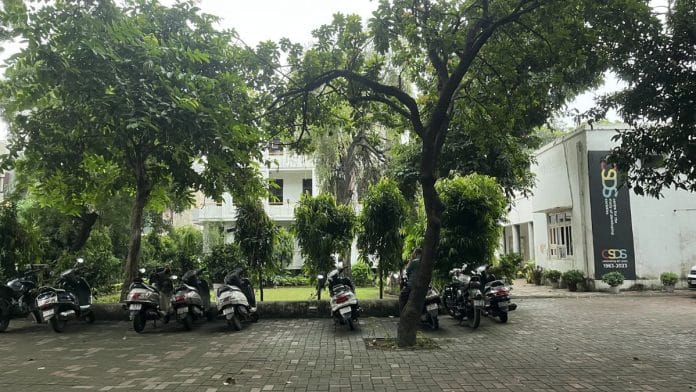
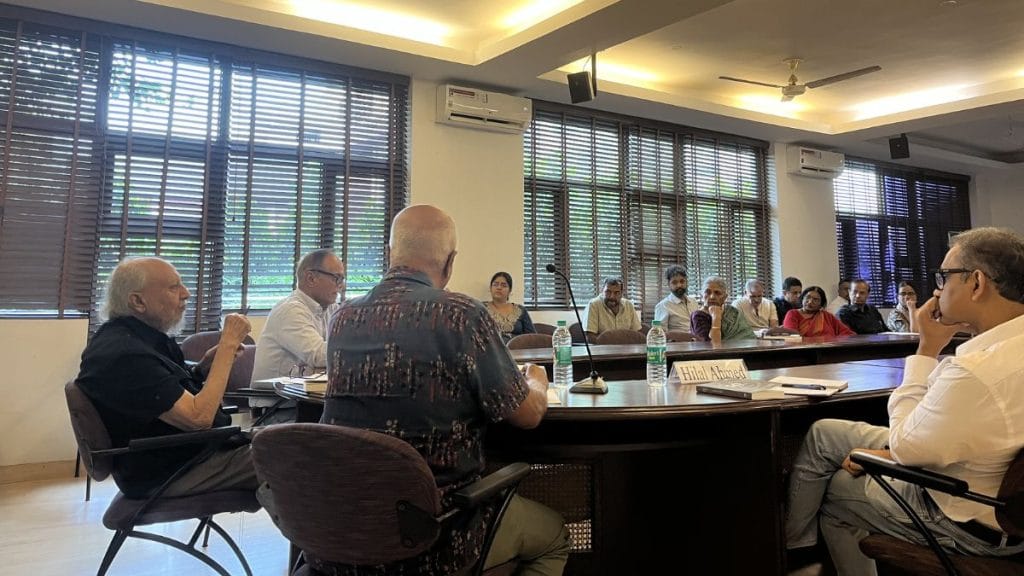
The centre sits in what used to be called a sleepy old government building. Today, this unassuming building is an outlier; sequestered among palatial, haveli-esque buildings in the capital’s Civil Lines. It looks like it belongs to another time––the same criticism that’s handed to CSDS by its detractors. But leading academics and scholars continue to make the pilgrimage. At a seminar last month, where former CSDS member Peter D’Souza opened his book on the Emergency up to former colleagues and others, there was a quiet acknowledgement. “It’s almost like old times,” remarked a current member.
During Bharagava’s stint as director, CSDS became increasingly “international.” Well-known scholars from across the world began passing through the Centre– including Canadian philosopher Charles Taylor and American political theorist Michael Walzer. CSDS researchers were also publishing in international journals. According to Bhargava, this acquired character, he said, was a natural continuation—such was the calibre of its scholars. But it was also “an unintended consequence of globalisation.”
At this time, according to Bagchi, CSDS changed again. Several younger PhD scholars were brought in by Peter D’Souza, and it began to present itself differently. Yadav left to join the Aam Aadmi Party, and it became a more “rigorous academic place”. Earlier, he said, it has been home to all genres of creative practitioners.
Over the last few years, CSDS has largely been in the limelight for Lokniti, its data repository that has chronicled every single Indian election since 1967. In an interview, Dhirubhai Sheth called it an “initiative to salvage the core of the centre.” Even so, there is a library of cutting-edge work and research to sift through.
CSDS’ media collective, Sarai, started Cybermohalla, an “experimental environment” created in different parts of the city –– jhuggis, resettlement colonies. Young, working-class people were invited to create–– and asked no questions. Their musings on a shifting urbanity were multimedia, emerging in the form of books, broadsheets, radio programmes.
Some of the work done at Cybermohalla—Trickster City: Writings from the Belly of the Metropolis—was published by Penguin in 2010. Another major product is the Cybrermohalla Hub, which was released by the London-based Sternberg Press. The latter sums up the project’s sidestepping of geographies. It accidentally turned ‘international.’ Work by an ensemble of 10 writers in Delhi’s LNJP became a collective project. German architects Nikolaus Hirsch and Michel Müller were called upon to build a prototype of the Cybermohalla hub, an imagined space. It was a response to the demolition of Nangla Manchi, a resettlement colony that was demolished to make way for the Commonwealth Games. Within this workers’ colony lay a tiny universe—a Cybermohalla lab.
“The hub could be built anywhere, just as it has been in the last five years of its life: in Stockholm, Bolzano, Vienna, and Copenhagen. And in Delhi, it could potentially be built in Burari, Loni, Greater Noida, Sawda-Ghevra, Badarpur, Jharoda, or Dakshinpuri—that is, any context that would be hospitable to it,” reads the introduction to the book, published in 2011. At one point, Sarai and NGO Ankur were in talks with the MCD to construct the hub, but it never came to fruition.
“Where were we, while the city—driven by a desire for positivity and performance—was being reorganised and consolidated? While acre after acre was being redrawn and recharted? “We were there,” she says. “We recorded every stone that was displaced,” are the lines of a poem in the book, written as the city was being made and remade for the Commonwealth Games.
The project has since been scrapped; however, the material produced continues to be used by researchers.
This project, a flagship Sarai product, was a far cry from academia. It was unfinished, reflexive, and deeply embedded in context. But that’s what CSDS was about.
“That kind of mutual exchange and regard was very exciting, and that was what CSDS was comfortable with. We think and learn from each other in ways we don’t fully understand,” Bagchi said, reflecting on the legacy of Cybermohalla.
He recalled a time in the 1990s, when they believed that they were on the precipice of something truly transformative.
“We felt it,” he said. “When Sarai started. We had independent fellows, and projects were rushing. So many people used to apply, we felt like a big transformation was happening.”
They were talking about the “digital divide” in 2001, the jurisdiction of the internet, the precariousness of media and reportage in 2003, and contending with the largesse of cyberspace.
There was also the Sarai media lab, which had an “intermittent life.” There was a newsletter, now no longer in existence, with a circulation of about 12,000.
It’s an institution of grave importance, once with enduring impact. Yet, it hasn’t expanded.
“CSDS is the only post-university research institute of social science that has an international presence. As a country of such scale, we should have had 50,” he said.
As the Centre navigates its latest inflection point, professors also spoke about the Centre’s silence — its steadfast refusal to market itself and give in to ideas of institutional histories.
But there is a belief that the centre’s best days are behind it. And luxuriating in its riches may not be an option.
“You cannot live in your past. No matter how good it was,” said Bhargava. “Every 10 years you have to reassess.”
(Edited by Saptak Datta)