





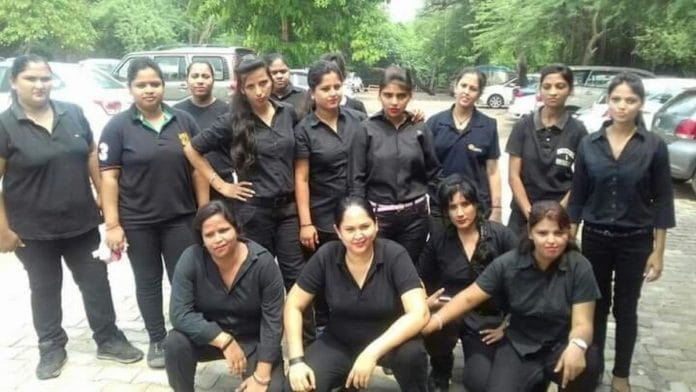



New Delhi: Monica hadn’t even heard the word ‘bouncer’ ten years ago. It all started with an event at the Kingdom of Dreams in Gurgaon when her friends urged her to enter a nearby club. At the entrance, she met a woman in a crisp black uniform—the first female bouncer she had ever seen.
“We exchanged numbers,” Monica recalled. But little did she realise that her muscular, heavy-built, powerful, and physically imposing figure would become the criterion to crack a job.
“Later, she called and asked whether I would want to work as a bouncer. I had never done that before. But she said, ‘Come with us, we’ll show you,’” Monica told ThePrint.
From basic self-defence drills to learning how to de-escalate drunken bar brawls without flinching, to ensuring women in nightclubs and public events are safe — that woman took Monica under her wing. The real challenge, however, waited at home. Monica’s mother was furious that her daughter was stepping into a job long associated with men, and doing so at 1.30 am, in a society where most women aren’t allowed to step out at night at all.
“I belong to a middle-class family. They used to question why I was working so late,” Monica said. When she insisted, the pushback turned into a warning. Standing today at the entrance of Hauz Khas SOCIAL, checking handbags and waving women through the scanner, she still carries that memory—a memory which works as a muted motivation.
“Eventually, they had told me that if I wanted to stay out at night, then my safety was my responsibility. And if something goes wrong, then I should not complain to them,” Monica added. “And today I protect other girls who step out at night…that’s a big thing for me. It is my honour and pride.”
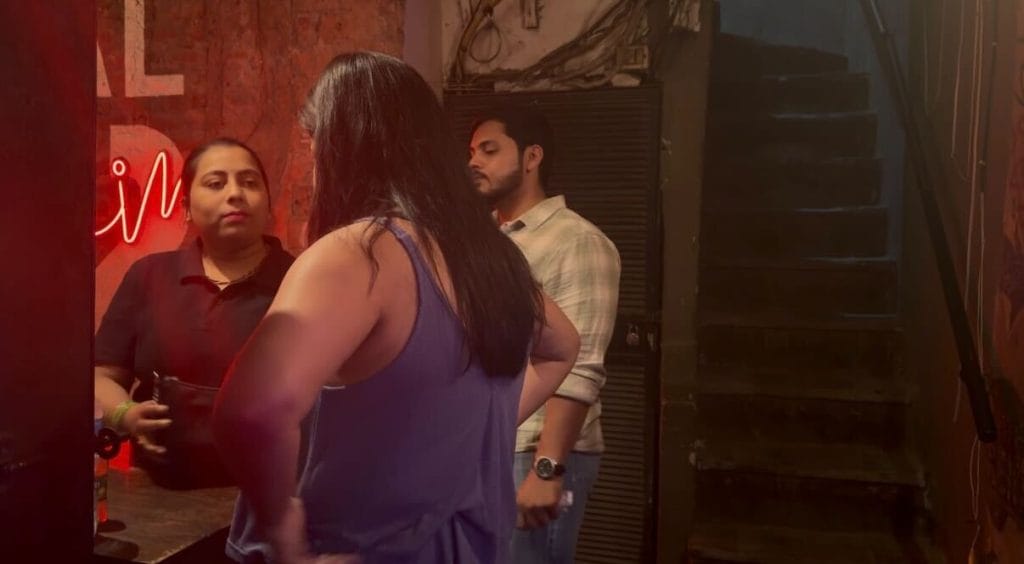
As more Indian city women step out into crowded public spaces and busy nightclubs, a new profession has begun taking shape alongside. That of lady bouncers. They are big, bold and tough-talking. They compete for space in predominantly masculine spaces like IPL matches, music concerts and watering holes.
In Delhi-NCR alone, there are nearly 2,500 lady bouncers — many of whom are now building support systems. One of their most active WhatsApp groups, called “Nari Shaktii,” has 208 members. Most conversations unfold through voice notes.
In one message, a woman says, “I can go to Faridabad, you’ve already shared the location — but who will pay for the travel? Almost half our earnings go into transport.” Another bouncer responds, “Send her a vehicle at 6 am.”
Between gig coordination, travel negotiations and last-minute fixes, the group functions both like a dispatch centre and an everyday sisterhood.
But female bouncers weren’t always “bouncers”. Until a few years ago, they were just ‘guards’ — a term that collapsed their work into low-skilled soft service and stripped it of any muscle-flexing authority. The shift to the word bouncer has mattered: it signals legitimacy and brings a measure of respect.
Explaining the shift in Language, Women’s Rights Activist Jagmati Sangwan said that just ‘guard’ is a vague, umbrella term — anyone protecting anything can be called a guard.
“Bouncer sounds like a more specialised, professional role, and it has long been associated with masculinity. That is perhaps why many women initially preferred calling themselves guards rather than bouncers. At the same time, this masculine perception of the profession is also what might have made their families uncomfortable and afraid of the work,” Sangwan added.
India’s first female bouncer
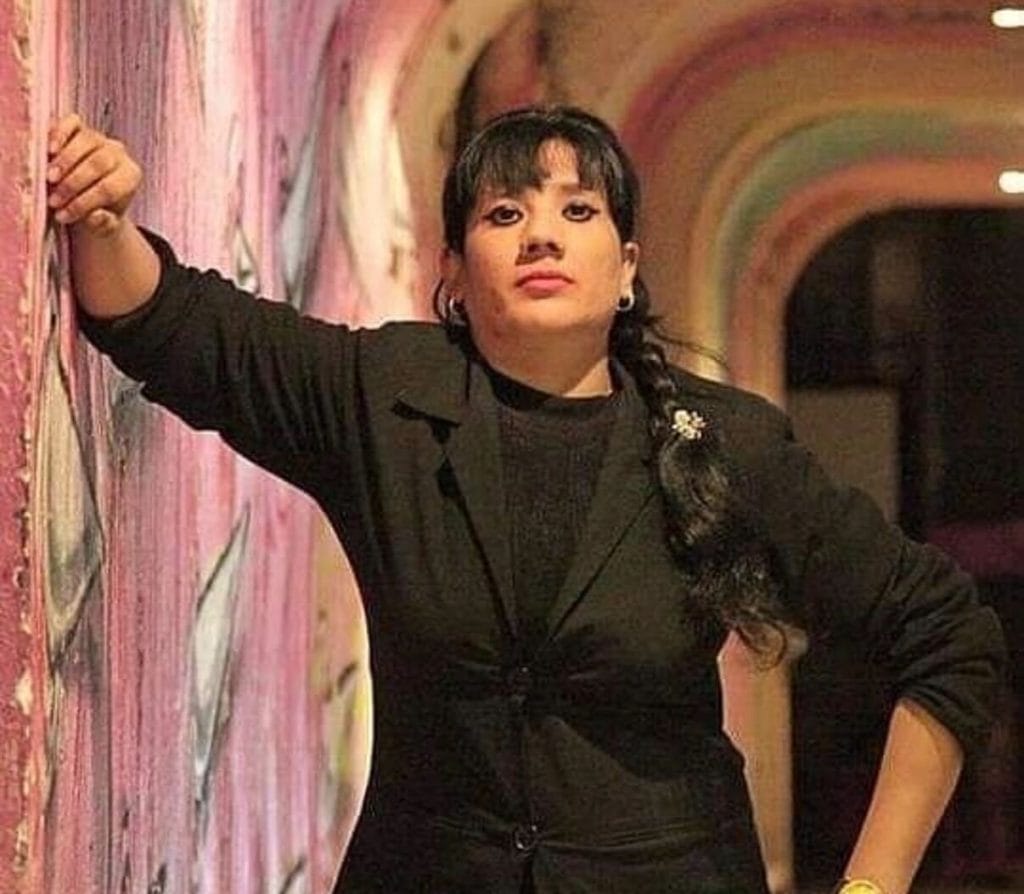
Dressed in a black coat and trousers, her long ponytail pulled back so neatly that it passes for a sharp bob from the front, Mehrunissa Shaukat Ali, 38, stands at Saket Social with the quiet authority of someone who has spent years holding her ground in difficult rooms.
Being the first female bouncer in India, she remembers the era before women like her were seen as anything more than soft-spoken helpers at the bag-check counter. Growing up in Western Uttar Pradesh’s Saharanpur, Mehrunissa said that she had always imagined herself in a uniform — but just not this one.
“I wanted to join the Army or the police, but my family was reluctant to let me work; my younger sister got married at the age of 12, and in their opinion, they felt that it was high time that I get married too,” she told ThePrint.
Saharanpur, she said, had its own rules for girls — rules that were enforced across religions. Childhood for daughters ended early, and for many, marriage was the only option. According to that worldview, a woman’s real life only began in her in-laws’ home.
“Whether Hindu, Muslim, Sikh or Christian — everyone believed the same thing: raise your daughters, and as soon as they turn 12 or 13, get them married,” Mehrunissa said, adding that education for girls in her society was only ornamental.
“Even if they did educate them, it was only enough to teach them societal mannerisms. After that, their marriage would be fixed,” she added. However, her mother, whom she lost in late 2025, and whom she considers to be her “biggest pillar of strength”, fought a lonely battle to protect and support her.
“My mother stood up to my father; she stood up to the entire extended family. She walked such long distances to support my education that her feet were covered in blisters, but she ensured that I studied,” Mehrunissa said.
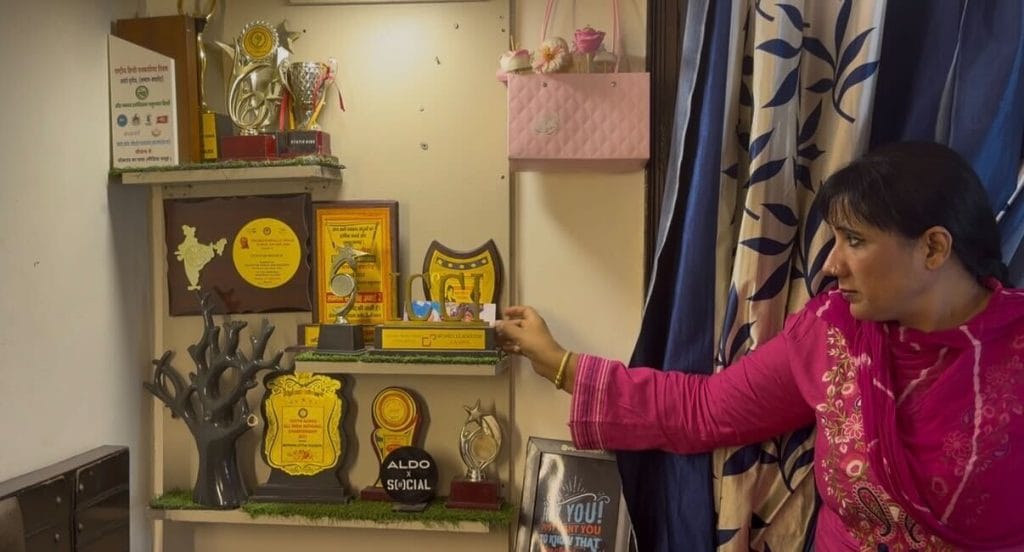
She had just taken the police entrance test and cleared the reasoning section when the pressure at home intensified. Sitting on her blue sofa, wearing a pink salwar-suit at her home in south Delhi’s Devli village, Mehrunissa recalled her mother’s words that had pinched her.
“Eventually, my mother had succumbed to the pressure and told me, ‘Beta, I fought your father and the whole family so you could study. I took all that blame on myself. But now, if you take up a job, people will say that I have spoiled my own daughter just for a little salary. I can’t bear this anymore.’ From that day, she asked me to do what my father says,” Mehrunissa said.
In anger and despair, she tore the acceptance letter and buried her dreams for which she had worked so hard. “My only regret is that had I been more insistent, perhaps today I would have been a police officer. When children stand their ground for what is right, parents do give in. I want every girl to remember that,” she added.
Life went as usual for Mehrunissa for four months — overwhelming thoughts, thoughts of not being persistent toward her dream. But then came the moment that rerouted her life: the day she saw a bouncer in 2003 and realised she could become one. She spotted a bouncer outside an event — tall, steady, dressed in all-black, carrying the same authority she had always associated with ‘sarkaari naukri’.
“I took up the job but hid it from my family. Initially, I thought this must also be a sarkaari job. I asked if I could do it — and that’s when I decided,” she added. “I used to leave my home wearing a burqa and carry my uniform inside my bag.”
Fate, however, had other things in store for Mehrunissa after her family had suffered a severe financial setback in 2006. Their fragile ego to not let their daughter take up a job had collapsed.
“This was right after my father had moved our entire family to Delhi in search of a job; he had suffered a massive loss in business, and we were left with nothing,” she said. “That’s when I decided to reveal my bouncer’s job to my family.”
Also read: Meet India’s star CFOs. They’ve moved beyond just balance sheets
‘Maybe, I was stubborn’
In the job, Mehrunissa had a reality check. She found that women were expected to stand quietly at bag-check counters while the men took charge of crowd control, confrontation, and made every decision that signalled power.
“They would call us security guards…as if we were only there to fold our hands and assist. I told them one day that I am not a guard, I am a lady bouncer,” she said.
It wasn’t an easy insistence to hold, as most women in the profession at the time were reluctant to challenge the label. “Other lady bouncers would tell me that they are here to earn, why fight over a word?” she recalled. “But that word decided how people treated us. It decided the respect we got. It decided what work we were allowed to do.”
So Mehrunissa made it a rule: if any organiser addressed her or her team as “security guards,” she would pick up her girls and walk out — even from the most lucrative assignments. “People thought I was stubborn. Maybe I was. The male bouncers would say that I am good at my job, but I am a little foolish for expecting people to call me a bouncer. But slowly they realised that they had no choice. The work would suffer without us.”
The tide turned sooner than she expected. Male bouncers began referring to her as “Bouncer Madam” whenever she would arrive at venues. People often corrected themselves and others around them mid-sentence. Over time, the designation printed on ID cards shifted too — from guards to bouncers.
The subtle change
Changing the title on the ID cards was a battle half won. While it was a huge step toward equality in such a male-dominated area, Mehrunissa’s joy was cut short when she witnessed other discrepancies in the job.
At events, she had noticed that male bouncers were fed lavishly — chicken korma, chole-bhature, juices, cold drinks. On the other hand, women only got dal-roti. On a ‘good’ day, kaddu-poori.
“We worked 12-18 hours, but nobody even asked if we wanted water,” she said. In 2010, during an IPL assignment outside Delhi, she put her foot down.
“I protested the only way I could; I refused to eat during my work shift. For two days, I worked without touching a bite until I reached home,” she said.
By late afternoon on the second day, the other women began whispering among themselves. “Nisha didi is refusing to eat anything,” they told one another. Eventually, word reached the male bouncers. Then the supervisor. And finally, the head of the security company, who was preparing to wrap up for the day.
The owner stepped out himself. He found Mehrunissa sitting on the road, right in front of the bus that was supposed to take the staff back. “He asked me, ‘Beta, what happened? Why aren’t you eating?’” she said. “And I told him exactly what I felt.”
“Sir, we are being treated like we are fools,” she remembers saying. “Women are given dal, roti, kaddu-poori…dal is something that I even eat at home…while the men get juice, cold drinks, biryani, chicken korma. Why? Are we doing less work? Are we not bouncers too?”
The owner stared at her for a moment, and then, to her surprise, burst out laughing. “He said, ‘You’ve made a fair point. Why should there be any difference? Men and women are doing the same job.’”
She remembers him turning to a staff member and saying, “Take this dal-roti and bring the same food for them.”
That night, trays of hot korma and naan were brought out for all the women on duty. “Other female bouncers started laughing and saying, ‘Nisha, thanks to you, we’re getting korma and naan today!’” she said.
From there, the ground kept shifting. Men at venues began offering her a chair. Organisers started approaching her directly. “People would bring cold drinks to me. They’d offer me chairs to sit. But, once duty starts, I never sit.”
Her team of women stopped accepting being addressed as “guards.” They began to correct people the moment the word was uttered. Mehrunissa clearly remembers the moment her girls finally started saying it out loud.
“Sir, hum guard nahi, bouncer hain. Guards haath jodte hain, hum haath todte hain. (Sir, we are not guards, but bouncers who break hands, unlike guards who fold them),” she said.
Today, once the clock strikes 8, she takes her usual stance at Saket Social — moving in steady loops across the dimly lit floor or holding position at the gate, shoulders squared, eyes everywhere, never once breaking the rule she set for herself years ago. She still does not sit while on duty.
Since then, Mehrunissa has built something far larger than a personal career. In 2010, she founded Marddani Bouncer and Dolphin Security Service Private Limited, a women-led security company that works with nearly 2,500 bouncers today. Much of her work focuses on training women from small-town Uttar Pradesh in martial arts, crowd control, and conflict de-escalation.
Also read: A quiet renaissance of Sindhi food is underway—social media, supper clubs and cookbooks
‘Neighbours would gossip’
It was in November 2021, after the nightlife industry reopened post-Covid-19 and clubs began actively seeking women-led security teams, that she formally began scaling the company. But revenue remains unpredictable.
“Jobs are scarce. I have hundreds of CVs lying in my drawer. I feel helpless that there is nothing more I can do,” she said.
“And I have a big family to support — my sister and her two kids, my father, and even my two cats,” she adds, absently stroking her ginger cat curled beside her. As she speaks, her nephew, a law student, walks out of the kitchen and quietly sets a cup of tea in front of her.
Despite financial strain, she takes pride in her competence — competence of resolving bar fights, identifying drug use, spotting fake IDs, and protecting women who come alone or with friends.
“There is nothing we haven’t handled. Sometimes things escalate in seconds,” she said. The journey to this point, however, was shaped by years of doubt and scrutiny at home.
“Ever after my family had agreed to let me take up this job, whenever I left the house, my brother and father would be filled with anxiety,” she said. “Earlier, we had very long shifts. We would leave at 3 or 4 pm and return post-midnight. Neighbours would gossip.”
It was her mother who had to bear the brunt of these whispers.
“But when she saw how exhausted I was, she would just reiterate her faith in her daughters. She always believed we would never do anything wrong,” she said.
Her father, she added, suffered silently. “Poor soul. He would stand on the balcony waiting for me till late. Stand outside all night sometimes. Thinking of it feels terrible now,” Mehrunissa said.
The same neighbours who once questioned her character have now changed their tone. “Today, those same people invite us for meals and say that every home should have a daughter like me.”
Instinct to tactful diplomacy
For women who join the profession, the work demands more than muscle. The job is built on restraint: people scream, shove, and even dare the bouncers to strike first so that the blame can shift.
Many bouncers say that concert duties are the worst; backstage corridors turn into battlegrounds of access cards, name-dropping, and tempers. There are moments where no decision is the right one: If you let someone in, the client complains. If you don’t, the client still complain but you just have to learn to navigate the least explosive route.
This makes the profession dependent on instinct and tactful diplomacy.
Watching Mehrunissa on the floor, it becomes clear that the real skill lies in temperament and the ability to defuse chaos without raising a hand. Physical force is a last resort. When someone needs to be removed, the team relies on technique, not aggression — a firm arm-lock, a quiet escort to the exit, a call to 100 if needed.
Women patrons, though, require a different kind of vigilance. The team often ends up playing older sister, therapist, and bodyguard all at once. On weekends, it isn’t unusual to see a female bouncer half-carrying a drunk woman to safety while being sworn at the entire way.
“Women tend to hurl abuses when under the influence of alcohol; people don’t always realise what they’re doing,” Mehrunissa said.
Men react differently. A woman telling them “no” — especially in public — disrupts the order they are used to. When a male bouncer intervenes, she said, it often becomes a challenge to the man’s ego; grudges are carried outside the club, friends are summoned, tempers circle back. With women bouncers, the resistance is still there, but the temperature is lower. Usually.
Mehrunissa recalled a recent incident when things had tipped over. A drunk man got furious when Mehrunissa’s manager refused him another drink and began hurling abuses across the counter. When Mehrunissa stepped in, the tirade shifted to her: claims of political connections, threats to get the staff fired, demands for a “man-to-man” conversation — followed by a threat to shoot her.
Before the male staff could intervene, an unexpected ripple moved through the room. Women at nearby tables stood up — some quietly edging closer, others glaring at the man, signalling that they would not let her stand alone.
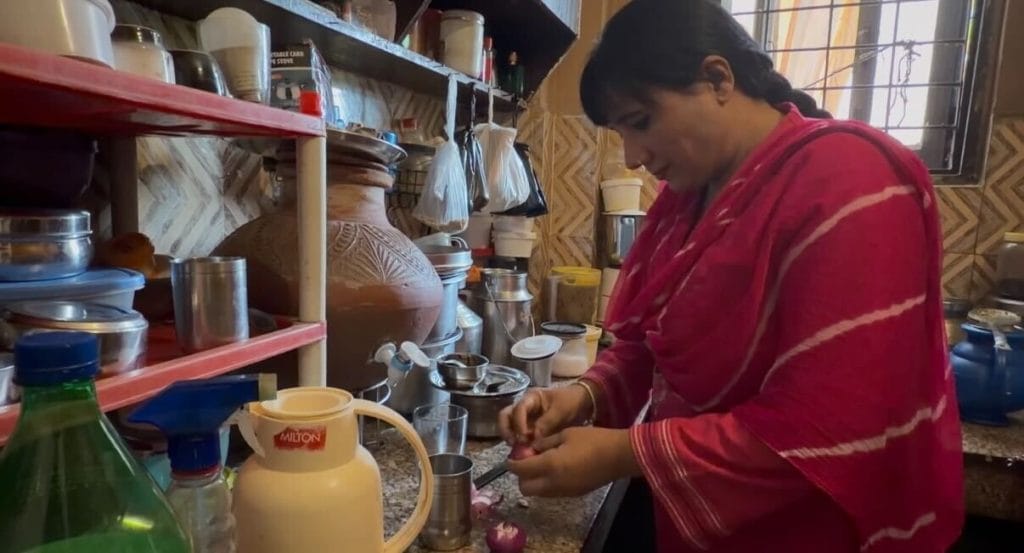
It is moments like these, the unspoken sisterhood in crowded, dimly lit rooms, that keep Mehrunissa anchored to her work. And it is this quiet solidarity that shapes the journeys of the women who have followed into the bouncer profession since then.
Among them is Rekha, 37, a resident of Nangloi, whose entry into the profession did not begin with bravado or rebellion. It began, as it does for many women in Delhi’s outer neighbourhoods, with need. Before this, she had worked at the counter of a jewellery showroom, a job that barely kept the household running.
When she was pregnant with her son and money had thinned to panic, someone passed her Mehrunissa’s number, whom she lovingly calls “Nisha didi”. She made the call.
“She told me to wait till my delivery,” Rekha told ThePrint. “And then she trained me herself.”
What began as a lifeline slowly grew into leadership — today, Rekha oversees 210 women placed across clubs through Mehrunissa’s company.
It was when the pandemic had wiped out incomes that Rekha’s family went under almost overnight. They had just finished constructing their home. Savings were gone. A family friend stepped in when things were at their worst for Rekha’s family.
“For one whole year, my friend paid for the ration coming to my house. He had handed me his credit card to use. I was dependent on him to feed my household,” she said.
Her daughter, now 17 years old, watched it all unfold, and one day, spoke a sentence Rekha says she will never forget: “Mummy, you have always handled every situation well, but the day you stop depending on Rahul uncle for ration, that day I will feel truly proud.”
Rekha carried those words like a wound. Soon after taking up the new job, she quietly cleared the debt and returned the card. “My daughter hugged me and told me that she is extremely proud of me,” she said, with a smile on her face.
Now that the family can breathe again, Rekha’s dreams have shifted toward her children.
“Now we are saving my salary for my daughter’s education…she wants to become a doctor, and medical colleges require a lot of money…I have told my daughter that she can aim for any college she wishes to go to…and that her mother will be able to pay her college fee,” she said.
Also read: Faridabad is the neglected, poor cousin in Delhi-NCR no one talks about
‘Women bouncers change the room’s energy’
Though female bouncers remain rare on the frontlines of Delhi’s nightlife, the shift is visible if one knows where to look. Even at the capital’s busiest parties, a premium club will usually have just one woman on a weekday security roster, and perhaps two on a heaving Saturday night.
In Hauz Khas Village recently, the contrast was stark. A stream of young women in sequins and heels moved past the neon-lit facades, while club promoters trailed behind them with breathless promises of free drinks, no cover, or ladies’ night perks. But when asked whether any of these clubs had a female bouncer on duty, every promoter shook his head. “No, madam! Not here.”
For Rekha and others like her, this is precisely what makes their presence matter. Today, even if female bouncers are still far from the norm, the reputed clubs have at least begun insisting on mixed teams. It’s a small correction, but for the women who stand at those doors, it signals something profound: that they are finally being seen not as exceptions, but as essential.
Divya Aggarwal, Chief Growth Officer at Impresario Entertainment & Hospitality Pvt Ltd, which manages the ‘Social’ chain, said that the idea of safety goes beyond just protocols — it is about how people feel in our spaces.
“Bringing women into our security teams has been a conscious step in that direction, and something we have been building across our outlets over the years. Female bouncers do not just add to operational strength; they change the energy of the room. They make our spaces feel more approachable, more balanced, and more reflective of the communities we serve,” she told ThePrint.
For many guests, especially women, their presence brings an added sense of ease and trust, Aggarwal said, adding, “More importantly, it signals a larger shift in hospitality, where roles are no longer defined by gender but by capability, confidence, and intent. For us, it is not a one-off initiative, but part of a larger, ongoing effort to make Social a space where everyone feels they belong.”
She added that for Social outlets located inside malls, the brand works in partnership with mall security teams and relies on them for female-bouncer support.
(Edited by Saptak Datta)
More lady drunkards means more jobs to lady bouncers. Also, the bouncers can inhale cigarette smoke for free inside the pubs.