





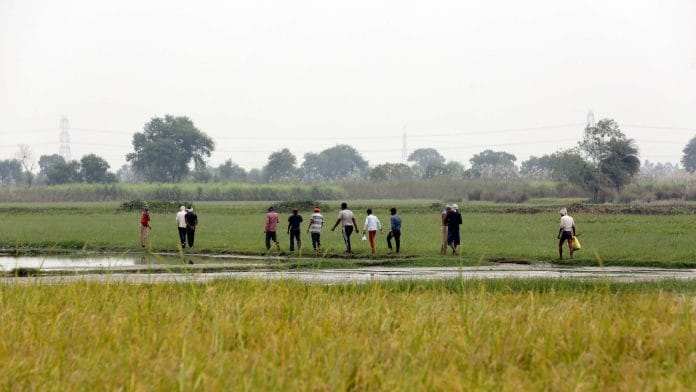



Jewar: Harminder Singh collapsed when he saw the number on his phone: Rs 2 crore. The Gautam Buddh Nagar authority had just transferred the compensation for his land, acquired to make way for Jewar Airport. Singh, a farmer who used to earn half a lakh in a year, became a millionaire overnight.
“I kept counting the zeroes. And soon, the panic seeped in on what to do with all this money,” Singh, 54, said.
That entire week, Singh was bedridden with fever until he figured out how to spend the money: Buying a couple of plots, a luxury car, and completely renovating his house. Once a narrow, low-roofed house, with buffaloes tied at the entrance for lack of space,its rooms bare with worn-out furniture placed against damp walls. Today, it stands tall in Dayanatpur village, with a massive courtyard and a two-storey glass tower.
He has ticked all the boxes of luxury: An SUV with a sunroof, a black German Shepherd, a sprawling house and the latest iPhone.
But he is not alone. The paddy-growing villages of Yadavs, Gujjars, Brahmins and Rajputs have transformed into an unapologetic display of new money and conspicuous consumption.
Every metre of Dayantpur is dotted with massive houses and luxury cars. Outside them stand Fortuners, MG Hectors, and Scorpio SUVs; in the courtyards, smaller, older cars sit quietly, some of them covered in dust. This sudden gush of wealth is also visible in the real estate offices that have cropped up across Jewar. These farmer-turned-real estate brokers are now reshaping the Jewar economy. They have learnt the vocabulary of the rich—investment, income and infrastructure. But little has changed for the women, still confined to the kitchen and household chores, deriving satisfaction from watching the men of the house enjoy this sudden brush with luxury.
As of September 2025, Yamuna Expressway Industrial Development Authority (YEIDA) has disbursed over Rs 8,000 crore to around 7,000 farmers for 2,400 hectares acquired in the first two phases for the International Airport in Jewar.
A similar burst of land sales, three decades ago, helped rural Gurugram remap its destiny. Today, it stands at an awkward juncture of rural-life-with-urban-extravaganza. Another wave of ‘new money’ swept through Noida and Greater Noida later. Farmers turned crorepatis almost overnight, and the landscape of these NCR cities transformed into a new cultural cocktail.
For its residents, mostly farmers, Jewar is on its way to becoming a new “millennial city,” much like Gurugram. The social fabric of the villages around the region has begun to change, with competition and envy seeping in. A newfound confidence has also emerged among the residents, who were once bogged down by the daily struggle of tilling fields and waiting for the monsoons. Conversations now revolve around questions like, “Who has the bigger house?” or “Who owns the bigger car?”
And everyone beams with collective pride about one thing. It is their wheat and paddy fields that has given rise to the Jewar Airport—touted as Asia’s biggest aviation hub.
The authorities acquired the land from the farmers in phases, offering compensation that many initially deemed insufficient. Protests erupted outside the authority’s offices, forcing a revision of the payouts—but even now, many farmers remain dissatisfied.
But the payouts have, without a doubt, changed the region. A report by Mercedes-Benz and Harun International has shed light on this transformation. In the last five years, over 800 farmers across the district’s three industrial development zones—Noida, Greater Noida and the Yamuna Authority area—have become millionaires, the report said.
But many also struggled to cope with their suddenly overflowing bank accounts.
Stories of families unable to cope with the unexpected influx of money are now retold as cautionary tales at gatherings.
For some families, the windfall has become a burden. Parents say their sons spent the compensation on alcohol and expensive things instead of investing it wisely, and the money disappeared quickly.
“Most of our lives are defined by scarcity and constraints. Suddenly when there is nothing we cannot do, we don’t know where to stop. That is exactly what happened in Gurugram and is now, happening in Jewar. You will see crimes also rising, a lot of rowdies and inability to handle good fortunes,” said Santosh Desai, author and columnist.
Also read: Noida gets its first woman DM. Jewar airport is her first priority
Trading in land
Wearing brand-new Ray Bans and the keys of his MG Hector dangling from his pocket, 47-year-old Harish Sharma chats with a group of friends seated on chairs in a lush green garden under the winter sun. This is his newly built real estate office near the Yamuna Expressway. Every now and then, he repeats the same sentence: “The future is Jewar.” Everyone agrees.
All of his friends, who were once farmers, used to take afternoon naps to save energy for the farm work in the evening. Now, with their land gone, they just unwind with friends.
But the villagers’ appetite for land hasn’t ebbed. They stay firmly tethered to the idea of land as security and investment. “When money comes all of a sudden, you don’t know what to do with it. Most farmers invest it in land, and that’s exactly what I did,” Sharma said.
With Jewar airport in the vicinity, the land prices have soared. And a new pattern has emerged across the region: Farmers are converting compensation into long-term wealth by making strategic land investments around Jewar. And it has become all about just lands, stocks, trading, betting and mutual funds.
In 2019, 10 acres of Sharma’s land in Banwariwas village were acquired under Phase 1 of the Jewar project—and Rs 10 crore landed in his account. He immediately reinvested, snapping up a few more plots, along with six acres of land in another Khajpur village. “I invested 5 crores in buying land,” he said.
And, the land he bought was acquired again in Phase 2. This time at a revised price of Rs 12 crore.
Using the money received from authorities, many are also buying plots in nearby villages that also fall under the Jewar Airport development map. “And these lands fall in different phases and are bought at revised prices,” said a farmer.
This wave has opened the door to a future that Indian farmers had only dreamed of. When Sushil Kumar received a payout of Rs 5 crore from the authority, the first thing he did was buy a plot in Greater Noida. Now, he is building a home there—the kind he has seen in the movies, he says.
Kumar had been at the forefront of the protests against the authorities regarding low compensation. The initial reaction among farmers was that the compensation being offered was far from sufficient.
But now in the villages, the selling of land, which is generally frowned upon as an indication of declining wealth, is celebrated.
In the first phase, the farmers received Rs 2,400 per sqm. The price was revised to Rs 3,300 per sqm in the second phase, and now it’s Rs 4,400 per sqm in phase three.
But the farmers say the price they got for their land is still not up to the mark when compared to market rates. “The authorities are selling the same land for a much higher price,” one of them said. “They are selling it for nearly a lakh per acre.”
Also read: An IPS officer’s covert op to crack Jewar land scam, slap Gangster Act. ‘Had to get to root’
Elevated social status
There are cautionary tales floating around too.
In the village of Dayanantpur, there’s a story that everyone knows—about two brothers, Sonu and Monu. They couldn’t handle the windfall of money and ended up spending it all. Today, they are left with nothing. Their undoing, villagers say, was luxury alcohol.
“The two brothers bought property first, and then fell into the habit of drinking expensive alcohol. They would sleep, play cards endlessly, and buy one car after another and drink,” said Umesh, another farmer.
According to him, the money lasted only a year. After that, they had to sell their property just to maintain the lifestyle they had grown accustomed to. But even that didn’t last long.
“Now, the two brothers are working just to support their families,” Umesh said.
Stories like theirs have made villagers wary of receiving money from the authorities. “A lot of money does more harm than good,” Umesh went on to say.
In the upcoming third and fourth phase, YEIDA has planned to acquire over 1,800 hectares of land that would cover around 14,000 farmers.
The residents say that the wealth has also attracted several scammers who are luring them into investing in land that exists only on paper, causing them to lose their money.
Harminder Singh’s living room ceiling is lit with LED lights, a decorative vintage rifle mounted on the wall, and a black leather sofa at the center—every detail speaks of luxury. Singh says that his son, an interior designer, helped him renovate the house. Even his photo frames are intricately designed with white beads. Adjacent to the sofa stands a tall ornamental lamp, its warm light adding softness to the room’s newness. Outside the living room is a modest seating area—his evening tea spot. It is where he watches the buffaloes in the shed, his German Shepherd, and his grandchildren at play.
“My son made sure everything was new and full of luxury,” Singh said.
For the elderly women in the household, the new lifestyle has elevated social stature. Whenever women gather, the conversation circles around polished new floors, expanded rooms, and the relentless demands of their children for the latest phones and cars. And they flaunt their new earrings, gold chains and compare their new saris.
“Earlier we would be lamenting about fasal (crops), now life feels a bit relaxed,” said Meenu, a resident of Dayanantpur village.
But for most women, financial dependence on men continues. Compensation is transferred to the bank accounts of land title holders—who are largely men—leaving women without direct access to money.
The same goes for Meenu, the money doesn’t change anything drastically in her life. She got a few shopping trips and new clothes, but she is still taking care of kids and cooking. “I told my husband that we should get a cook. He says he only likes food cooked by me,” she smiled.
Singh learned his lesson about investing nearly two decades ago. When his sister and her husband, who live in Manesar, had their land acquired by the Gurugram authority for the city’s development.
It was the first time something like this had happened in the NCR. Farmers suddenly found themselves flush with cash, and no one really knew what to do with all that money. “They didn’t know how to handle the money and went into losses. The same happened in Noida and then Greater Noida. I learnt my lessons from there and I am being more cautious,” said Singh, with the confidence of an experienced man.
Every house in Singh’s village is nothing short of two or three storeys. In houses where young men live, a Royal Enfield is parked outside; in others, a white SUV stands proudly in the courtyard.
Another resident, Vicky, who got around Rs 4 crore, spent weeks mulling over ideas—where to invest, what to build, how to do something different from the rest. “I didn’t want to do what everyone was doing,” he said. He studied only till Class 8 and dreamed of opening a restaurant.
But the restaurant failed. He chalks it up to inexperience and low footfall. “The restaurant still stands like a ghost hall. Barely anyone comes now, except for couples and the occasional children’s birthday party,” he said.
Now, he has put the remaining money into buying more land, and returned to farming.“For someone like me, who is illiterate, it’s best to farm and buy a few plots. That’s what we’ve known all our lives,” Vicky said, sounding relieved.
Even Singh still keeps a red tractor in his courtyard, which he starts every now and then so it doesn’t stop working. In one corner lie uplas (cow dung disks) stacked neatly for use as fuel for cooking.
Their villages becoming part of the cities is what the residents fear the most. “The village air is clean, the comfort is far better than in the cities. I was much happier as a farmer than as a millionaire. Everyone was a friend—there was no malice, no money to judge,” Singh said, looking down, as if remembering his old life.
Editor’s note: A previous version of this article incorrectly mentioned ‘per acre’ instead of ‘per square metre’. The error is regretted.
(Edited by Theres Sudeep)
Write about employment scam in Noida Airport to children of affected families as promised by law and government.
Children are going through Financial and mental harrasment by government officials.
Children are fighting for their rights by sitting on road.
Government and it’s representatives are fighting for children by sitting in Air conditioners in their office.
Why are so many people in India, unhappy on seeing farmers investigating in mutal funds….
Another person who would have collapsed upon seeing farmers receiving so much money and spending it on alcohol is Mohandas Karamchand Gandhi. Adi Godrej stands vindicated in his statement that farmers should invest in stocks. The economically illiterate became the Father of the Nation, while the job creator was cast as a ‘villain’ in socialist India.