





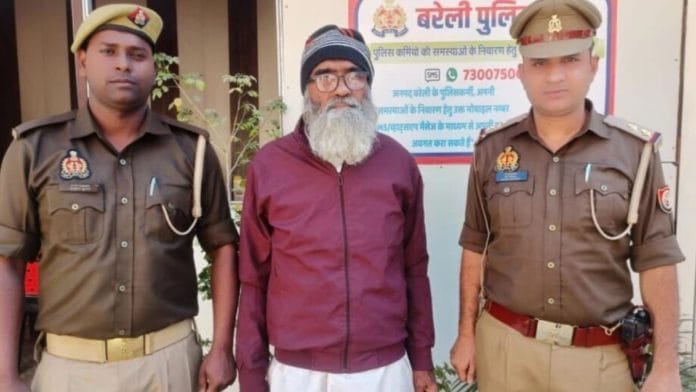



Bareilly/Moradabad: Nisha, 23, sat on the edge of a charpoy. Clutching her Redmi phone, she waited for a call she didn’t know how to answer. It could be from the police station, a jail official, maybe a lawyer, or even her father whose criminal past has overshadowed her present and future. A murder Pradeep Kumar Saxena aka ‘Abdul Rahim’ committed four decades ago has shaken her world.
“I don’t know what happened back then. I don’t know who my father was before I met him…He is a good man,” Nisha said as she broke down, surrounded by neighbours whose questions she doesn’t have answers to.
Pradeep Kumar Saxena aka Abdul Rahim, 70 was arrested last week, 38years after he killed his younger brother Sanjeev in 1987, following a bitter argument fuelled by suspicion and family resentment. He kept under the radar of the Uttar Pradesh Police for nearly four decades, having jumped parole in 1989. But an Allahabad High Court directive last month pushed officials to trace long pending fugitives. And Rahim was arrested on 27 November from Delapir Mandi in Bareilly, just when he was about to leave for Moradabad in his truck.
25,047 people were released on parole in 2023, as per the latest NCRB report. Of this, 279 people have been identified as parole absconders. And police have made only three arrests. That’s how rare Rahim’s case is. The reopening of the case 36 years later spotlights the cracks in India’s criminal justice system. Rahim lived under a new identity, built a new family, and worked openly—not very far from the place where he committed the murder—even as generations of police officials and court functionaries retired from the system.
“To understand how a man convicted of murder could disappear for decades, it exposes the insensitive and ineffective nature of our criminal justice system,” said Amit Dwivedi, a Delhi-based criminal lawyer. “In India, the prison population has risen, and undertrials who should be out, are locked inside, and proven convicts are left outside. When resources are stretched, parole-jumping becomes common, identities get changed, and deterrence and retribution loses meaning.”
Also read: 12 officers, a tip-off, and a 7-day operation—how DFO Parveen Kaswan caught ‘Veerappan of East’
“Khurafati Pradeep”
Deep inside Bareilly’s jewellery market in Prem Nagar, the shops come to life after 10 am. The lane is crowded by rickshaw pullers and food carts. This is where Pradeep lived with his younger brother and his wife on rent for a few years before the murder.
Barely 3 km away, his elder brother Suresh lives in a two-room house in one of the narrow lanes of Sahukara.
When ThePrint met Suresh at his house, he took a long pause before acknowledging that Pradeep Kumar Saxena is his brother. “He was “khurafati” since childhood.”
The joint family that once stayed together in Rampur, later moved to different parts of Bareilly. Pradeep lived with Sanjeev, the younger brother who took care of him. Sanjeev worked as a conductor in Rudarpur bus depot while Pradeep drove trucks.
Pradeep was unpredictable, difficult to manage, and moved through jobs, often.
Suresh doesn’t remember much from May 1987—when his one brother killed the other. Even the case was filed by the owner of the Prem Nagar house where Sanjeev and Pradeep stayed.
He recalled a conversation he had while boarding a bus to Badaun where he was employed as a factory worker.
“The conductor told me, “why are you here? Didn’t Sanjeev get killed?” When I reached home, the house looked still, there were blood spots, I was shocked, how could Pradeep take such a step?” Suresh said.
When Suresh reached the hospital, Sanjeev had died, and police had taken Pradeep into custody.
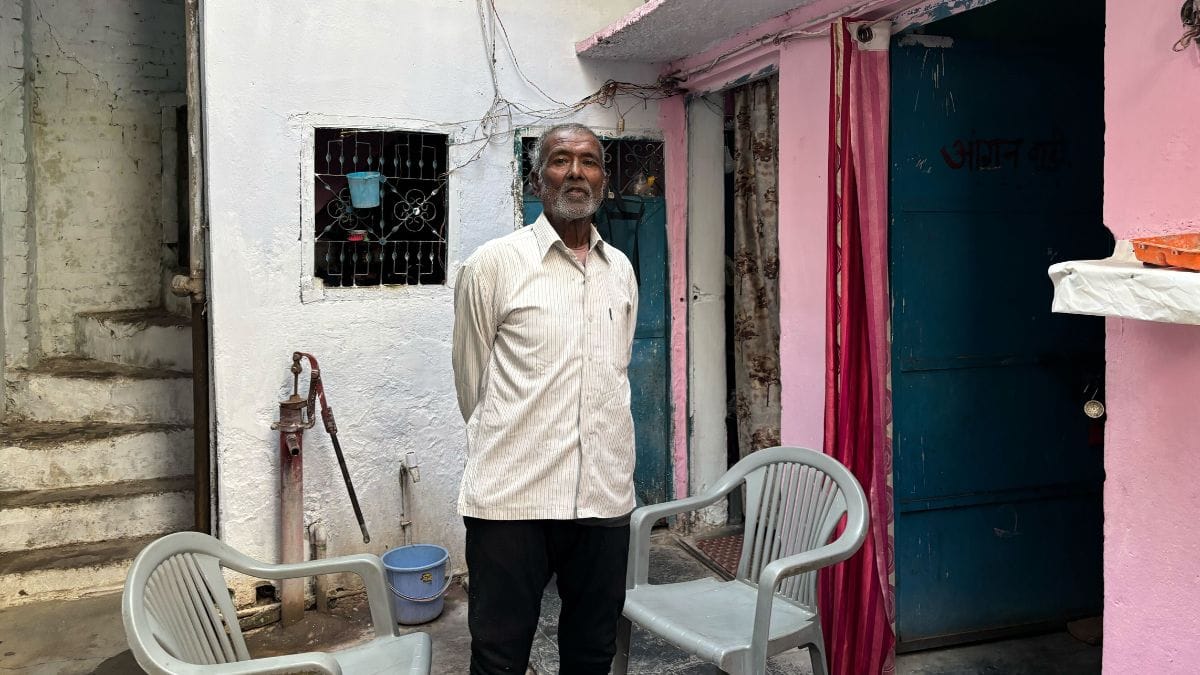
“Pradeep was khurafati, nobody wanted to keep him, it was only Sanjeev who took up the responsibility. Even his wife never wanted Pradeep to stay,” said Suresh. There would be frequent arguments between the brothers.
It was Sanjeev who got Pradeep a stable job, a house, and a regular life, despite the family being left in fragments.
“There were three things important for Sanjeev: be it jar, joru, or jameen. And Pradeep had triggered Sanjeev over all three. That is why he kept arguing with Pradeep, until Pradeep couldn’t control it, and stabbed him,” he said. Police said Pradeep was trying to misbehave with Sanjeev’s wife, and that triggered the argument.
After the murder, Pradeep was lodged in Bareilly jail when the trial court awarded him life imprisonment. In 1989, he appealed against the trial court order in the Allahabad High Court and eventually secured a parole.
It was first heard after 29 years of being listed in 2018. The case, as per court records, was heard in February 2018.
The same year, a protest at the high court would disrupt the paperwork, extending the parole window for Pradeep who exploited it and went into hiding. Between 1989 to 2002, Pradeep juggled between Sambhal, Pilibhit, Shahjahanpur, Badaun, working as a truck driver, and keeping his identity hidden. He would only speak with a few family members, one of them would be his sister, Sunita.
“I have tied him a rakhi, and used to meet him during festivals,” Sunita said.
In 2002, having spent over a decade away from the clutches of the law, Pradeep decided to shift his base to Moradabad, barely 100 km away from the Bareilly. And that’s when Pradeep Kumar Saxena became ‘Abdul Rahim’.
“Pradeep decided to change his faith from Hinduism to Islam. He changed his name from Pradeep Kumar Saxena to Abdul Rahim, he changed his look, he had a beard, a pair of glasses,” SP Bareilly Anurag Arya told ThePrint.
He found a house on rent near Moti Masjid area in Moradabad. The same year, he married Salma, a widow, who had a daughter. And continued working as a truck driver in different pockets of Morababad, especially in and around Transport Nagar and Dingarpur areas.
All this while, the Saxena family claimed, they did not know Pradeep’s whereabouts. Suresh, however, recalled a newspaper advertisement that he saw in 2002.
“It was my brother’s photo, it was a small advertisement. It said he had changed his name and faith. Our family was shocked but we didn’t react. We cut ties with Pradeep. We had nothing to do where he was, how he was, we did not want any more police visits,” Suresh said.
Also read: Night before VIT Bhopal burned—A slap, a Reddit post, and a jaundice scare
“Namazi Rahim”
More than 100 km away from Suresh’s home, in Dingarpur, the chatter within the local residents, truck drivers, workers is now over “Bareilly wala aadmi.”
For years, the men here in Dingarpur’s truck adda have spoken of Rahim more like a rumour than a person.
“Farar tha ye…murder ke masle mein…Bareilly waala aadmi…Musalman ban ke rehta tha….” one driver tells another, as they rolled bidis and sipped tea on a cold winter evening.
Last week, when the news of Rahim’s arrest broke out, Facebook news pages like News With Aftab, India News HD flashed the news continuously on their mobile phones.
“Kya SIR ke baad pakda gaya?” a truck driver said to another. They were referring to Rahim’s arrest and how it came at a time when police verifications are on a rise because of the ongoing SIR exercise.
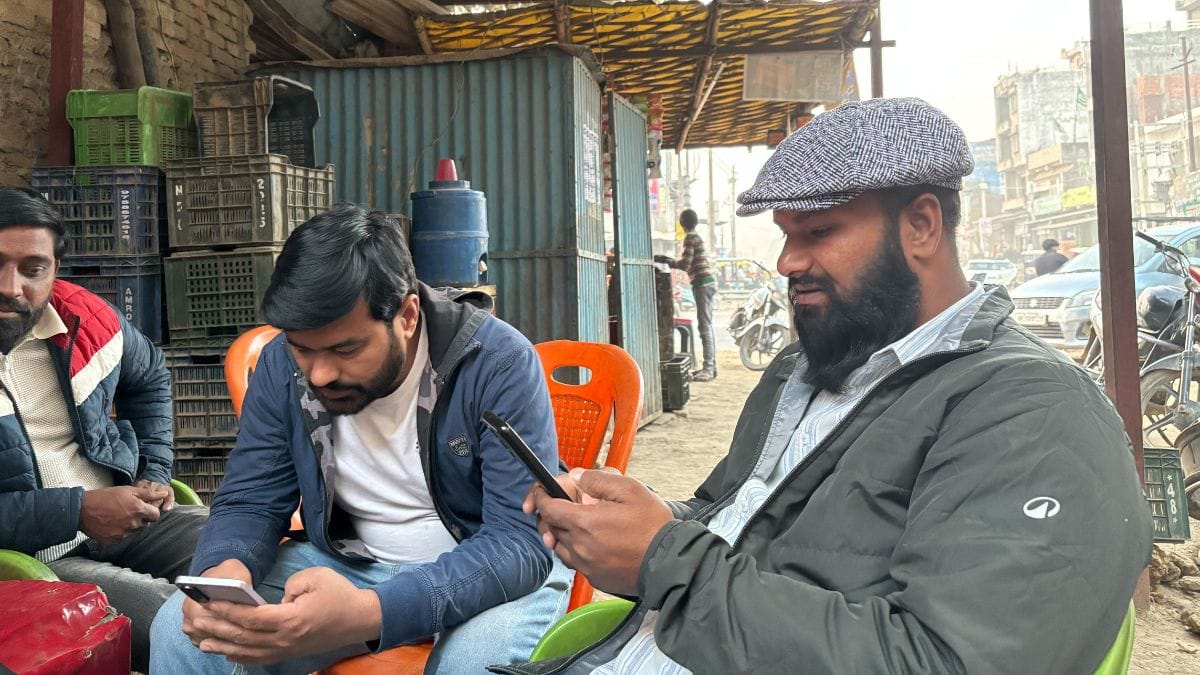
No one knew that the man they called “Rahim driver” had once been Pradeep Kumar Saxena.
People in the Dingarpur neighborhood said he first appeared in the early 2000s. Back then, the settlements were new—a cluster of fresh mud houses surrounded by fields. The local transport network was expanding. Work was easy to find if one was willing to drive long hours. Trucks began operating in the region in the 1970s, but Transport Nagar took shape after 2000. It brought a wave of drivers, labourers, and small traders to a place where half the residents arrived from some place else, a new face would rarely trigger questions.
By the time the settlement grew dense, slowly, concrete houses replaced the thatched roofs. And, Rahim had already slipped into the routine of a working-class Muslim man.
“Abdul sa’ab Namazi they bohot, masjid jaate they, sabse acche se baat karte they (Abdul used to pray Namaz every day, he used to visit mosque every day, and would speak with everyone with respect”,” said Aftab, who works in the transport business in Dingarpur.
Moradabad is a pocket where Mughal, Turk, Pasha, Mirza families have resided for decades. Even as Hindu drivers occasionally passed through, but a Hindu man, converting and settling would normally draw attention.
“Pradeep would say Mashallah and Subhanallah more than often, it was natural to him, we never found awkward transitions. We did not know he was Hindu, previously,” said Aftab.
Pradeep drove trucks across local routes, Dingarpur, Taharpur, Morabadad, and Bareilly. He never stayed long enough to create stories, and he kept to himself.
Also read: Is Delhi University no longer in demand? Vacant seats, misfit faculty, bloated syllabus
He would distribute Quran Sharif
In Karula Mohalla, where Pradeep lived before his arrest, the lanes are quiet. Here, Rahim is now “aaropi” (accused). His neighbours are still trying to come to terms with the new reality.
For some, he was bhai, for others, mamu. The trust was mutual.
Nisha knew her father as somebody who was religious, and protective of the family. Rahim avoided all conversations about his past. Nisha neither knew about the conversion, nor the murder.
“Where was the police for 36 years? Why has he been arrested now? If he told us something, we would at least be able to fight…,” said Nisha as she turned teary eyed.
In the neighbourhood, the chatter is fresh. The news about “Abdul Rahim’s arrest” is being watched by the people on Facebook. The videos reported in Hindi are loud and many channels use the same photo of Rahim: bearded and wearing a pair of glasses.
“Abdul bhai has been a person we look up to, even at this age, he worked, we had a lot of respect for him,” said Rahim’s neighbour Gulfam, while leaving to buy meat for dinner.
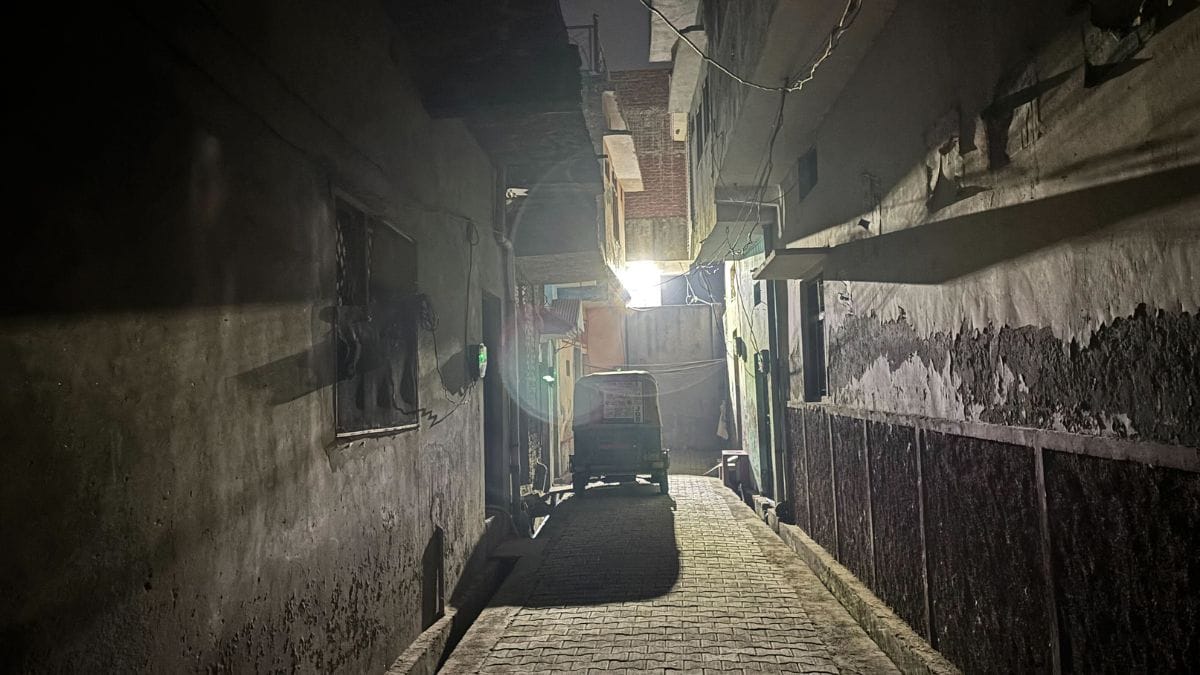
As people crowd outside the lane, they share the information they have collected from the media. “Kuch pata chala (did you get to know anything)?” one of them asks, “naya video nahi aya (There is no new video released in media),” says another.
Zareena lives in the house opposite to Rahim and has seen him help out kids from the madrassa nearby. “With whatever he could, he would help feed the children, he would distribute Quran Sharif. He used to do Sadka, and make contributions to the poor. How can he be accused of this crime?”
The mohalla wants Abdul out of prison. They discussed the process of mulaqats—meeting in jail.
Also read: He didn’t sleep for days. Inside the SIR pressure that broke a Rajasthan BLO
No photo, no address, and two names
Back in Bareilly, the team of police that managed to arrest Abdul have been rewarded by the Superintendent of Police, Bareilly.
Senior Superintendent of Police (City) Manush Pareek said that it was challenging to arrest Rahim.
The matter came to light when the Allahabad High Court was reviewing appeals filed in 1989, they came across an appeal, where nobody appeared since then. When they informed the police to check, nobody was in jail, hence, the directives were issued.
The police didn’t have much to start with. A court order, no photographs, no confirmed addresses—and a name: Pradeep Kumar Saxena.
A new team was formed on 1 November, tasked for his arrest. But none would confirm the presence of Pradeep to the police—from Shahi area of Bareilly to Prem Nagar. The house where the incident took place has been sold at least four times in four decades, cops investigating the case said. And the owner, who was the initial complainant in the FIR, hasn’t been found since.
“We assumed the identity on the basis of his age. When we contacted Suresh, his brother, he told us he has a hint that Pradeep could possibly be residing in Moradabad,” said an officer.
“Pradeep was mafrooz (wanted) in Bareilly,” said SSP Pareek.
The police team camped in Moradabad. For days, they met truck drivers, young and old, from Moradabad and from outside. While they kept hunting for “Pradeep Kumar Saxena” the truck drivers in the area told them about the presence of a man who identified himself as “Saxena driver.”
On 27 November, the police found success.
“We confronted a man who matched the description, he was old, and in a truck, parked in Dilaper Mandi. He firstrefused. When we asked him his name, he told us he was Abdul Rahim, and we arrested him,” said an officer.
Abdul was sent straight to Bareilly jail.
Back at his in Bareilly house, Suresh is not sure about his brother’s fate.
“Will the police call us if he dies? We have no connection with this man. He ruined my entire family because of his actions. We will never do his final rites. Now, he has a new family, let them do it. We don’t want any more police, reporters, or TV mics in our home.”
(Edited by Anurag Chaubey)