





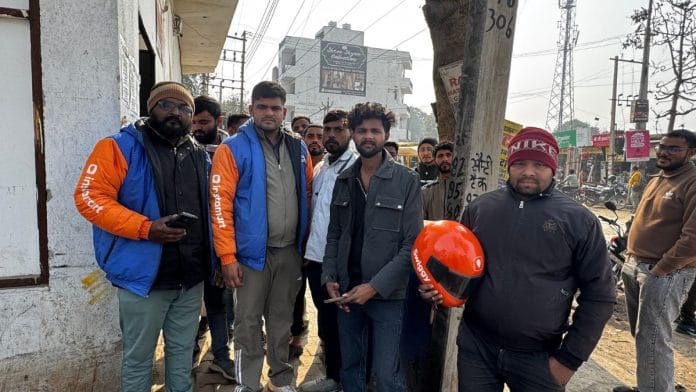



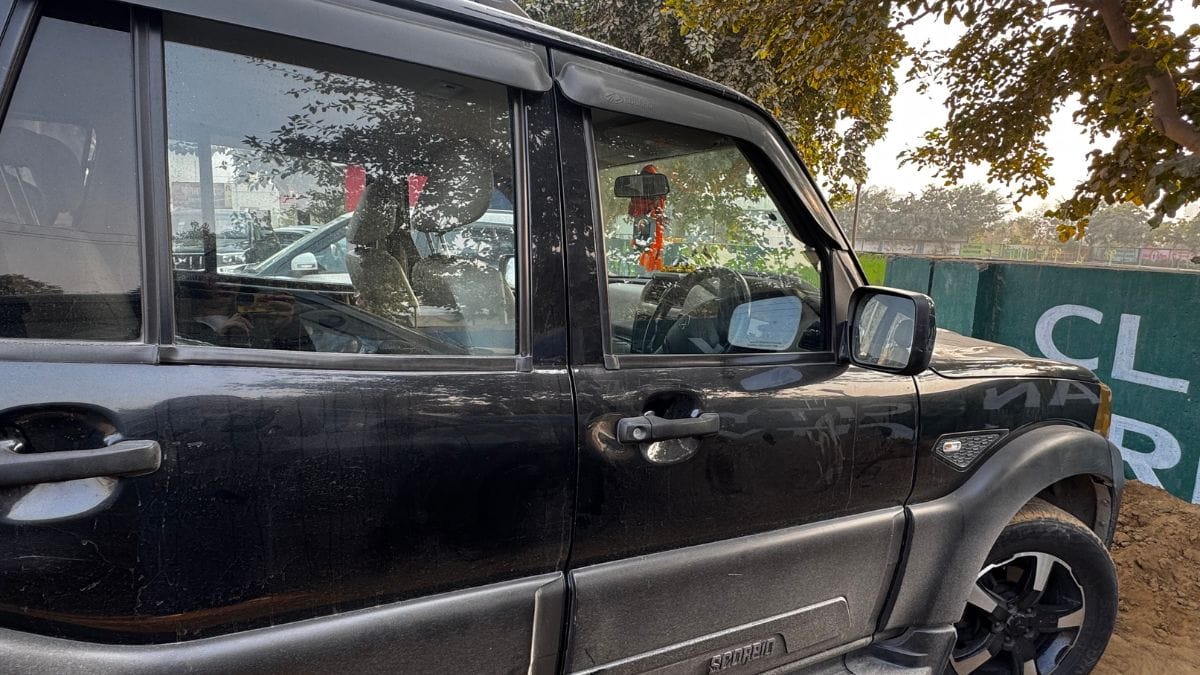
Gurugram: A Swiggy Instamart jacket. Loud screams. And a black Scorpio that did not stop. This is what Rajeev Tawar remembers from Sunday night, when his colleague Tinku Pawar was run over repeatedly outside an Instamart dark store in Sector 93, Hayatpur, Gurugram.
It was 10.30 PM. The two had been sitting on the benches, waiting for the next order to drop on their screens.
“In that moment, it hit me that our lives don’t count,” said 24-year-old Tawar. “We are just delivery boys—people anyone can hit, crush, and walk away from.”
It was Rajeev who alerted other delivery workers in the area as Tinku lay injured on the road. The police was called, and Tinku was rushed to the hospital. He has sustained multiple fractures in his legs and back and is currently undergoing treatment at a hospital in Rewari.
CCTV footage of the incident soon spread rapidly online, triggering public anger. The video shows a black Scorpio ramming into parked motorcycles. Moments later, when a man steps forward, the SUV is seen reversing to run over him multiple times. Delivery workers who witnessed the incident said the driver, fuming in rage, parked his car and walked back into his house barely 50 meters away from where Tinku lied. When police arrived later in the night, the man refused to open the gate. He was taken in for investigation the following morning.
Police said Yadav was allegedly carrying pent up anger against the delivery workers over the parking of their motorcycles in the narrow lane. The workers said it was the only space available to them.
But the conflict was never about parked motorbikes. It was about who belongs to this neighbourhood? It’s a question of stature and power —between the landowning insiders and on-the-margins outsiders. Surrounded on all sides by the millenium city’s growth manifesting through high rises and the Dwarka expressway, the so-called rural pockets of Hayatpur are villages only in name. Residents here aspire to live the city life like how it exists in the DLFs—where the class boundary between residents and workers is clear.
The Hayatpur incident lies at the heart of a classical dilemma between joining the growth story and protecting community interest. While a dark store in this urban-rural pocket is a sign of economic prosperity, it also threatens the old ways of living.
In that imagination, delivery workers are viewed as intrusions, vitiating what residents consider a closed environment. What happened on Sunday night is another incident highlighting India’s new class war.
The assault has, once again, shed light on poor working conditions of delivery persons who work in these dark stores also known as mini-warehouses. These centres are created exclusively to cater 10-minute online delivery orders.
On Monday, delivery workers stayed away from work and gathered outside the Sector 93 police station, demanding action.
“We protested until the police assured us of action,” said Tawar. The accused—identified as Navin Yadav, an Ayurvedic doctor—was arrested later that day.
The assault has, once again, shed light on poor working conditions of delivery persons who work in these dark stores also known as mini-warehouses. These centres are created exclusively to cater 10-minute online delivery orders.
An FIR has been registered under Section 109(1) (attempt to murder) of the Bharatiya Nyaya Sanhita (BNS).
“What happened in Hayatpur was unfortunate,” said a senior police official.
“There is no justification for an attempt to kill someone. If there was an issue, mowing a person down was not the solution. It was a deliberate attempt to cause death.”
Also read: Noida Sector 150 residents up in arms after techie death. ‘We live Ram ke bharose like beggars’
10-minute delivery and other pressures
Six months ago, Darshan Chauhan and Tinku Pawar moved from their old Instamart dark store to the newly opened outlet in Hayatpur village. The management relied on the two senior employees to kickstart operations, train the new recruits, and set the pace for the team.
“Tinku and I were chosen to get the place running,” said Chauhan. “We had to teach the new recruits how to use the app, maintain the pace of delivery, and manage other day-to-day operations. We weren’t paid extra for it, but it was a responsible role.”
But within a week, trouble began, the delivery workers said. Every day, a resident from Bhagat Singh Colony would demand that they shift their bikes. The dark store was located in the same colony, and soon the residents started questioning them for even using the tiny tin-shed toilet assigned to the workers, which was within the locality. Threats followed soon after.
The workers said that the men from the locality would come to their store and ask them to leave this place. Chauhan recalled two instances when the residents even threw beer bottles at them.
“They would call us pollutants.”
Chauhan said it was not under their control. They hadn’t chosen the location and were performing every task within the boundaries of their job.
“We kept the bikes around the premises. There are over thirty 10-minute delivery workers. They come for a few minutes, pick up a packaged item from the warehouse, and leave. For that short period, they park outside the store, or if there’s no space, along the wall of the warehouse,” he said.
Even the washroom, which is cramped, stinky, and in poor condition, is attached to the warehouse within the colony.
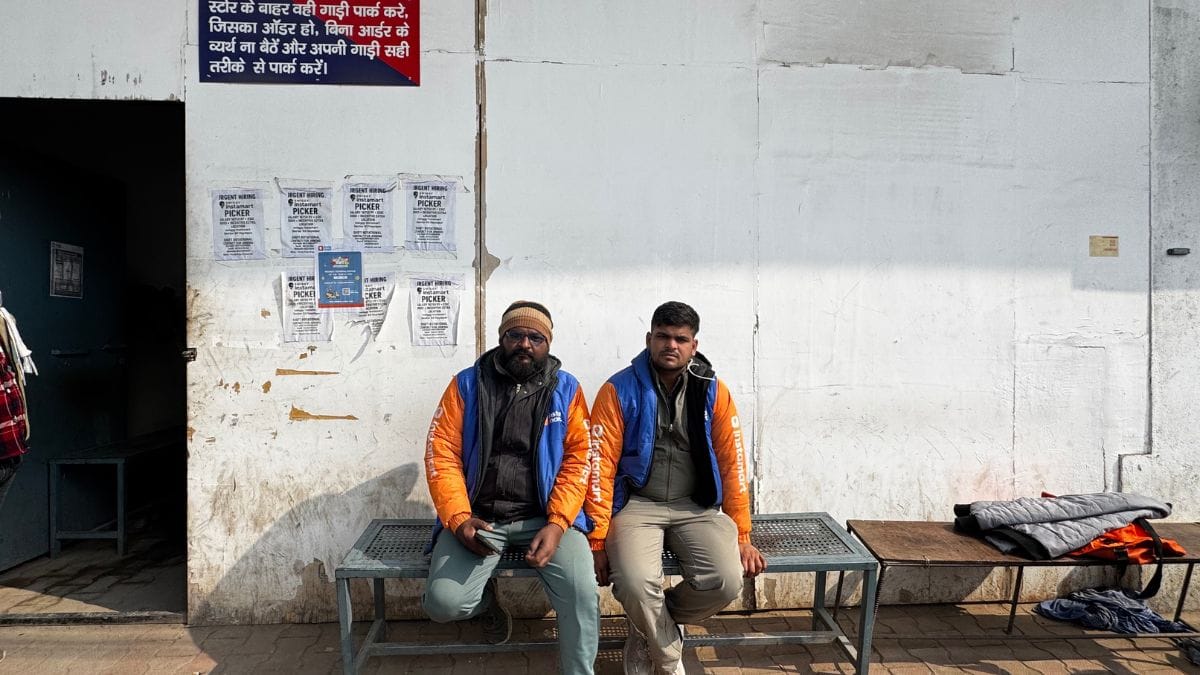
“We know the condition of the washroom is bad. But it has been assigned for our use. Can’t we even use that? What problem can the locality have with that?” Darshan asked, sitting on a bench outside the dark store.
Three to four benches are kept outside the warehouse where the workers sit while waiting for their next orders. They said they are always on their toes, with barely any time to even attend family calls.
“We hear from the customers if the order is delayed. We get scolded by the management over the orders and now, this. We are frustrated,” Darshan said.
The delivery persons said they had raised the red flag with their seniors two months ago. They were assured of a solution, that things will get better.
“Our deliveries were getting delayed because of this. One delayed delivery means Rs 350 lost,” said Tawar, who joined the service two months ago.
But the seniors only gave them repeated assurances until Pawar was attacked by the SUV owner.
“We were told that they were discussing it. They even once suggested keeping the bikes outside the opposite shops, but we said that would delay orders,” said Darshan, his voice heavy with anger.
Also read: Jewar farmers are crorepatis now. They’re investing in stocks & mutual funds, not just land
Defending the insider
The Bhagat Singh Colony in Hayatpur is barely a cluster of four to five houses. But for its close-knit community, it is their own little enclave. SUVs are parked outside two- to three-storey houses with glass facades. Now, this neighbourhood is united in defending the accused Navin Yadav.
Sonal, one of the residents, said Yadav was returning from a friend’s place where he had a beer. Upon his return, he lost his temper when he saw the delivery bikes parked haphazardly and blocking his SUV’s way.
“After drinking, he came home and saw the bikes again,” said 40-year-old Jyoti, whose father-in-law sat outside under the winter sun, a hookah by his side. “He lost his temper because these delivery workers block our roads. Coming in and out has become a struggle.”
For the residents, the delivery boys are intruders in an otherwise calm society. It’s a small lane where mothers could keep a watch on their children while they play on the road without having to step outside of their homes.
A man lounged in the winter sun with chairs set outside his home; another took a sip of hookah from friends gathered nearby.
The residents claim the delivery executives are a bad influence on their children. Jyoti, mother to a four-year-old, said her son had begun picking up abusive words from watching the workers talk on the phone.
“They keep shouting and swearing, and my child is learning it,” she said. “They are always out here, on the roads, everywhere. One cannot even pass by the washroom attached to the dark store. It’s dirty and the stink has reached our houses.”
These days the men of the neighbourhood are engaged with a singular mission: to get Navin out on bail. Every day, they are going to the police station and the lawyers to discuss the way out. For them, what Yadav did was not wrong but a result of months of suppressed anger and frustration.
“Everyone is only seeing the result. No one can see what led to this,” said Jyoti.
After the incident, the delivery workers have stopped using the washroom. Their bikes are now parked together outside the dark store, not in the lane. Avneesh said that if the humiliation won’t stop, they will all resign.
“I didn’t come from Uttar Pradesh for this humiliation. I came to work and earn money for my family. But in these big cities, our work and existence is invisible,” he said, sitting on a bench and staring at the sky.
A loud beep on his phone disrupted the conversation. He jumps up, picked his bike from the cluster of two-wheelers and sped off.
(Edited by Anurag Chaubey)
You know that human life is dispensible when even murder is justified. Just what is SO essential that it is needed in under 10 minutes?